
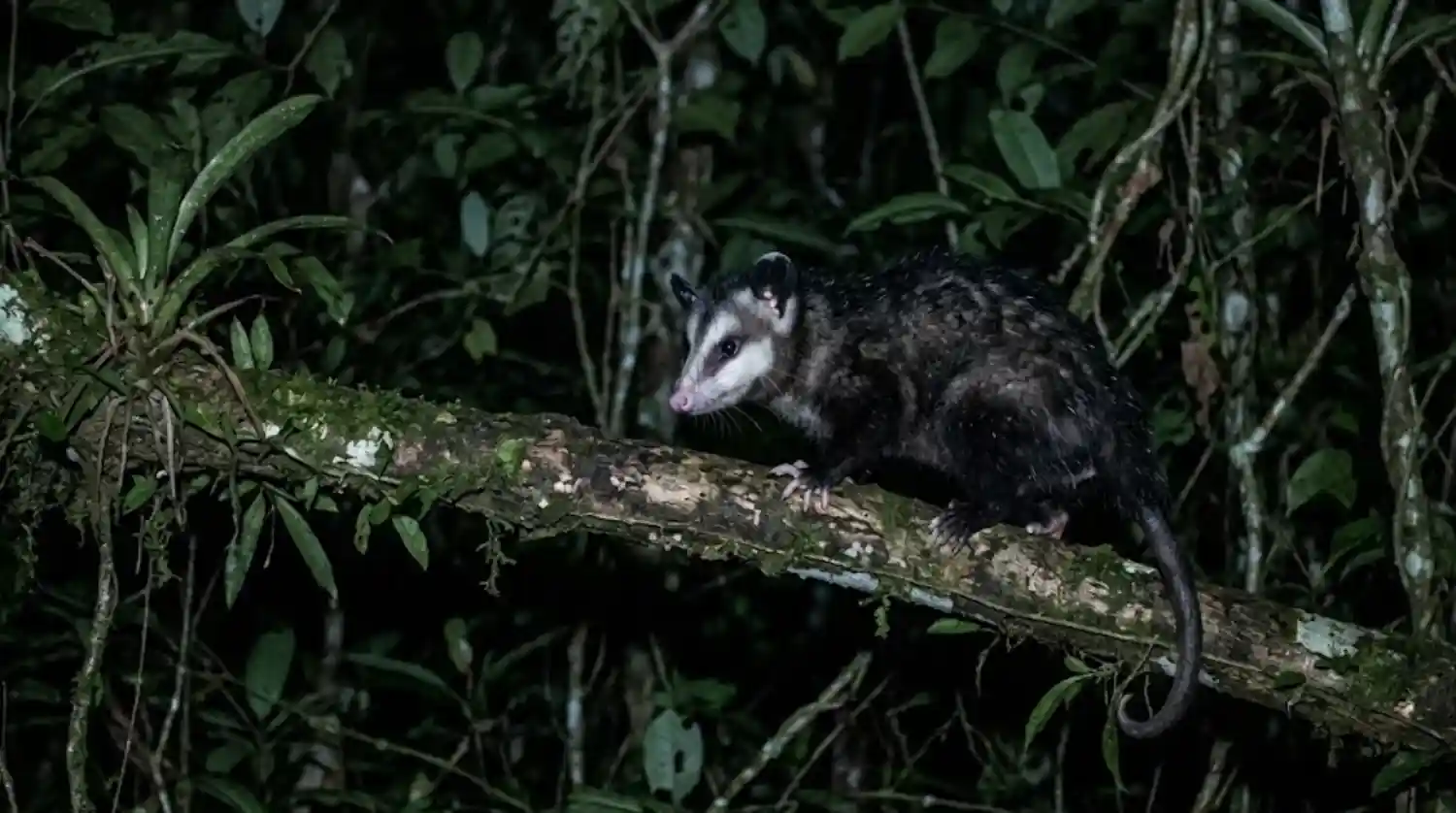
Often misunderstood and unfairly stigmatized, the black-eared opossum has one of the most extraordinary immune systems in the animal kingdom. This marsupial can survive bites from snakes whose toxins would be fatal to almost any other mammal, making it a remarkable subject for biology, conservation and biotechnology.
According to advanced biological research, the blood of these marsupials contains a cocktail of specialized proteins that neutralize the destructive enzymes in the venom of rattlesnakes and other snakes in the genera Crotalus and Bothrops. The mechanism does more than help the opossum survive an attack. It also allows the animal to regularly include venomous snakes in its diet.
A molecular shield hidden in the blood
The opossum’s resistance to venom is not simply a matter of physical tolerance. It is an active chemical neutralization process, in which natural substances prevent toxins from carrying out their destructive work. Scientists have identified natural inhibitors of metalloproteinases and phospholipases in the opossum’s blood serum.
These enzymes are among the main substances responsible for tissue destruction and hemorrhaging caused by venom. When a toxin enters an opossum’s bloodstream, the proteins in its serum bind to the venom molecules, like a key fitting into a lock, and stop them from attacking the animal’s cells.
According to the biological research described in this report, the process occurs without causing inflammation or permanent damage to the marsupial’s internal organs. The result is a molecular shield inside the body, acting before toxic enzymes can unleash their full destructive capacity.
This natural immunity is the result of millions of years of coevolution between predator and prey. In the Amazon and other regions of Brazil, the opossum of the genus Didelphis occupies the role of an opportunistic predator. Because it can withstand venom, it is able to use niches where other mammals would not dare to hunt.
A predator providing a free ecological service
The opossum’s evolutionary advantage has consequences beyond its own survival. By eating venomous snakes, the animal helps control their population density in areas near human settlements. In this way, it provides a free biological service and can help reduce the risk of snakebite accidents for local communities.
This role does not make the opossum an aggressive animal. The marsupial prefers to flee rather than confront a threat. Its ability to withstand toxins allows it to take advantage of a food source that many other mammals avoid, but it does not change its defensive behavior around people.
In addition to its resistance to venom, the opossum is an effective seed disperser and a voracious consumer of ticks and scorpions. A single individual can consume thousands of ticks in one season, helping to prevent the spread of diseases such as spotted fever.
In the Amazon, where biodiversity is the first line of defense against zoonotic diseases, the opossum acts as a quiet guardian of the forest. Its presence helps keep potential pests at low levels, supporting the biome’s sanitary balance and protecting the health of both traditional and urban communities.
What opossum blood could teach medicine
Brazilian and international science has taken a renewed interest in the opossum, particularly in biotechnology. Studying the inhibitory proteins found in these animals could transform how antivenoms and treatments for envenomation are produced.
At present, antivenom production depends on horses. The synthesis of peptides based on the opossum’s genetics could lead to treatments that are cheaper, more effective and associated with fewer side effects for humans. Protecting the marsupial is therefore, indirectly, a way of protecting humanity’s future ability to save lives.
Scientific interest also extends to mapping the genomes of Brazilian didelphids. Understanding how these animals deal with pathogens and venoms may offer clues about biological resilience in a world experiencing constant climate change. Resistance to toxins may be only the beginning of broader questions about their biology.
The Amazon, as a living laboratory, gives Brazil an opportunity to lead the global bioeconomy through the ethical study and preservation of its native wildlife. That opportunity depends on turning traditional and scientific knowledge into social well-being while keeping research connected to the protection of the environments that sustain this diversity.
The misunderstood animal in yards and forests
Despite its importance, the opossum still faces prejudice. Many people reject it because it can release a strong odor or because it has the habit of pretending to be dead, a behavior known as thanatosis. Fear and misinformation lead some residents to attack these animals when they appear in their yards.
Understanding its biology is essential for changing that relationship. The opossum is not aggressive and prefers escape to confrontation. Teaching society about the uniqueness of its immune system and its ecological importance is a crucial step toward conserving the species.
The opossum is a marsupial, related to kangaroos, and carries its young in a pouch called a marsupium. This detail of its reproductive life reminds us that behind the stigmatized image is an animal with a complex evolutionary history and a distinct role within its ecosystems.
Promoting peaceful coexistence allows these guardians to continue their work of cleaning and balancing forest environments. Respecting them is also a sign of environmental maturity, because a society that values biodiversity must recognize the importance of species that are less conventionally charismatic.
Protecting the pathways of resistance
Protecting riparian forest areas and urban forest fragments is essential if opossums are to keep moving through the landscape and performing their ecological role. Habitat connectivity allows gene flow and helps ensure that proteins associated with resistance continue to be passed on to future generations.
Every opossum preserved can be seen as a natural biological-control factory operating around the clock, at no cost to public finances and with incalculable benefits for biodiversity. Its highly efficient metabolism allows it to eat venomous snakes as well as fruits, insects and small vertebrates.
This dietary flexibility, combined with chemical resistance, makes the opossum one of the most resilient mammals in the Americas. It can survive from the depths of the Amazon forest to the densest urban centers, providing vital ecosystem services in very different environments.
Looking at an opossum and seeing a natural laboratory of healing is the first step toward a new environmental ethic. Across the vast Amazon, where every living thing has a vital function, this marsupial’s immunity teaches that an answer to major human challenges may be hidden in the quiet resistance of a small tree-dwelling animal.
Scientific knowledge and respect must move forward together. Protecting the opossum means conserving a piece of Brazil’s biodiversity, maintaining its ecological functions and preserving the possibility that its proteins may inspire solutions for envenomation. In this case, scientific curiosity begins with the simple decision not to harm the animal that appears along the way.
Reporting: Anne Silva / Amazonia Mag

Editor, English Edition — Amazonia Mag
Anne Silva is the editor of Amazonia Mag, the English-language edition of Revista Amazônia. She curates, translates and adapts the outlet's science and environment coverage for an international audience, reporting on Amazon wildlife, flora, rivers, climate and research. Every story she edits is grounded in peer-reviewed studies, official data and on-the-ground reporting from the Revista Amazônia newsroom in Belém, Pará, Brazil. More by Anne Silva →