
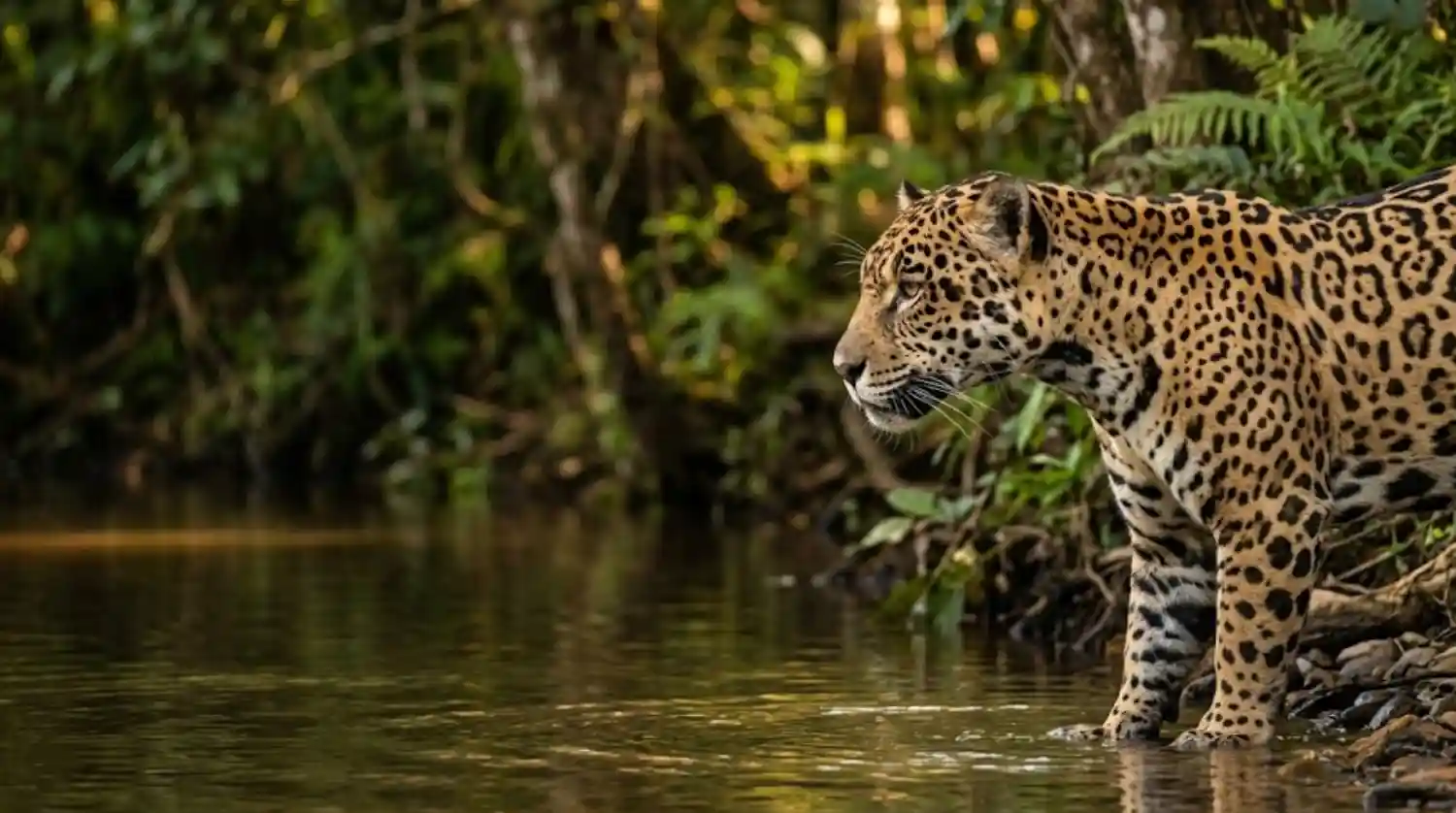
The jaguar, Panthera onca, has developed one of the most remarkable adaptations among the great predators of the Americas. Unlike distant relatives such as lions and tigers, which generally bring down prey by suffocation, this cat uses a hunting technique based on directly piercing the temporal bones of the skull. Its bite is not simply a display of power. It is a precise biological tool for reaching food sources that other predators struggle to open.
According to animal biomechanics studies, the jaguar has the most powerful bite in the world relative to its body size. It can exert more than 1,500 pounds per square inch, or PSI, of pressure, about 10,342 kilopascals. That extraordinary force allows the species to exploit feeding niches that are inaccessible to other carnivores, including the extremely tough shells of tortoises and the armored bodies of caimans.
A skull built for crushing force
The secret of the jaguar’s power lies in its craniofacial anatomy. Compared with other big cats, the jaguar has a proportionally wider and shorter head. This structure improves the mechanical leverage of the masseter and temporal muscles, which close the jaw with enough force to break a turtle’s shell as if it were a walnut shell.
That feature is especially important in the Amazon. The region contains many reptiles and other animals protected by hard structures, so a hunting strategy based only on speed would not be enough. The jaguar combines accuracy, immediate impact and the ability to attack prey shielded by bone, carapace or armor.
The cat’s teeth are another part of this natural engineering. Its canine teeth are more robust and thicker than those of the leopard, for example. Their strength allows the animal to withstand the mechanical stress of biting bone surfaces without the risk of dental fractures, a critical advantage for maintaining a varied diet.
That durability helps the jaguar survive periods when land mammals are scarce. During those times, it can efficiently use the abundant resources of Amazonian rivers and floodplains. The adaptation expands the animal’s food options and helps meet its metabolic needs through prey from aquatic and wetland environments.
How predation affects turtles and freshwater habitats
The jaguar’s ability to break the shells of tortoises and Amazon turtles performs an ecological function that often goes unnoticed. By acting as a principal predator of these turtles, the jaguar helps regulate their populations. Without that control, the animals could place excessive pressure on aquatic vegetation and food sources in riverbeds.
This top-down regulation helps preserve the integrity of freshwater habitats. It also allows ecological succession to proceed in a balanced way and helps protect the biodiversity of riverbanks for future generations. The bite, therefore, is not only an advantage for an individual jaguar. It is connected to processes involving plants, reptiles and the many organisms that share rivers and flooded areas.
The presence of the jaguar is considered an indicator of environmental quality. Where a healthy jaguar population exists, there is also a rich and functioning ecosystem capable of supporting large carnivores. In the Brazilian Amazon, monitoring projects show that conserving the species is directly connected to maintaining large areas of primary forest.
Protecting the jaguar means, by extension, protecting thousands of plant and animal species that share its territory. That relationship makes the cat a flagship species for regional sustainability. Its survival depends on forest integrity, while forest integrity also benefits from the presence of its top predator.
Hunting through rivers, igapós and floodplains
In the Amazon’s dense network of channels and igapós, the jaguar stands out as an excellent swimmer, a rare ability among most cats. Its affinity for water has allowed it to include both the spectacled caiman, known in Brazil as the jacaré-tinga, and the black caiman, or jacaré-açu, in its regular diet.
An attack on a caiman is not a chaotic struggle. It is a surgical movement. The jaguar uses its powerful bite to pierce the rear portion of the reptile’s skull, reach the central nervous system and neutralize the prey instantly. This minimizes the risk of injury to the cat during the encounter.
This skull-piercing technique is unique to the jaguar among the great cats. It is also one reason the species commands such respect in local culture and in scientific communities. The method concentrates force on a precise point instead of prolonging the confrontation or relying on suffocation.
A fast and efficient hunt prevents prolonged suffering and reduces the cat’s exposure to other predators or competitors. Piranhas and larger caimans, which could be attracted by blood, are among those dangers. In this process, the energy spent on the attack is quickly offset by the high nutritional value of prey rich in protein and fat.
Science, conservation and cultural meaning
Brazilian researchers at institutions such as the Mamirauá Institute and Onçafari have led fundamental studies of these animals’ behavior in the Amazon. Satellite tracking collars and camera traps have shown that jaguars occupy extensive territories. Those areas must be protected from the expansion of deforestation and illegal mining.
Brazilian science is pioneering efforts to understand how habitat fragmentation affects the jaguar’s ability to hunt and, consequently, the health of the entire forest. The research seeks solutions that connect conservation with the development of local communities. Protecting the cat requires attention to the territory on which its hunting strategy depends.
Valuing the jaguar also involves sustainable wildlife tourism. In regions such as the Pantanal and preserved parts of the Amazon, a living jaguar generates far more economic value for local populations than illegal hunting. This model encourages wildlife protection and educates the public about the importance of these animals.
By turning fear of the jaguar into national pride and economic opportunity, Brazil is leading a global conservation movement that treats biodiversity as a nation’s greatest heritage. The relationship with the species, however, is not only economic or scientific. The jaguar is deeply rooted in the mythology and oral traditions of Amazonian Indigenous peoples.
According to the oral tradition of several ethnic groups, the jaguar is the guardian of fire and jungle knowledge. It is a sacred being that represents the strength of the earth. This cultural connection is a powerful conservation ally because ancestral respect for the animal can help reduce conflicts between people and wildlife, encouraging coexistence based on admiration and recognition of each being’s place in the web of life.
Keeping jaguars roaring in Brazil’s forests means ensuring that the heart of the Amazon continues to beat. Every footprint left in the mud along a riverbank signals that the forest still possesses its primal strength. The same bite that breaks a tortoise’s carapace helps maintain the balance of one of the most complex biomes on Earth.
The force becomes clearer through comparison. A large dog such as a Rottweiler exerts about 320 PSI, approximately 2,206 kilopascals, while an African lion reaches roughly 650 PSI, about 4,481 kilopascals. The jaguar exceeds 1,500 PSI and can crush cattle bones with ease, making it, proportionally, the undisputed champion of jaw strength among all terrestrial carnivores on the planet.
The jaguar is not merely a predator. It reflects the resilience of the Amazon itself. Its powerful bite, shaped by millions of years of evolution, shows that protecting the whole requires respect for the most fundamental and imposing parts of nature’s machinery. Protecting this icon is both an ethical duty and a strategic necessity for Brazil, reaffirming a commitment to a future in which nature and humanity can thrive together in harmony and mutual respect.
Reporting: Anne Silva / Amazonia Mag

Editor, English Edition — Amazonia Mag
Anne Silva is the editor of Amazonia Mag, the English-language edition of Revista Amazônia. She curates, translates and adapts the outlet's science and environment coverage for an international audience, reporting on Amazon wildlife, flora, rivers, climate and research. Every story she edits is grounded in peer-reviewed studies, official data and on-the-ground reporting from the Revista Amazônia newsroom in Belém, Pará, Brazil. More by Anne Silva →