
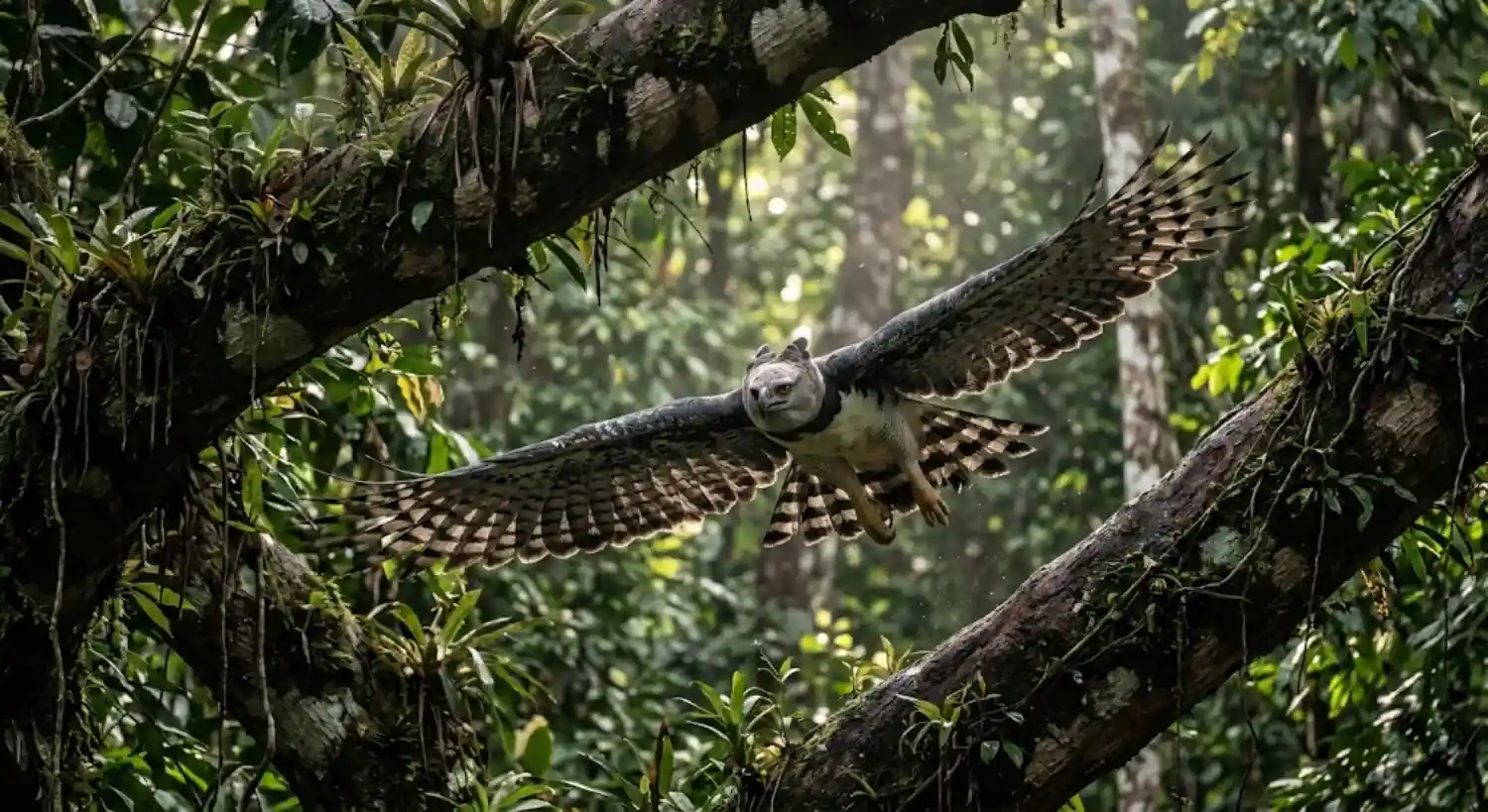
The majesty of the harpy eagle, Harpia harpyja, known in Portuguese as gavião-real, comes from a physical feat that seems to challenge the logic of natural flight. The bird can weigh up to 9 kilograms, seize a capuchin monkey or sloth from the treetops, and continue flying without losing lift.
Unlike open-country eagles, which rely on broad wings to glide on thermal currents, the harpy eagle works in an environment where open space is almost nonexistent. To survive and dominate the interior of the Amazon rainforest, it developed biological engineering that combines brute strength with surgical agility, allowing it to move through vegetation corridors that would stop another bird of similar size.
Wings built for a closed canopy
One of the first features that stands out in the harpy eagle’s silhouette is the proportion of its wings. They are unusually short and extremely broad compared with the total length of the body. This shape is not an evolutionary accident. It is a specialized adaptation to life in the canopy.
From an aerodynamic perspective, short wings reduce the risk of striking branches and trunks during evasive maneuvers or rapid attacks. Their width, meanwhile, creates a larger surface area and provides the lift needed to carry prey that may weigh as much as 70% of the bird’s own body weight.
The harpy eagle’s wingspan ranges from 1.76 to 2.01 meters, or about 5.8 to 6.6 feet. That span is not designed only for soaring. Its wing architecture is optimized for agility in confined spaces and for generating power during vertical takeoffs, even when the bird is carrying a heavy animal.
The physics of this flight involves what is known as wing loading. Seabirds have long, narrow wings suited to gliding over long distances. The harpy eagle uses its wings instead as high-power propellers. After capturing prey in the foliage, it must beat them forcefully enough to overcome gravity and the resistance created by leaves.
That effort depends on dense chest muscles, a combination that few species can match. Broad wings, a powerful body and precise control allow the bird to reach surprising speeds over short distances. Together, these traits make it one of the most efficient apex predators in the rainforest.
Talons built to stop prey instantly
The harpy eagle’s success does not depend only on reaching its target. It must also hold that target securely. Its rear talons, known as hallux claws, can measure up to 13 centimeters, or about 5.1 inches, making them longer than the claws of a brown bear.
The pressure produced by those extremities is even more striking. Biological studies indicate that a harpy eagle can exert crushing pressure greater than 400 pounds per square inch, or PSI. That force is enough to pierce the cranial bones of primates instantly, neutralizing prey before the bird begins carrying it to the nest.
This carrying ability is essential to reproduction. Harpy eagles build their nests at the tops of the tallest trees in the forest, including the majestic Brazil nut tree, Bertholletia excelsa, and the kapok tree, Ceiba pentandra.
The route from the capture site to the nest may involve miles of dense forest. Without the combination of powerful talons and short, maneuverable wings, the energy cost of raising a chick would be impossible to sustain. That is why conserving these giant trees is as vital to the species as protecting the animals that provide its food.
The nesting strategy also reveals the scale of the habitat the predator requires. Harpy eagles prefer trees more than 40 meters tall, or roughly 131 feet, where they can obtain a panoramic view of their territory. Losing these trees removes both a breeding platform and part of the hunting landscape.
A signal of a healthy Amazon
As an apex predator, the harpy eagle acts as a regulator within the ecosystem. By preying on sloths and monkeys, it controls their populations, helps prevent excessive herbivores from degrading local vegetation and limits the rapid spread of disease in overcrowded populations.
The presence of a harpy family in a region is one of the most reliable indicators of a healthy, balanced primary forest. If an ecosystem can support an animal with such high energy demands and such extensive territorial needs, the trophic levels beneath it are functioning together.
That extreme specialization also makes the species vulnerable. Habitat fragmentation is the harpy eagle’s greatest enemy. When large nesting trees are cut down or forest areas become isolated islands, the bird loses the ability to hunt efficiently.
Conservation projects in Brazil, including work carried out by the National Institute of Amazonian Research, INPA, focus intensively on mapping these nests so that the surrounding habitat can remain undisturbed. Protecting the harpy eagle is, in practice, protecting the entire biome over which it flies with such mastery.
A silent hunter among the treetops
Unlike other falcons that hunt with long-distance vision across open fields, the harpy eagle combines acute eyesight with highly developed hearing. Its facial disk of feathers can be raised at will and works in a way similar to that of owls, directing sound waves toward the ears.
This feature allows the bird to locate an animal moving behind dense layers of leaves, where vision alone could fail. In the species’ anatomical profile, its eyesight is described as eight times more powerful than human vision, allowing it to detect minimal movements under filtered light.
Once prey has been located, the attack begins with a stealthy approach. The harpy eagle moves through the middle layers of the forest and uses the shadows of the crowns to conceal its outline until the final moment of impact.
This secretive behavior has earned the bird legendary status among many traditional communities. According to the oral tradition of several Indigenous peoples, the harpy eagle is the guardian spirit of the heights, an entity that watches everything and preserves the balance between sky and earth.
For science journalism, that mythical image echoes the bird’s biological importance. Where the cry of a harpy eagle is heard, there is vigorous life and preserved forest. Understanding the physics of its flight and the biology of its strength is more than an academic curiosity. It is a tool for designing environmental management strategies that respect the space the species needs.
Slow reproduction makes protection essential
Long-term monitoring has revealed fascinating information about the longevity and reproduction of these birds. A female harpy eagle lays only two eggs every two or three years, and usually only one chick survives.
The period of parental care can last up to two years. This extended investment means that any population decline is recovered extremely slowly. For that reason, accurate science communication and efforts to counter false claims about the danger these birds pose to humans are essential.
The harpy eagle is not a threat to human settlements. It is an ally in maintaining the health of the forests on which people and wildlife depend. Every flight carrying heavy prey through openings in the canopy is a reminder of nature’s resilience.
It is a performance of precision that took millions of years to be refined by natural selection. By protecting the habitat required for its aerial maneuvers, people preserve one of the most impressive biological spectacles on the planet.
Science shows that the harpy eagle’s strength lies not only in its talons, but also in the integrity of the forest it calls home. The survival of a giant can depend on details invisible to an untrained eye, such as the density of a branch or the silence of a morning in the woods.
Preserving this species means keeping an essential part of the Amazon alive and ensuring that the balance between strength and vulnerability continues to shape the rhythm of life beneath the canopy.
Reporting: Anne Silva / Amazonia Mag

Editor, English Edition — Amazonia Mag
Anne Silva is the editor of Amazonia Mag, the English-language edition of Revista Amazônia. She curates, translates and adapts the outlet's science and environment coverage for an international audience, reporting on Amazon wildlife, flora, rivers, climate and research. Every story she edits is grounded in peer-reviewed studies, official data and on-the-ground reporting from the Revista Amazônia newsroom in Belém, Pará, Brazil. More by Anne Silva →