
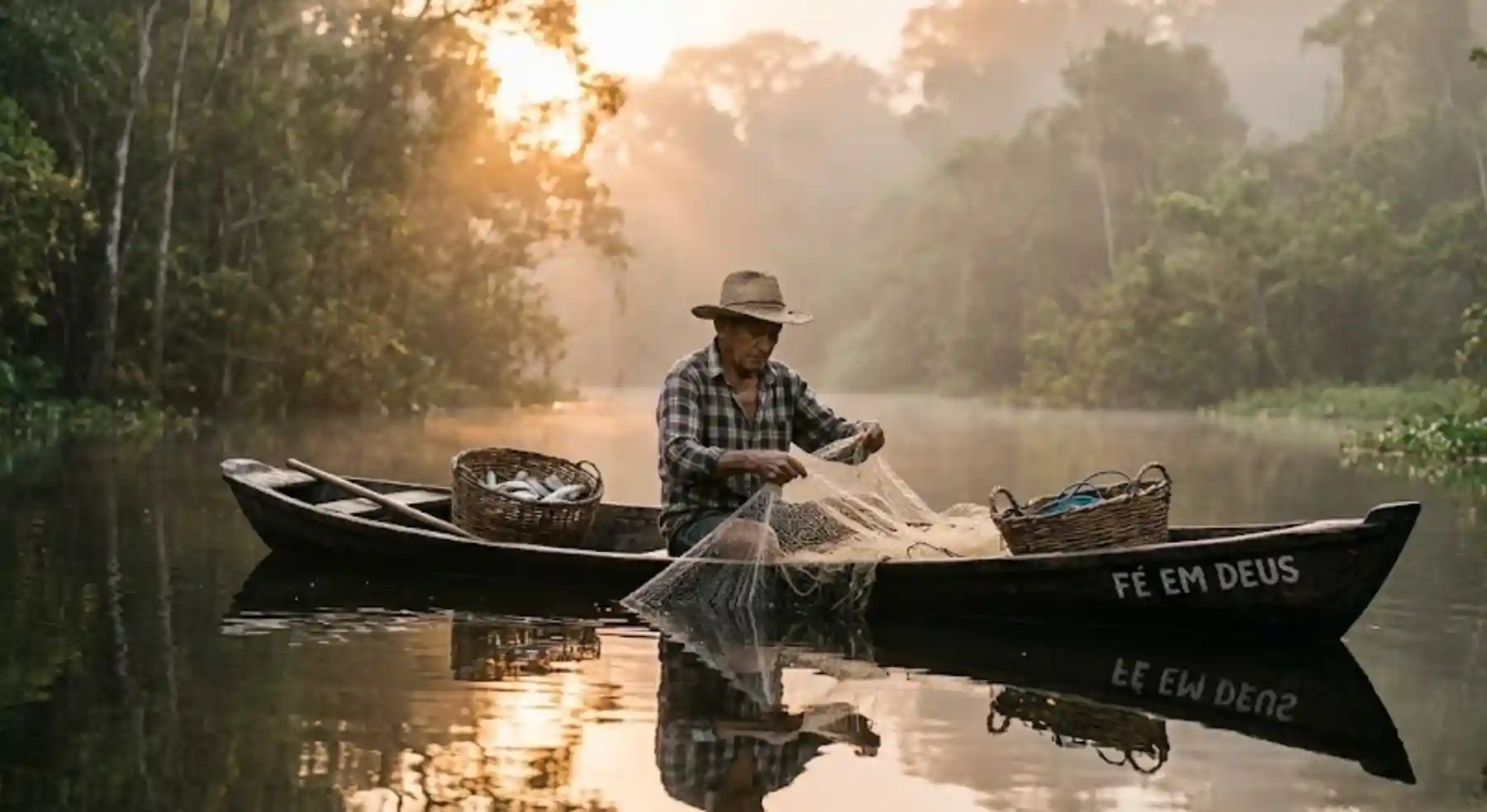
Across large stretches of the Brazilian Amazon, the decision about where fishing is allowed and where it is forbidden does not come from a distant government office. It comes from a community meeting held on the riverbank. The people who make that decision are known in Brazil as ribeirinhos, a word that describes river-dwelling communities: populations who live along the Amazon waterways and organise their entire year around the rhythm of rising and falling water. They divide the lakes inside their territory into three clearly defined categories, and they enforce that division among neighbours. It is a zoning system built from accumulated observation rather than decree, and studies indicate that it works.
Three categories, one logic
The instrument is called a community fishing agreement. Through it, river-dwelling families separate bodies of water according to the role each one plays. Maintenance lakes are reserved for daily use and household subsistence. Commercial lakes allow controlled sale within agreed limits. And breeding lakes are off limits: fishing there is strictly prohibited, with no exceptions and no open season.
That empirical zoning is arguably the most significant contribution these communities have made to aquatic biodiversity conservation, and it has proved more efficient than a great deal of state enforcement carried out from a distance. Studies indicate that lakes under community management hold populations of pirarucu (Arapaima gigas) and tambaqui (Colossoma macropomum) significantly larger than those found in open access areas.
Modern science arrived later and took notes. Those traditional models now inform the design of Sustainable Development Reserves, a legal format built on a straightforward recognition: the local resident is the most effective environmental monitor the forest can have, because their survival depends directly on the health of the ecosystem around them.
Reading the river before reading the calendar
Behind those decisions sits a capacity for environmental reading that is striking in its precision. River-dwelling communities anticipate the reproductive cycles of aquatic fauna through subtle phenological indicators, such as the smell of the water or the sound of wind moving through the canopy. From those signals they built rigorous seasonal calendars that allow resources to be taken without crossing the forest’s limit of resilience, the threshold modern ecology calls carrying capacity and that these communities have been working with for centuries.
That empirical science, passed on orally between generations, kept fish stocks standing in areas where industrial fishing would have caused irreversible biological collapse within a few years. It is worth being precise about what this means. The knowledge in question is technical, tested against outcomes, and corrected when it fails. It is not a set of picturesque customs attached to a landscape.
Forest and river as a single organism
For river-dwelling families, forest and river are not separate entities but one organism breathing along with the flood and drought cycle. The forest management they practise rests on diversification. Instead of exploiting a single species until it is exhausted, they draw on a wide range of non-timber products: essential oils, resins, fibres and fruit. Research into traditional agroforestry describes their productive home gardens as genuine biodiversity laboratories, which also assist seed dispersal and the natural restoration of degraded ground.
One notable technique is the selective management of palms and emergent trees. By clearing the base of certain species and removing smaller competitors, the river dweller accelerates the growth of fruiting trees without reaching for chemical fertiliser or machinery. That technical knowledge, which contemporary forest science is beginning to validate under the name of precision management, keeps the canopy structure intact and preserves the microclimate that thousands of insect and small vertebrate species depend on.
When the river stops being predictable
This way of life is now being tested by something new: climatic unpredictability. The severe droughts and extreme floods that studies indicate are becoming more frequent because of global warming put pressure on stilt house building techniques and on planting cycles in the floodplains. The response of these communities lies in their flexibility. Unlike rigid economic systems, the river dweller adjusts diet, transport logistics and even housing according to what the river demands. Understanding how they manage scarcity through historic droughts without destroying the biological wealth around them is essential input for climate mitigation policy anywhere in the world.
Solar panels, satellite internet and fair trade
Modernity has reached the rivers not only as a threat but also as a tool. Solar panels used to keep fish fresh and satellite internet access have allowed young river dwellers to document their own practices and reach fair trade markets directly. That integration keeps the value of the forest product inside the community, which pushes back against the poverty that so often drives people towards illegal activity such as informal mining or logging.
Bioeconomy and benefit sharing
The Amazon bioeconomy of the future will have to be built on the foundation of river-dweller knowledge. When molecular science hunts for new compounds in medicinal plants, or when engineering looks for sustainable materials, it is frequently following trails left by traditional knowledge. That is why patent recognition and benefit sharing are central issues rather than side notes: without them, cultural sustainability fails to keep pace with biological preservation.
Land tenure, the condition for everything else
Despite their ecological importance, river-dwelling communities face political invisibility and constant pressure on their territories. The expansion of large infrastructure projects and the absence of land tenure regularisation put centuries of accumulated expertise at risk. When a community is displaced, what is lost is far more than a group of people: a living archive of how to interact with the forest without destroying it disappears with them. Securing access to health care, quality education adapted to rural reality and legal protection of land is the baseline step for any serious environmental strategy in Brazil.
Two languages for the same reality
The future of the Amazon depends on recognising that there is no preserved forest without the people who keep it alive. Modern science and traditional knowledge are not opposites but complementary languages describing the same complex reality. By choosing products from sustainable extractive sources and supporting policies that strengthen traditional communities, every citizen contributes to holding that balance in place. Respect for river-dwelling communities is, in the end, an act of strategic intelligence.
Reporting: Anne Silva / Amazonia Mag. Source: Instituto Mamiraua and Conselho Nacional das Populacoes Extrativistas (CNS).

Editor, English Edition — Amazonia Mag
Anne Silva is the editor of Amazonia Mag, the English-language edition of Revista Amazônia. She curates, translates and adapts the outlet's science and environment coverage for an international audience, reporting on Amazon wildlife, flora, rivers, climate and research. Every story she edits is grounded in peer-reviewed studies, official data and on-the-ground reporting from the Revista Amazônia newsroom in Belém, Pará, Brazil. More by Anne Silva →