
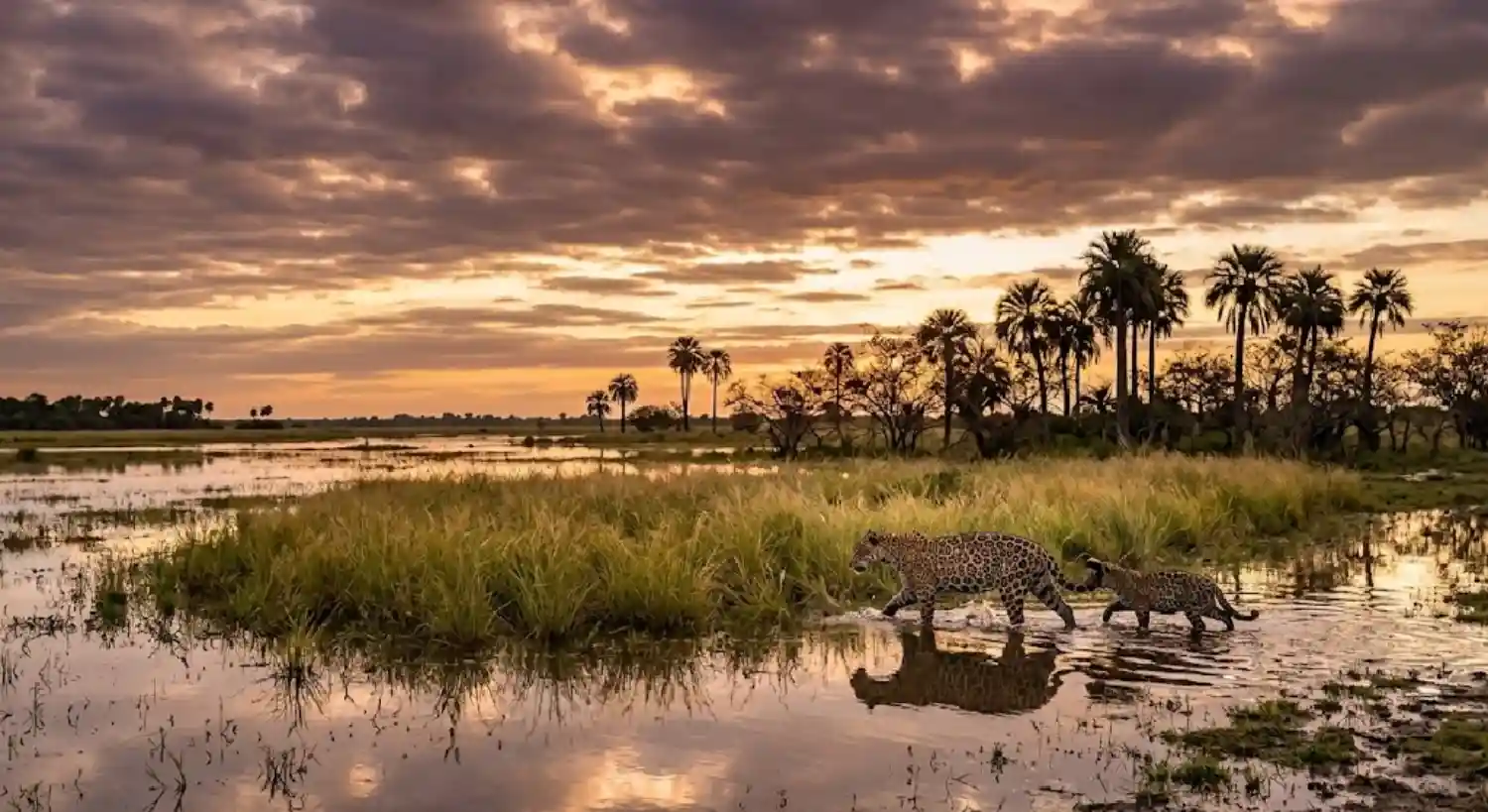
For more than seventy years, the Esteros del Iberá, a vast wetland in the Argentine province of Corrientes, carried an absence that no visitor could easily see: the absence of its top predator. The jaguar, Panthera onca, the largest cat in the Americas, had been wiped out locally by hunting and by the advance of the agricultural frontier. When it vanished, part of the wetland’s machinery went with it. Today the animal moves again through the marshes, grasslands and lagoons of Iberá, and its return has become the centrepiece of one of the most ambitious biological restoration projects in the Southern Hemisphere.
The reintroduction was never a symbolic gesture, nor a rescue of stray animals. It was an operation planned over years by the Rewilding Argentina foundation, working alongside the local government and international partners, with a goal that reaches well beyond a single species: giving the country’s largest wetland back its ability to regulate itself. That strategy has a name, rewilding, and it rests on a premise that traditional conservation finds uncomfortable: protecting a landscape without its functional species means preserving an empty stage.
What breaks when a large mammal disappears
Ecosystems are not static paintings. They are dynamic systems held together by constant interactions between species and their environment, and large mammals sit among the players with the greatest influence over that machinery. When they vanish, through hunting, habitat loss or conflict with human activity, they leave a functional gap that triggers a domino effect of imbalances. Without large herbivores to graze and disperse seeds, and without top predators to keep herbivores and mesopredators in check, vegetation structure shifts, species diversity falls and nutrient cycling is interrupted.
This is why restoration ecology speaks of ecosystem engineers. Large herbivores such as the European bison or the marsh deer sustain mosaic landscapes in which open pasture alternates with dense woodland. That structural heterogeneity supports a wide range of smaller species, from birds to insects, which depend on different microhabitats to complete their life cycles. Top predators work from the other end of the chain: by regulating herbivore numbers and pushing them into more cautious behaviour, they prevent overgrazing, allow riverside vegetation to regenerate and indirectly protect entire watersheds.
The most cited example in the world remains the return of the grey wolf to Yellowstone National Park in the United States, where a single predator reordered whole food webs. Iberá is the South American version of that bet, with a big cat at its centre and a wetland as its stage.
Iberá, the wetland that got its predator back
Bringing the jaguar home is the highest point of the Corrientes project, and also the hardest part of it. Locally extinct for more than seven decades, the cat was the missing piece in a system where capybaras and caimans had multiplied without check, precisely because nothing was left to regulate them. Restoring that function required far more than releasing animals into open country.
The process involved translocating individuals from different regions, which safeguards genetic diversity, building acclimation enclosures where the animals learn to hunt and to navigate the terrain, and running rigorous satellite monitoring once they are released. That tracking serves two purposes at once: confirming that the animals are adapting, and anticipating any conflict with neighbouring communities. The birth of the first wild jaguar cubs in decades inside Iberá marked a historic milestone for South American conservation and turned the project into an international reference.
Not only the cat: rebuilding the whole web
The jaguar takes the headlines, but the work in Iberá has always aimed at rebuilding a network rather than a single flagship figure. Alongside the cat came the giant anteater (Myrmecophaga tridactyla), the pampas deer (Ozotoceros bezoarticus), the giant otter (Pteronura brasiliensis) and the vinaceous parrot (Amazona vinacea).
Each of those species plays a distinct role: dispersing seeds, controlling insect populations, shaping vegetation or moving nutrients between water and dry land. Together they rebuild a complex food web, and that is exactly what separates a resilient ecosystem from a landscape that looks beautiful yet remains functionally poor. Contemporary conservation no longer measures success in protected hectares alone, but in ecological processes that start happening again.
That distinction matters far beyond Corrientes. Across South America, protected areas often keep their forests and their water while quietly losing the species that once did the ecological work inside them. A reserve can look intact from a satellite image and still behave like a hollow system on the ground, because the animals that dispersed its seeds, regulated its herbivores and moved nutrients through it are gone. Iberá is valuable precisely because it treats that hollowing out as the problem to solve.
The real obstacles: genetics, health and fear
No reintroduction advances without friction. On the technical side, teams must guarantee enough genetic diversity in founding populations, sustain health monitoring that prevents the spread of disease, and identify habitats with genuine carrying capacity to support the new arrivals. An area can look suitable on a map and prove entirely unsuitable in practice.
Even so, the toughest challenges tend to be social and political. The return of large carnivores generates resistance and fear among nearby communities, worried about their own safety and about livestock predation. Ignoring that fear is the fastest way to sink a technically flawless project.
The answer that worked in Corrientes combined conservation science with community involvement and sustainable economic development. Ecotourism built around wildlife watching created jobs in hospitality, food service and guiding, and reshaped the regional economy. Former hunters became defenders of biodiversity, not because of a persuasive speech, but because living wildlife started to be worth more than hunted wildlife.
Individuals, not pieces on a board
There is a dimension of rewilding that technical debate often leaves out. Reintroduced animals are not tokens on an ecological board: they are sentient individuals, able to feel pain, fear and joy, and to build complex social bonds. Ethical management of these species, respecting their welfare and their autonomy, is now a pillar of any serious conservation project.
Seen that way, reintroduction is not a manipulation of nature. It is an act of repair and of care, restoring to wildlife the right to inhabit territories from which it was unjustly expelled. The resurrection of the landscape in Iberá works as an uncomfortable and necessary invitation to rethink our relationship with the ecosystems we have degraded, and it shows that restoration is possible when science, policy and local communities push in the same direction.
Reporting: Anne Silva / Amazonia Mag. Source: Rewilding Argentina Foundation, Iberá Park, International Union for Conservation of Nature (IUCN) and United Nations Environment Programme (UNEP).

Editor · Amazonia Mag
Anne Silva is the editor of Amazonia Mag, the English-language edition of Revista Amazônia. She curates, translates and adapts the outlet's science and environment coverage for an international audience, reporting on Amazon wildlife, flora, rivers, climate and research. Every story she edits is grounded in peer-reviewed studies, official data and on-the-ground reporting from the Revista Amazônia newsroom in Belém, Pará, Brazil. More by Anne Silva →