
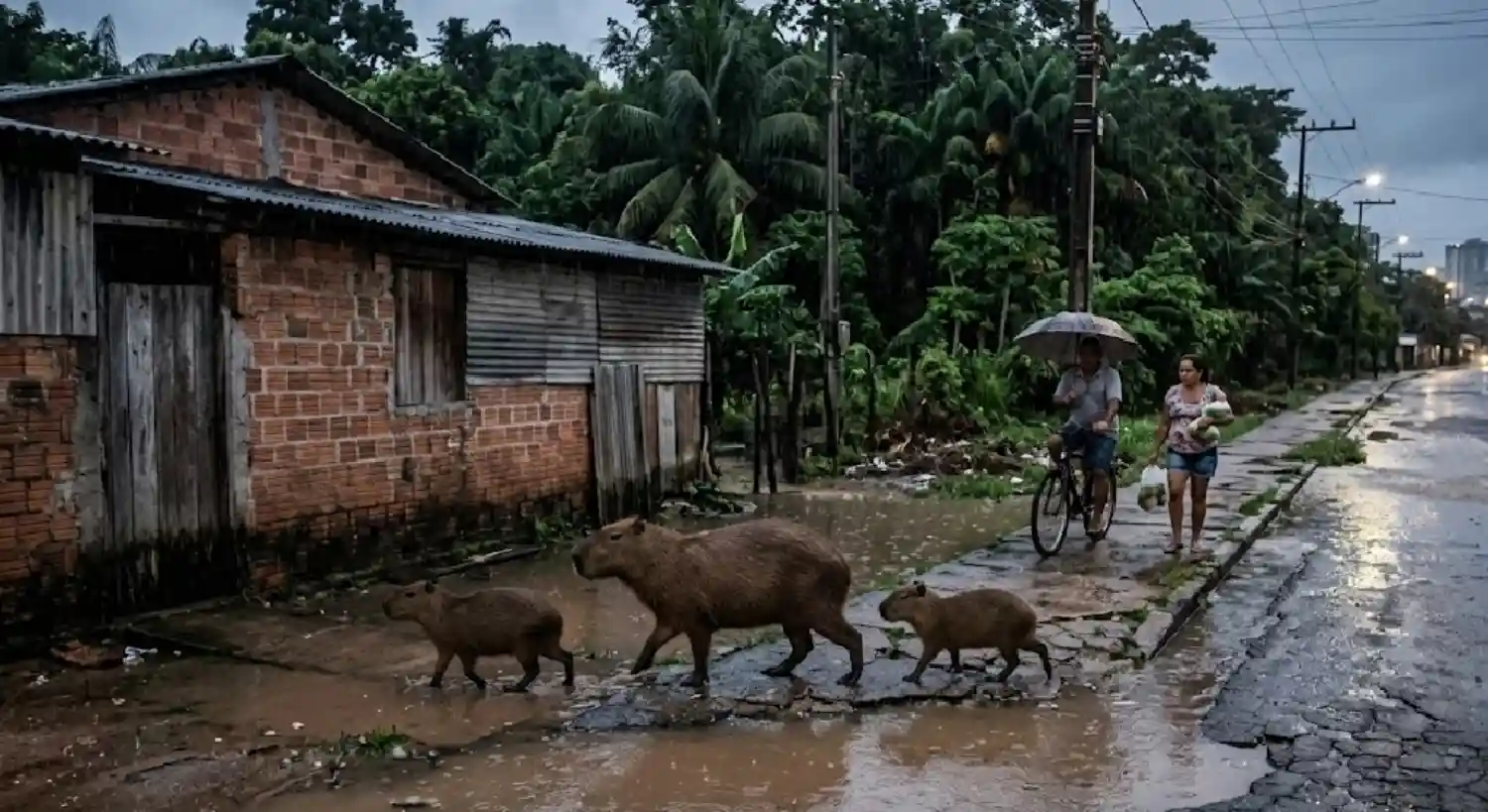
In many Amazonian cities it no longer surprises anyone to see a family of capybaras crossing an avenue at dusk, grazing on the lawn of a public square or resting beside a drainage canal. The scene looks like a charming anecdote at first glance, but it is in fact the most visible sign of a deep ecological process. Biologists call it synanthropy: the phenomenon through which certain species find adaptive advantages inside the environment modified by human beings and end up settling there for good.
The presence of wild animals at the heart of a metropolis is not accidental. Organisms with high behavioural plasticity manage to exploit abundant urban resources, such as shelter from natural predators and alternative sources of food. That behaviour reveals the remarkable resilience of wildlife, able to turn squares, backyards and drainage channels into active new ecological niches. Yet when cities expand rapidly over the edges of the Amazon rainforest, this mutual adaptation takes on far more complicated contours.
The rodent that read the city best
Among mammals, the capybara (Hydrochoerus hydrochaeris) stands out as one of the strongest symbols of that transition. Because it is a semiaquatic animal, it finds in runoff canals and urban ponds a habitat well suited to resting and to thermal regulation. The absence of its historical predators, such as the jaguar and large caimans, combined with the steady supply of grasses in parks, gardens and roadside strips, creates a highly favourable setting for the growth of its family groups.
The way in was already open. In Amazonian cities the transition between the natural and the urbanised environment is often thin: rivers, igarapés and fragments of riparian forest push into the urban fabric and work as genuine green highways for wild species. Capybaras, sloths, iguanas, small primates and a vast diversity of birds use those residual ecological corridors to move between forest strongholds and densely populated districts.
Comparing species helps explain why the capybara became so visible. The three toed sloth (Bradypus tridactylus) and small primates such as marmosets depend directly on the continuity of tree canopies in order to move around. Forest fragmentation forces them down to the ground or onto electrical wiring to cross public roads, a desperate attempt at adaptation that exposes them to vehicle collisions, electrocution and attacks by domestic animals. The capybara, by contrast, travels over ground and through water, two surfaces the city never fully interrupted.
When asphalt reaches the forest edge
The geographical overlap between asphalt and dense forest forces daily encounters between residents and local wildlife. That contact is intensified by habitat fragmentation, which happens when a large area of continuous forest is split into smaller pieces by new roads, power transmission lines or the expansion of neighbourhoods. The resulting geographical isolation produces what is known as the edge effect, in which the margins of the fragment undergo drastic microclimate changes, with greater exposure to wind, heat and urban noise.
For wildlife, those edges are areas of high vulnerability, where the risk of predation by domestic animals, the exposure to disease and the number of road deaths all rise significantly. The response of many species is to change their schedule: animals that are originally diurnal shift to predominantly nocturnal or crepuscular habits inside the urban perimeter, a strategy to avoid the busiest hours of vehicle traffic and the heaviest movement of people.
The city also interferes with communication and with biological rhythms. Songbirds living in urban areas tend to sing at higher frequencies and at louder volumes in order to rise above the constant noise of traffic, an adaptive adjustment that burns precious energy reserves. Permanent artificial lighting disrupts the biological clock of amphibians and reptiles, affecting reproduction and feeding cycles that were once strictly guided by the phases of the moon and by natural darkness.
The public health side of coexistence
The most delicate point in the meeting between wildlife and the city is rubbish. Improper disposal of organic solid waste draws wild animals towards bins and refuse deposits. Although it may look like an easy source of food, eating human leftovers exposes wildlife to dangerous pathogens and to poisoning by plastics and harmful chemical substances, compromising the long term health of the populations that live in edge areas.
The risk runs in both directions. A wild animal that feeds on rubbish loses autonomy, concentrates around fixed points of the city and multiplies its contacts with people and with domestic dogs and cats, precisely the situations that most favour the circulation of disease. That is why environmental education programmes are so important: residents need to understand that the animals living in squares and parks must not be artificially fed or tamed, so that they keep their natural instinct to search for native food.
There is also a subtler consequence for the animals themselves. A capybara group that settles permanently around an urban pond, protected from predators and fed by an unlimited supply of grass and leftovers, keeps growing until the surrounding space no longer matches the size of the herd. What began as a local curiosity then turns into a management problem for city authorities, and the conflict that follows tends to fall hardest on the animals, which are usually the ones removed or relocated.
Biophilic urban design instead of walls
Promoting a peaceful and healthy coexistence requires cities to be planned not only for people, but as integrated ecological systems. The traditional model of urbanisation, marked by the total paving of the ground and the rigid channelling of watercourses, has to give way to sustainable concepts of architecture and city planning. Among the main measures to reduce conflict and protect urban wildlife, four complementary fronts stand out.
Ecological corridors and wildlife crossings: installing aerial rope bridges over public roads for primates and sloths, along with tunnels beneath highways for small mammals and reptiles, sharply reduces the number of animals killed by vehicles.
Protection of riparian forest: keeping the banks of igarapés and rivers free of construction guarantees natural buffer zones that serve as refuge and as safe foraging ground for local species, capybaras included.
Smart road signage: putting up warning signs and speed reducers in known animal crossing areas, especially near parks and urban reserves, protects wildlife and drivers alike.
Proper waste disposal: using wildlife proof bins in wooded public areas prevents species such as monkeys and coatis from becoming dependent on urban rubbish, cutting the public health problem off at its root.
Those measures work best alongside reforestation projects able to reconnect the green islands scattered across the urban grid, restoring continuity to fragments that are isolated today. Preserving biodiversity in cities is not a matter of raising barriers between the asphalt and the forest, but of designing safe and respectful transition points for both sides.
Seeing capybaras, sloths and tropical birds crossing everyday paths should be read as a privilege and also as a collective responsibility. By building ecology into infrastructure planning, the cities neighbouring the Amazon can grow in harmony with the natural heritage that surrounds them and show that urban development and wildlife are able to travel the same road.
Reporting: Anne Silva / Amazonia Mag. Source: Revista Amazônia, International Union for Conservation of Nature (IUCN) and United Nations Environment Programme (UNEP).

Editor, English Edition — Amazonia Mag
Anne Silva is the editor of Amazonia Mag, the English-language edition of Revista Amazônia. She curates, translates and adapts the outlet's science and environment coverage for an international audience, reporting on Amazon wildlife, flora, rivers, climate and research. Every story she edits is grounded in peer-reviewed studies, official data and on-the-ground reporting from the Revista Amazônia newsroom in Belém, Pará, Brazil. More by Anne Silva →