
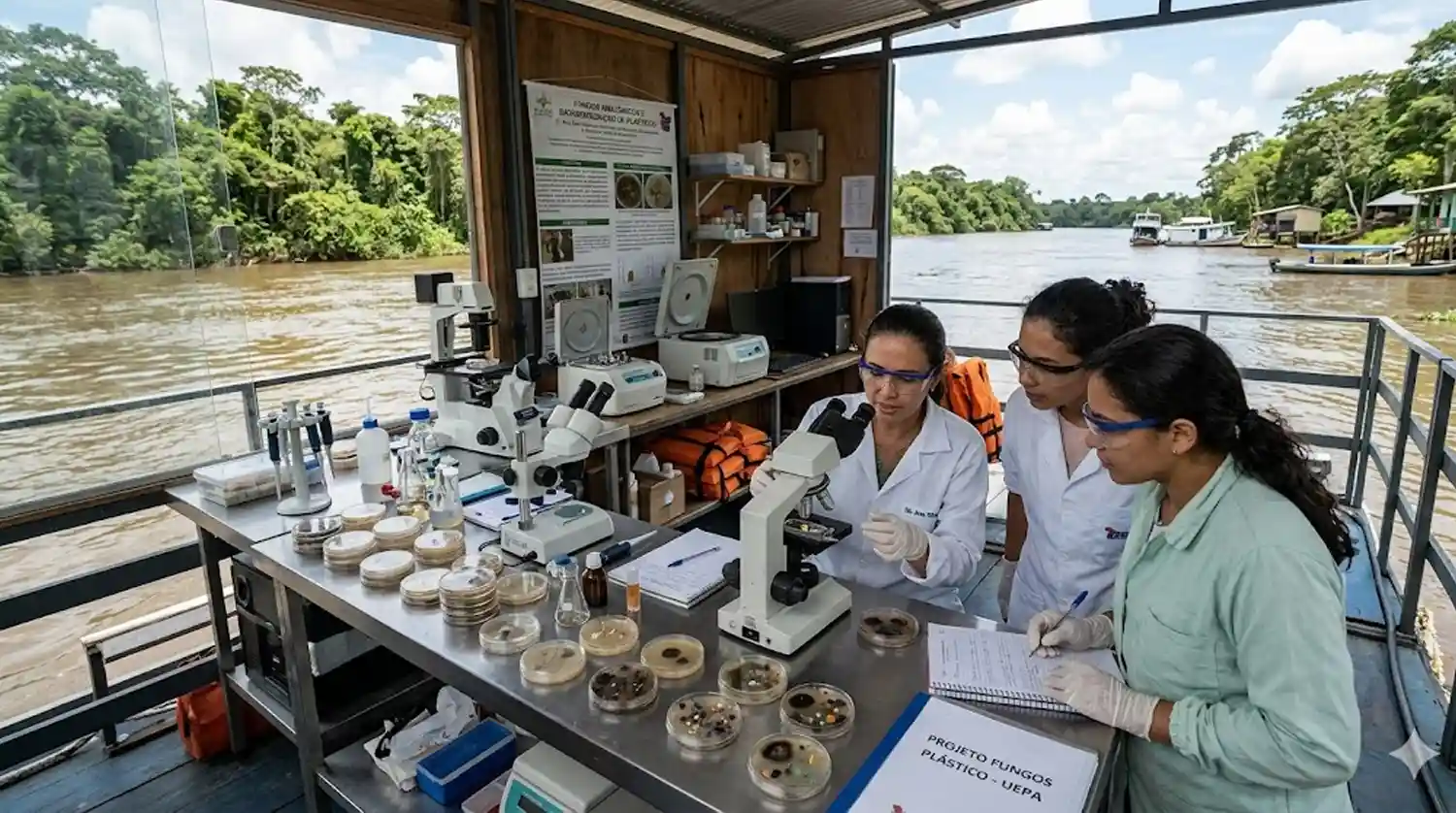
While the world argues over decarbonization targets, a quiet revolution is unfolding beneath the soil of the Brazilian Amazon: fungi that eat plastic. Brazilian science has reached a historic milestone by cataloging the 120th strain of fungi capable of digesting synthetic polymers in the soil of Pará, a feat that cements the Amazon as the largest biotechnological pharmacy on the planet.
The figure, confirmed by the international bioeconomy consortium operating in the region, points to something even more striking: these microorganisms are evolving faster than the most optimistic projections made at the start of the decade. The recycling that nature runs on its own could erase the buildup of polyurethane in illegal dumping zones in less than two years, a timeline that once sounded impossible to environmental engineers.
What makes the discovery so consequential is its location. The same forest long prized for medicinal plants is now revealing microscopic allies that could reshape how humanity deals with its most stubborn waste. Each new strain added to the catalog widens the toolbox available to fight plastic pollution, and the pace of new findings shows no sign of slowing.
An urban bioremediation pilot in Belém
The star of this story is no longer a laboratory promise. In Belém, the capital preparing to host the most important climate conference in history, the fungus has become the centerpiece of an urban bioremediation pilot. The initiative uses colonies of Pestalotiopsis to treat leachate and the plastic waste still lingering in old landfills across the metropolitan area.
The results stunned even the most skeptical technicians. In just the first 72 hours of application, the treated soil recorded a 15% reduction in the mass of microplastics present. It is proof that Amazonian biotechnology is already at work in the real world, not only in Petri dishes.
Artificial intelligence maps the plastic-eating enzymes
A new generation of researchers is redrawing the region’s biotechnology with the help of artificial intelligence, used to map the genes responsible for producing the “plastivore” enzymes. One of the most notable advances was the complete genome sequencing of a variant found on Marajó Island.
That variant showed unprecedented heat resistance, withstanding temperatures of up to 113°F (45°C) without losing its ability to break plastic down. The detail solves one of the technology’s biggest bottlenecks: adapting the fungus to hotter climates or to industrial processes that generate heat. With it, the plastic-decomposing fungus can be exported as a solution for environmental crises in tropical zones of Africa and Southeast Asia.
From river to fertilizer: closing the loop
The economic impact is already visible in the new green industrial districts springing up along the BR-310 highway. Biotech companies are moving into the region to produce commercial-scale “fungal bioreactors.” The business model centers on bio-extraction: plastic collected from the rivers is transformed by these fungi into a protein-rich byproduct.
After rigorous treatment, that byproduct can be converted into organic fertilizer or raw material for new bioplastics. It is the perfect closing of the material cycle, where yesterday’s pollutant becomes tomorrow’s nutrient, turning a financial engine that keeps the forest standing and valued.
Nature is already defending itself
On the conservation front, expeditions to remote areas of the Upper Solimões found that these fungi are already acting naturally on the garbage deposits swept in by the rivers’ floods. This wild adaptation suggests that Amazonian nature is building its own defense mechanisms against the Anthropocene.
Even so, scientists warn that this “natural cleanup” must not become an excuse to continue irresponsible dumping. A priority of Brazilian environmental policy will be to implement biosafety protocols to ensure that the massive use of these fungal strains does not alter the original microbiota of protected areas.
A showcase for COP30 and the world
The infrastructure built for COP30 has become a living laboratory. The new delegation reception complex in Belém unveiled a waste-treatment system based entirely on local microorganisms. Through glass panels, visitors watch in real time as vibrant mycelia consume plastic cups and packaging.
That technological showcase is Brazil’s closing argument to attract sovereign investment funds, built on the thesis that sovereignty over biodiversity is the most valuable asset of the 21st century. The country also sealed a technical cooperation agreement between the Ministry of Science and Technology and European universities to create the first Global Center for Fungal Bioremediation. The goal is to standardize large-scale application methods and ensure the technology reaches developing nations facing severe sanitary crises.
Reporting: Anne Silva / Amazonia Mag
This article is the English edition of reporting originally published by Revista Amazônia. Images: Revista Amazônia archive.

Editor · Amazonia Mag
Anne Silva is the editor of Amazonia Mag, the English-language edition of Revista Amazônia. She curates, translates and adapts the outlet's science and environment coverage for an international audience, reporting on Amazon wildlife, flora, rivers, climate and research. Every story she edits is grounded in peer-reviewed studies, official data and on-the-ground reporting from the Revista Amazônia newsroom in Belém, Pará, Brazil. More by Anne Silva →