
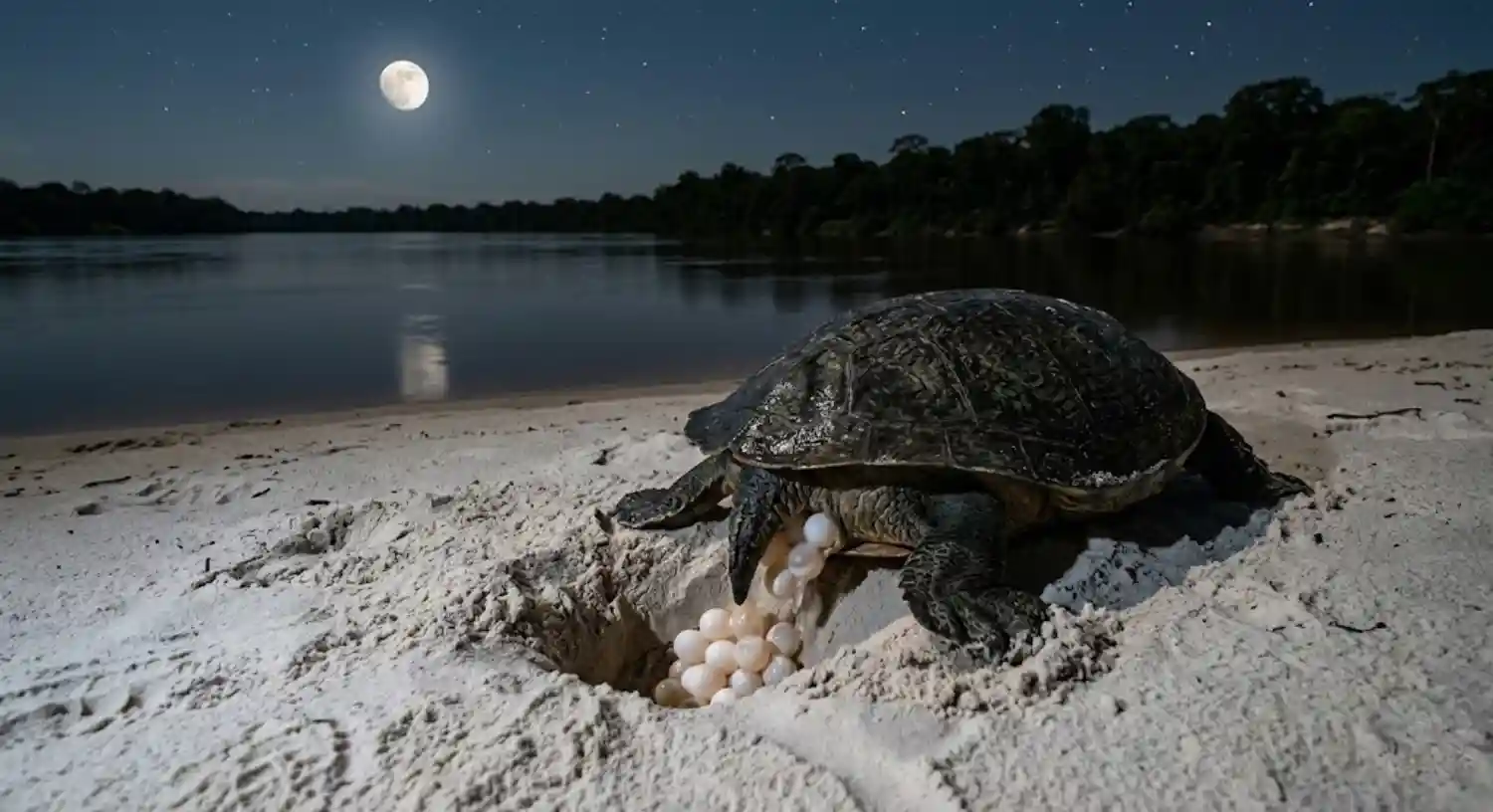
The imposing giant Amazon river turtle, Podocnemis expansa, is the largest freshwater turtle in South America. Across the Amazon rivers, this species carries an extraordinary secret: after exploring the basin’s waterways for years, adult females can travel thousands of miles, thousands of kilometers, and return with remarkable precision to the same white-sand beach where they hatched.
The behavior has puzzled scientists for decades. The turtle does not rely on visible landmarks or smells to find its destination. Instead, it uses an extraordinary sensitivity to Earth’s magnetic field, an internal biological GPS that allows it to navigate through a vast environment and through waters that can be difficult to see through.
A magnetic map learned at birth
Science recognizes that these animals possess a form of magnetic navigation. The mechanism allows them to record the unique magnetic characteristics of the beach where they were born and use that information later, when they must return to the place where they will nest.
Studies indicate that soon after hatching, young turtles undergo a process of “imprinting,” or magnetic learning. During this period, their nervous system records the “signature” of the magnetic field at that specific location, preserving an invisible reference to their birthplace.
That record acts as a lasting map that the turtle can consult throughout its adult life. The information remains connected to the natal beach and becomes an essential tool for guiding the long journey through Amazonian rivers.
During the return trip, the giant Amazon river turtle constantly monitors subtle variations in Earth’s magnetic field. It compares those variations with the original record of its beach and adjusts its route until it reaches the nesting destination associated with that magnetic signature.
The return to white-sand beaches
The return of Podocnemis expansa is an event of epic proportions. It generally takes place during the dry season, when river levels fall and white-sand beaches emerge again along the Amazon waterways.
Thousands of females, driven by the same ancestral instinct, gather on these beaches and create a remarkable display of biodiversity. Their concentration shows how important these places are and how strongly the species’ reproductive cycle depends on the persistence of river environments.
Turtles generally climb onto the beaches to nest at night. This behavior helps them avoid predators and limits their exposure to the excessive temperatures that sand can reach during the day.
After digging a deep nest in the sand, the female lays dozens of eggs and covers them. In this way, she provides the protection and suitable temperature needed for the embryos to develop before returning to the river.
The process is exhausting and often places the female at significant risk. Even so, it is essential to the continuation of the species, because each nest links the memory of one beach with the next generation of Amazon turtles.
Fidelity that also creates vulnerability
The giant Amazon river turtle’s loyalty to its birthplace is one of the most striking examples of biological adaptation. Yet the same trait that gives the animal such precise orientation can make it vulnerable when its nesting habitat is changed.
If a nesting beach is significantly altered, the turtles’ nesting instinct can be affected. The change may result from human activities, such as hydroelectric dam construction or sand extraction, and it may also be caused by natural events.
Under those circumstances, females may have difficulty finding the exact place they once used. They may also be forced to nest in less suitable locations, which can reduce reproductive success and threaten the future of the population.
Protecting nesting beaches and preserving the integrity of river ecosystems is therefore essential. Conservation does not mean protecting only the animals that arrive on the sand. It also means maintaining the rivers and the places that support every stage of their life cycle.
Conservation alongside local communities
Knowledge about magnetic navigation and loyalty to nesting beaches has had a significant positive impact on conservation efforts in the Amazon. Conservation organizations and local communities work together to monitor turtle populations, protect nesting beaches and promote sustainable management of these animals.
Those initiatives have helped populations recover in some areas. The results show that biodiversity conservation can be reconciled with sustainable development when efforts consider both the species’ needs and the reality of people who live beside the rivers.
Community conservation and management projects are fundamental to protecting the giant Amazon river turtle. Nongovernmental organizations and riverside communities cooperate to safeguard nesting beaches, monitor populations and promote the sustainable harvesting of eggs for community consumption and sale.
These initiatives help secure the species’ continuation while also generating income for local communities. Protecting the giant Amazon river turtle is therefore connected to the health of river ecosystems and to the quality of life of the populations that depend on them.
A symbol of Amazonian richness
The giant Amazon river turtle is a symbol of the Amazon’s natural wealth. Protecting it is a commitment to the future of the region and to the sustainability of the planet, because its story reveals the connection among animals, rivers, beaches and human communities.
The ability of these creatures to navigate such a vast and complex environment is a testament to the inventiveness of life and its resilience in the face of challenges. Every return to a natal beach expresses a deep relationship between a species and the territory where it began.
As knowledge about these animals grows, so do respect for nature and responsibility for its conservation. The turtle’s journey, guided by such a complex biological mechanism and such a powerful ancestral instinct, invites reflection on the interconnection of all forms of life.
The question that remains is whether humanity will be able to protect the habitats essential for this age-old journey to continue being told by Amazonian rivers. The answer will depend on protecting beaches, supporting community management and preserving the integrity of the ecosystems that make the return possible.
Reporting: Anne Silva / Amazonia Mag

Editor, English Edition — Amazonia Mag
Anne Silva is the editor of Amazonia Mag, the English-language edition of Revista Amazônia. She curates, translates and adapts the outlet's science and environment coverage for an international audience, reporting on Amazon wildlife, flora, rivers, climate and research. Every story she edits is grounded in peer-reviewed studies, official data and on-the-ground reporting from the Revista Amazônia newsroom in Belém, Pará, Brazil. More by Anne Silva →