
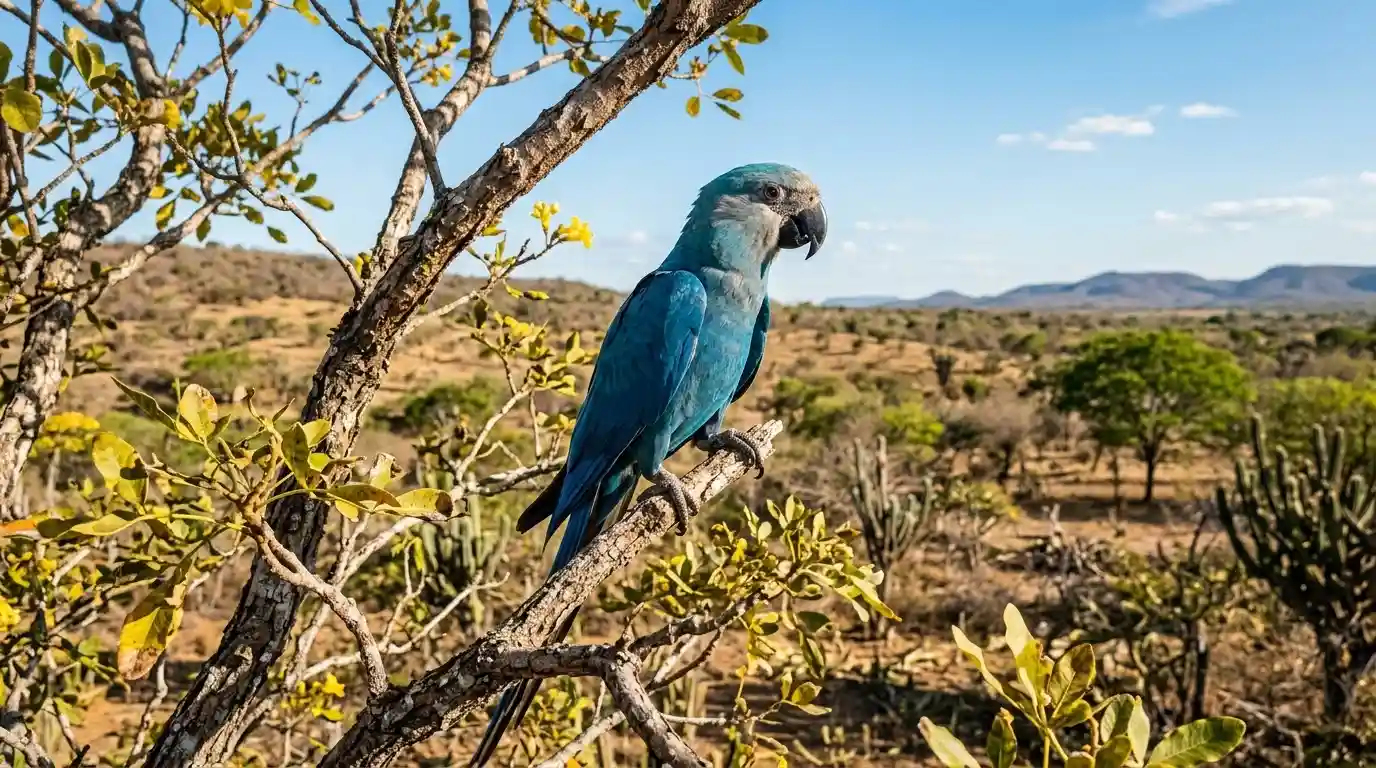
The last wild Spix’s macaw (Cyanopsitta spixii) disappeared from Brazil’s skies in the year 2000, leaving an ecological void that many scientists believed would last for generations. Today the picture has changed dramatically thanks to a release project in Curaçá, in Bahia state, where captive-bred birds are relearning how to live free in their ancestral habitat. It is one of the rare cases in the world where a species declared extinct in the wild manages to reclaim its territory through strategic human intervention.
Training for freedom
The project’s success rests on a complex pre-release protocol that teaches the birds to recognize natural predators and to find native food in the Caatinga, Brazil’s semi-arid scrubland. Reintroduction is not a one-off release but a continuous process of biological and behavioral adaptation.
Every released bird is monitored around the clock by radio transmitters, letting researchers follow each wingbeat and every interaction with the local flora. Early results show the macaws are using the crowns of caraibeira trees (Tabebuia aurea) for shelter and food, renewed hope for the other extinct or threatened Brazilian birds waiting for similar projects.
Mentors from another species
One of the boldest features of the strategy has been the use of “tutors” from a different species to speed up the birds’ acculturation. Blue-winged macaws (Primolius maracana), which already lived free in the region, were placed with the groups of Spix’s macaws to serve as survival guides in the backlands.
Because the blue-winged macaws know the dangers and the water sources of the region intimately, they teach their blue cousins where to find water and how to avoid hawk attacks. This social-learning technique sped up the birds’ integration into the wild and sharply reduced the mortality rates that usually haunt long-term reintroduction projects.
Genetics at the cutting edge
Behind the birds in the sky lies decades of careful genetic work. Because the entire living population descends from a small number of founders, every pairing is planned to preserve as much genetic diversity as possible and to avoid the inbreeding that can doom a recovering species. The knowledge gathered in the Bahian backlands on genetic variability in captivity and on remote monitoring now sits at the cutting edge of global conservation science.
Climate barriers and the fight against trafficking
Even so, the path toward a self-sustaining population still faces challenges that test the species’ resilience. The climate crisis has made dry spells in the semi-arid region more severe, cutting the supply of seeds and seasonal fruit that are essential to the diet of the newly arrived birds.
Beyond the environmental factor, vigilance against wildlife trafficking must be relentless: the extreme rarity of the Spix’s macaw makes it a high-value target on the international black market. Effective habitat protection is therefore as vital as the individual care given to each bird that takes to the sky.
The community of Curaçá
Scientists expect the first chicks born entirely in the wild to arrive within the next breeding cycles, cementing the victory over extinction. For that to happen, the involvement of Curaçá’s residents has been the backbone of the project. Local people now act as true guardians of the territory, taking part in environmental education programs and building responsible ecotourism. That engagement turns conservation into a tool for economic development, ensuring that protecting the wildlife is seen as a source of pride and a direct benefit for those who live in the region.
The stakes reach far beyond a single bird. The Spix’s macaw became a global symbol of extinction, and its return is watched closely by conservationists everywhere as a test of whether captive breeding and reintroduction can truly bring a species back from the brink. Success in Curaçá would hand a proven playbook to the many other threatened Brazilian birds still waiting for a project of their own.
The ultimate goal is that, within a decade, the sky of the Caatinga will show the metallic blue of these birds on its own, with no need for constant human support. Brazil reaffirms its leadership in ecological restoration, proving that extinction need not be a final sentence for charismatic species.
Reporting: Anne Silva / Amazonia Mag. Source: Spix’s macaw reintroduction project in Curaçá, Bahia.
This article is the English edition of reporting originally published by Revista Amazônia. Images: Revista Amazônia archive.

Editor · Amazonia Mag
Anne Silva is the editor of Amazonia Mag, the English-language edition of Revista Amazônia. She curates, translates and adapts the outlet's science and environment coverage for an international audience, reporting on Amazon wildlife, flora, rivers, climate and research. Every story she edits is grounded in peer-reviewed studies, official data and on-the-ground reporting from the Revista Amazônia newsroom in Belém, Pará, Brazil. More by Anne Silva →