
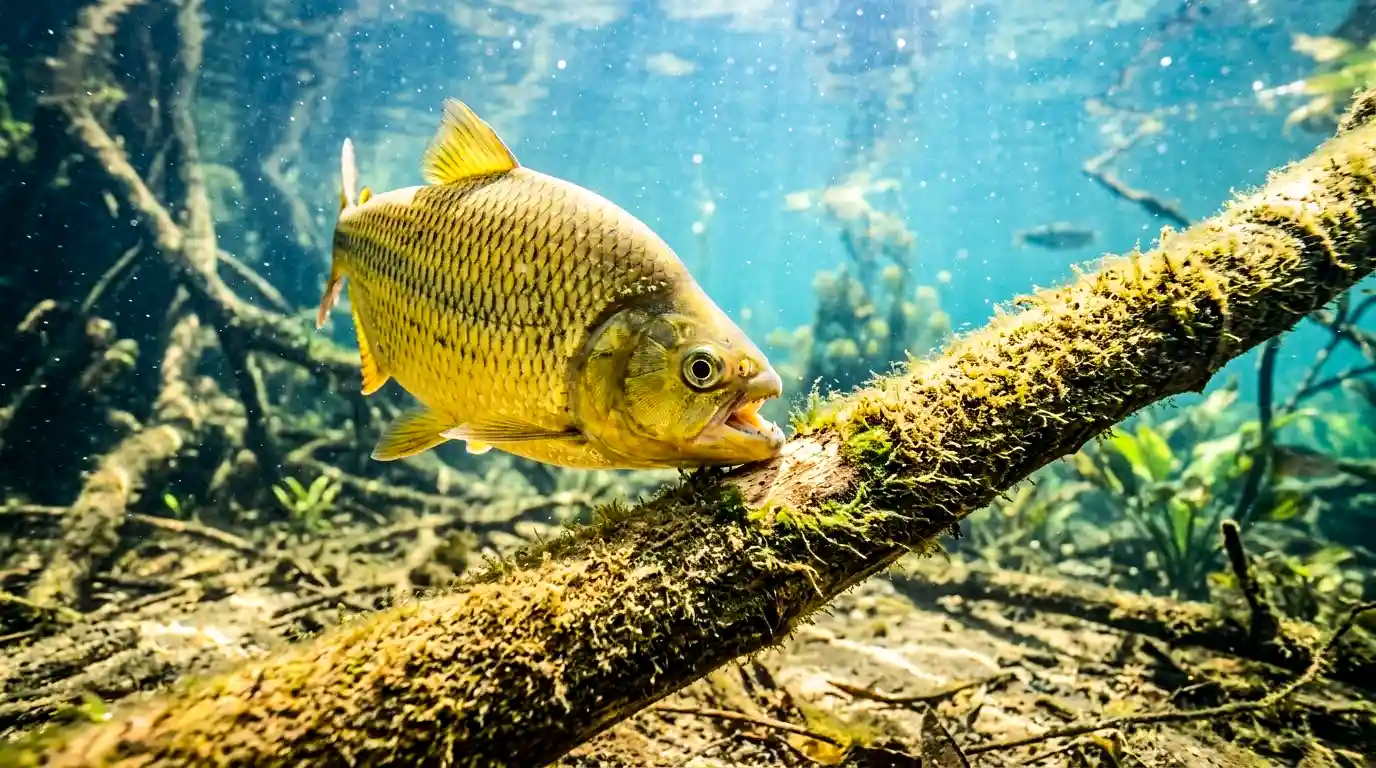
A single school of filter-feeding fish can process the equivalent of truckloads of organic debris in just one low-water cycle across the Amazon basin. The figure, confirmed by ecologists monitoring the Rio Negro basin, points to an underwater cleaning crew that never clocks out. These fish are what keep the waters of the world’s largest rainforest from turning into pools of rotting matter. At the center of this natural logistics operation is the pacu-bosta, a detritivorous pacu that, despite its odd and often dismissed popular name, carries the job of keeping the chemistry of giant rivers such as the Tapajós and the Xingu in balance.
The biological engineering behind heavy-duty cleaning
These animals are not merely river residents: they are river keepers. Evolution shaped their anatomy for recycling nutrients. Unlike large predators such as the peacock bass (Cichla spp.) or the piraíba catfish (Brachyplatystoma filamentosum), the pacu-bosta and its detritivorous relatives have mouths positioned for scraping and filtering. Their teeth, which in some species bear an unsettling resemblance to human dentition, are not built to kill prey but to strip away layers of algae and microorganisms crusted onto rocks and fallen logs.
That biological layer, technically known as periphyton, is a mix of algae, bacteria and fungi. Left unchecked, periphyton would trigger eutrophication. In plain terms, the excess organic matter would consume all the oxygen in the water, suffocating larger fish and turning clear rivers into dead zones. By working as filters, these fish turn what would be pollution into biomass, feeding the entire food chain and keeping the Amazon ecosystem’s energy flow healthy.
A vital role in aquatic biodiversity
The health of the rivers depends intimately on this underwater grazing. During the flood months, when the flood pulse connects the main channel to the igapó (seasonally flooded forest), these workers of nature widen their range. They move into the flooded forest and provide a double environmental service: besides clearing excess fungus from submerged roots and trunks, they become the region’s main seed dispersers.
What the pacu-bosta eats in the forest travels through its digestive tract and is deposited miles (kilometers) downstream, often in areas not yet colonized by certain plant species. This process helps reforest riverbanks naturally and continuously, keeping the riparian forest dense and resilient. It is a flawless piece of biological engineering that links the muddy river bottom to the crowns of the tallest trees. Without these filter feeders, the flooded forest’s cycle of renewal would be severely compromised, even affecting the supply of fruit for land animals.
Silent threats and the risk of pollution
Today, the biggest challenge to these animals’ survival is not commercial fishing pressure. Because they are bony and fetch a relatively low market price compared with the tambaqui (Colossoma macropomum) or the pirarucu (Arapaima gigas), they are rarely the main target of nets. Yet their place at the base of the food chain makes them extremely vulnerable to chemical changes in the water, especially mercury from illegal gold mining and pesticides used in monocultures along the edges of the biome.
Because they feed directly on sediment and algae at the river bottom, they are the first to suffer the bioaccumulation of heavy metals. When the population of these filter feeders drops along a stretch of river, the signs of degradation appear fast: the water loses its characteristic transparency, the smell of organic decay becomes noticeable, and the supply of prized fish for riverside communities collapses. Protecting the pacu-bosta ultimately means protecting the water that reaches local communities and the food security of millions of people.
Resilient waters and a duty to protect
Valuing traditional riverside knowledge alongside scientific authority points to the need for river sanctuaries where these filtering processes can happen without human interference. Sustainable management should focus not only on what we take from the river but on preserving the species that “maintain” the river itself. In a global market debating carbon credits and the bioeconomy, the service this fish provides is one of the most valuable, and still free, assets the planet’s largest river basin holds.
Respecting hydrological cycles and the lives of these animals means keeping rivers as arteries of life rather than channels for waste. Science is now racing to map how global warming and the extreme droughts of recent years affect these fish’s metabolism. As water grows warmer, organic decay speeds up, demanding even more from our natural filters. The pacu-bosta, with its tireless cleaning work, reminds us that in nature there is no waste, only transformation.
Reporting: Anne Silva / Amazonia Mag
This article is the English edition of reporting originally published by Revista Amazônia. Images: Revista Amazônia archive.

Editor · Amazonia Mag
Anne Silva is the editor of Amazonia Mag, the English-language edition of Revista Amazônia. She curates, translates and adapts the outlet's science and environment coverage for an international audience, reporting on Amazon wildlife, flora, rivers, climate and research. Every story she edits is grounded in peer-reviewed studies, official data and on-the-ground reporting from the Revista Amazônia newsroom in Belém, Pará, Brazil. More by Anne Silva →