
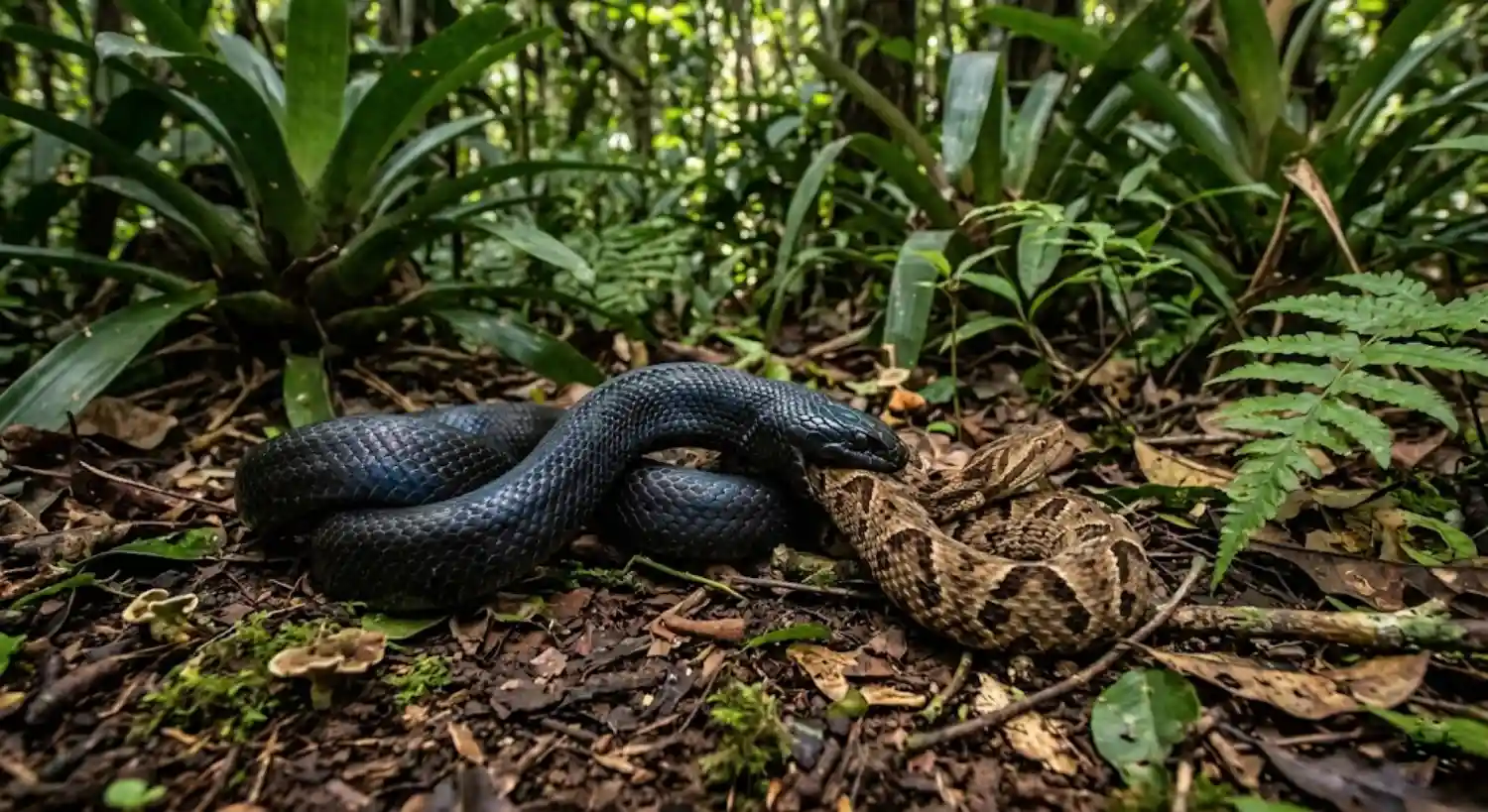
The mussurana carries one of the most remarkable adaptations found in Brazilian wildlife. While many mammals and reptiles can die within minutes after exposure to the powerful mix of proteolytic toxins produced by a jararaca, this snake with sleek, black scales can confront a venomous snake and remain unharmed.
Its blood contains a biochemical secret that challenges the usual rules of survival in the forest. The Clelia clelia developed natural antibodies that can completely neutralize venom, according to the biological description of the species. This is not presented as partial resistance or luck, but as absolute, hereditary immunity.
For science, the ability opens a broad field of research into antivenoms and biological evolution. For ecosystems and rural communities, it makes the mussurana a silent ally that helps control some of the most dangerous snakes in Brazil.
A hunter specialized in other snakes
The mussurana is ophiophagous, meaning that its diet consists almost exclusively of other snakes. Its hunting strategy often unfolds beneath the leaf litter, quietly, and combines powerful constriction with firm bites.
Unlike snakes that rely mainly on venom to bring down prey, the mussurana uses strength, precision and persistence. When it encounters a jararaca or a rattlesnake, the attack is fast. It bites the prey’s head or neck and ignores attempts to strike back.
Even if the venomous snake manages to inject venom into it, neutralizing proteins in the mussurana’s plasma prevent tissue destruction or systemic failure. It is one of nature’s most unusual reversals: one snake turns another snake, also dangerous, into its prey.
The species has opisthoglyphous teeth, positioned toward the back of the mouth. Its main defense against toxins, however, is not its teeth but the immunity in its blood, a trait that gives it an extraordinary advantage when it confronts venomous animals.
A body built to swallow snakes
The mussurana’s anatomy is adapted to ingest prey that can often be about as long as the predator itself. The animal can grow beyond 2 meters, or more than 6.6 feet, and has a muscular body suited to constriction.
Its highly flexible jaws allow it to swallow venomous snakes whole. Digestion begins after a capture that requires strength and control, then proceeds slowly but extremely efficiently. The prey does not need to be torn apart for the mussurana’s metabolism to use it.
During digestion, the metabolic system processes not only the captured animal’s flesh but also its venom glands. This ability makes the mussurana a biological processing machine, adapted to specialized niches where a highly dangerous animal can also become a source of food.
The scene represents a complete reversal of the relationship between hunter and hunted. A jararaca or rattlesnake carries venom to defend itself and capture other animals, but that advantage becomes far less effective against the mussurana. The predator can bite, constrict, swallow and digest its venomous rival.
A wide range across the Americas
The mussurana has a broad geographic distribution. The species occurs from Mexico to Argentina, with a particularly strong presence throughout the Amazon Basin and the Atlantic Forest, two Brazilian regions known for extraordinary biological diversity.
In Brazil, river communities and farmers have historically respected the snake. People familiar with its appearance can identify the bluish sheen of its black scales when it is young and the deep dark color it develops as an adult.
Having a mussurana nearby can be like having a natural guard. Where it lives, the incidence of snakebite accidents involving people tends to decrease sharply because the snake helps keep populations of species in the genus Bothrops under strict control.
That control can prevent those snakes from approaching homes in search of rodents. The mussurana’s role therefore extends beyond the forest food web. It is also connected to the safety of people who live or work in rural and forested areas.
Prejudice, habitat loss and ecological risk
Despite its importance, the mussurana suffers from the widespread prejudice directed at almost all snakes. Because of a lack of knowledge, many people kill it when they find one on a trail or in a yard, unaware that they are removing one of the region’s main agents for controlling venomous animals.
Habitat loss also harms the species. Indiscriminate pesticide use reduces the availability of its natural prey and pushes mussuranas into increasingly fragmented areas, where the environment loses continuity and relationships between predators and prey become more fragile.
Science considers protection of Clelia clelia a direct indicator of ecosystem health. Its presence near the top of the reptile food chain signals that the environment’s trophic structure remains preserved and functional.
An ally for health and biotechnology
Protecting the mussurana goes beyond romantic conservation. It is also a public health issue, especially in places where antivenom is difficult for local populations to access.
According to the research described for the species, mussurana serum neutralizes the hemotoxins of jararacas. That property makes the snake essential to biological control in rural areas and strengthens scientific interest in understanding how its body confronts venom capable of destroying tissue and causing systemic failure.
Understanding how the mussurana eats a venomous snake and remains unharmed could open paths for pharmaceutical biotechnology and the development of new treatments for humans. Every individual protected in the forest is a living laboratory holding answers about cellular resistance and extreme adaptation.
Valuing Brazilian wildlife means recognizing that even animals that inspire fear can be decisive allies in maintaining life and safety. Preserving the mussurana is not only about saving a species. It is also about allowing the forest’s invisible balance to continue working quietly for rural communities and biodiversity.
Reporting: Anne Silva / Amazonia Mag

Editor, English Edition — Amazonia Mag
Anne Silva is the editor of Amazonia Mag, the English-language edition of Revista Amazônia. She curates, translates and adapts the outlet's science and environment coverage for an international audience, reporting on Amazon wildlife, flora, rivers, climate and research. Every story she edits is grounded in peer-reviewed studies, official data and on-the-ground reporting from the Revista Amazônia newsroom in Belém, Pará, Brazil. More by Anne Silva →