
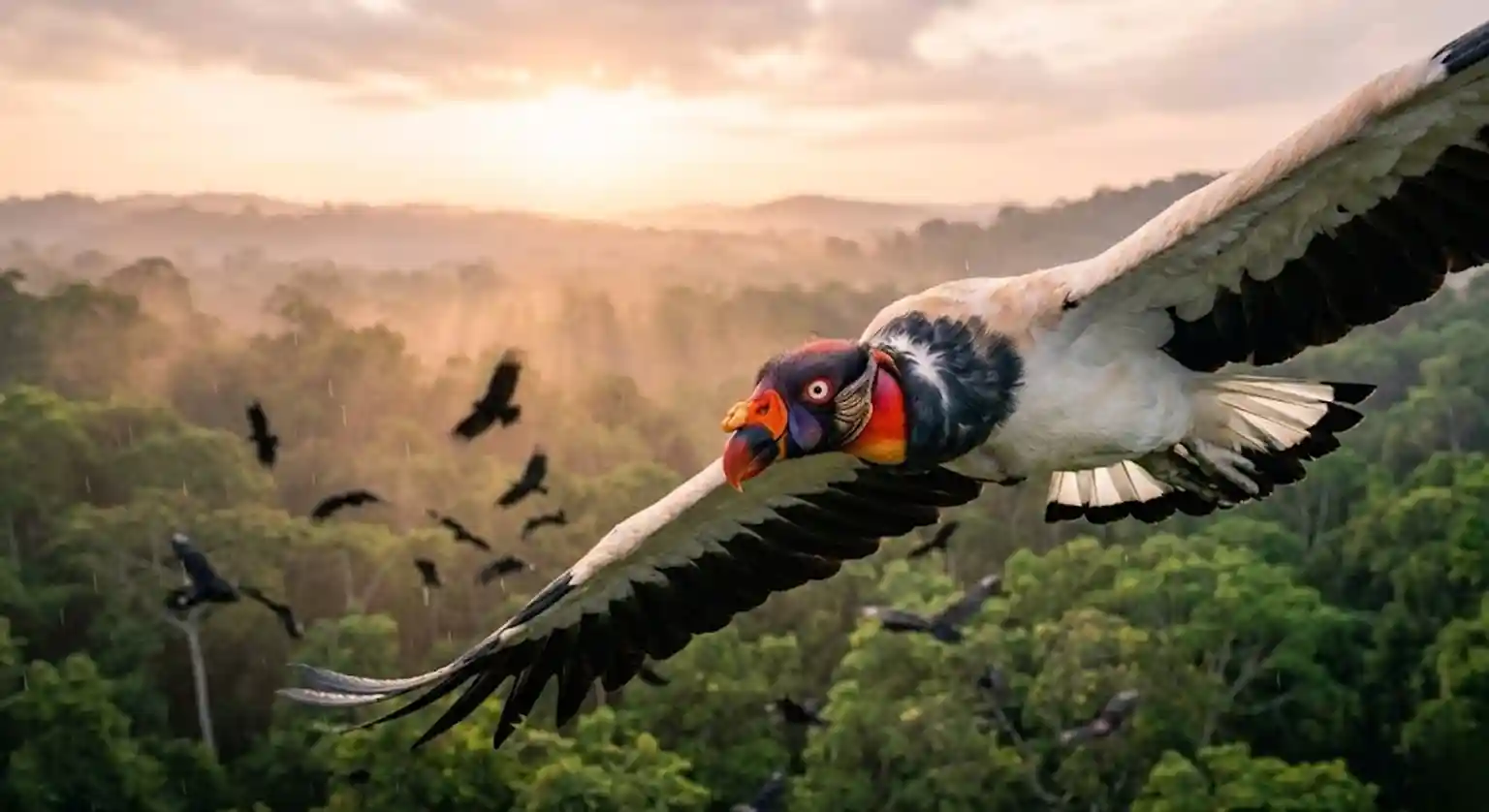
In a forest clearing, the arrival of a single king vulture can change the behavior of dozens of black vultures. Its physical presence and the display of its facial colors are enough to push the smaller birds back and establish who will begin feeding. This is not an exercise in tyranny. It is a form of organization that makes the Amazon’s biological cleanup service more efficient.
Where death has appeared, the arrival of this large scavenger sets the pace of the feeding event. By organizing access to a carcass, the king vulture helps decomposition follow its natural course and reduces the time that remains are exposed on the forest floor. Without its intervention, the use of large carcasses would be more chaotic, increasing the time that pathogens could remain in the forest soil.
Specialists at the National Institute of Amazonian Research, INPA, observe that the species acts as a biological master key. Its superior jaw strength allows it to open tough hides that other birds cannot break. In this way, the bird not only obtains food for itself, but also makes the inner parts of the carcass accessible to the other scavengers.
A colorful face that communicates authority
The king vulture’s behavior is guided by visual signaling that removes the need for exhausting physical fights. Its featherless head displays a complex palette of orange, yellow and red. These colors act as an indicator of health and aggression, while also communicating the individual’s social position among the smaller scavengers.
The more saturated and vivid the colors, the higher the bird’s status appears to be within the group. This coloration is not only genetic. It also reflects a carotenoid-rich diet and an absence of parasites, signaling a leader in strong condition.
The signal can change during an interaction. When the king vulture lowers its head as a sign of attack or raises it to observe, the intensity of its colors changes because of blood flow. This allows the bird to communicate its immediate intentions without having to begin a fight.
The other birds respond to that signal instantly. They retreat to a safe distance and wait until the sovereign has finished its share of the meal. The Amazon Institute of People and the Environment, Imazon, highlights that this social organization prevents serious injuries among the birds and optimizes feeding time in open areas.
The specialist that opens the toughest remains
Vultures serve as nature’s sanitation workers, but the king vulture is the team’s specialized operator. Many large mammal carcasses have skin that is too thick for the bills of smaller species, such as the black vulture. In these cases, the larger bird makes the first cuts with its massive, curved beak.
That action opens the way for the entire chain of decomposers. Without this opening function, many carcasses would rot slowly from the inside and become breeding grounds for dangerous anaerobic bacteria. The cooperation is involuntary, but the result benefits the different birds that arrive afterward.
This behavior helps keep the forest free of anthrax hotspots and other diseases that could wipe out mammal populations. Research indicates that where the king vulture is absent, the rate at which infections spread among wild animals rises sharply because decomposition is less efficient.
The process is highly efficient. A medium-sized carcass can be reduced to bones in just a few hours under the visual coordination of this bird of prey. Its telescopic vision and keen sense of smell allow it to locate death even beneath the dense canopy, indirectly guiding the other scavengers to the food.
Extinction and the risk to forest health
The extinction of the king vulture would mean more than the loss of an exotic beauty. It could also lead to the collapse of part of the forest’s public health system. Data published by Nature on vulture population declines on other continents provide a severe warning for Brazil’s reality.
In India, the decline of scavenging birds caused an explosion in feral dogs and rats. As a result, human rabies cases reached alarming levels. In the Amazon, the scenario could be similar, with the accumulation of dead biomass contaminating groundwater and waterways that are essential to local communities.
The Brazilian Institute of Environment and Renewable Natural Resources, IBAMA, monitors the impact of pesticides and diclofenac in cattle carcasses. These substances are lethal to vultures. Because they occupy the top of the cleanup chain, the bioaccumulation of toxins affects king vultures disproportionately and lowers their birth rate.
The loss of the species would also force smaller vultures into more violent disputes. Those conflicts would reduce the overall efficiency of biological waste processing and leave more remains exposed in the ecosystem.
Protecting the great scavenger
Protecting the king vulture requires the preservation of large, untouched territories. The birds need extensive home ranges to find food and, unlike their smaller relatives, avoid densely urban areas. For that reason, their presence serves as an indicator of the environmental quality of primary forests.
Conservation projects that educate rural producers about the disposal of cattle carcasses are essential for preventing accidental poisoning. The Oswaldo Cruz Foundation, Fiocruz, warns that maintaining natural epidemiological sentinels, such as vultures, is the least expensive way to prevent pandemics.
By monitoring where these birds feed, scientists can detect disease outbreaks in wild animals before they reach humans. The king vulture’s behavior, therefore, is more than a forest curiosity. Its colors, hierarchy and role as a carcass opener are part of a security and sanitation system that protects the entire forest.
Respecting the king vulture’s hierarchy means recognizing that nature has its own safety and hygiene protocols, established over millennia. The bird’s sovereignty allows life to continue flourishing over the remains of what has passed, keeping the forest vibrant and safe. The beauty of its colors in the face of death is the visible sign that the cycle is working.
Reporting: Anne Silva / Amazonia Mag

Editor, English Edition — Amazonia Mag
Anne Silva is the editor of Amazonia Mag, the English-language edition of Revista Amazônia. She curates, translates and adapts the outlet's science and environment coverage for an international audience, reporting on Amazon wildlife, flora, rivers, climate and research. Every story she edits is grounded in peer-reviewed studies, official data and on-the-ground reporting from the Revista Amazônia newsroom in Belém, Pará, Brazil. More by Anne Silva →