
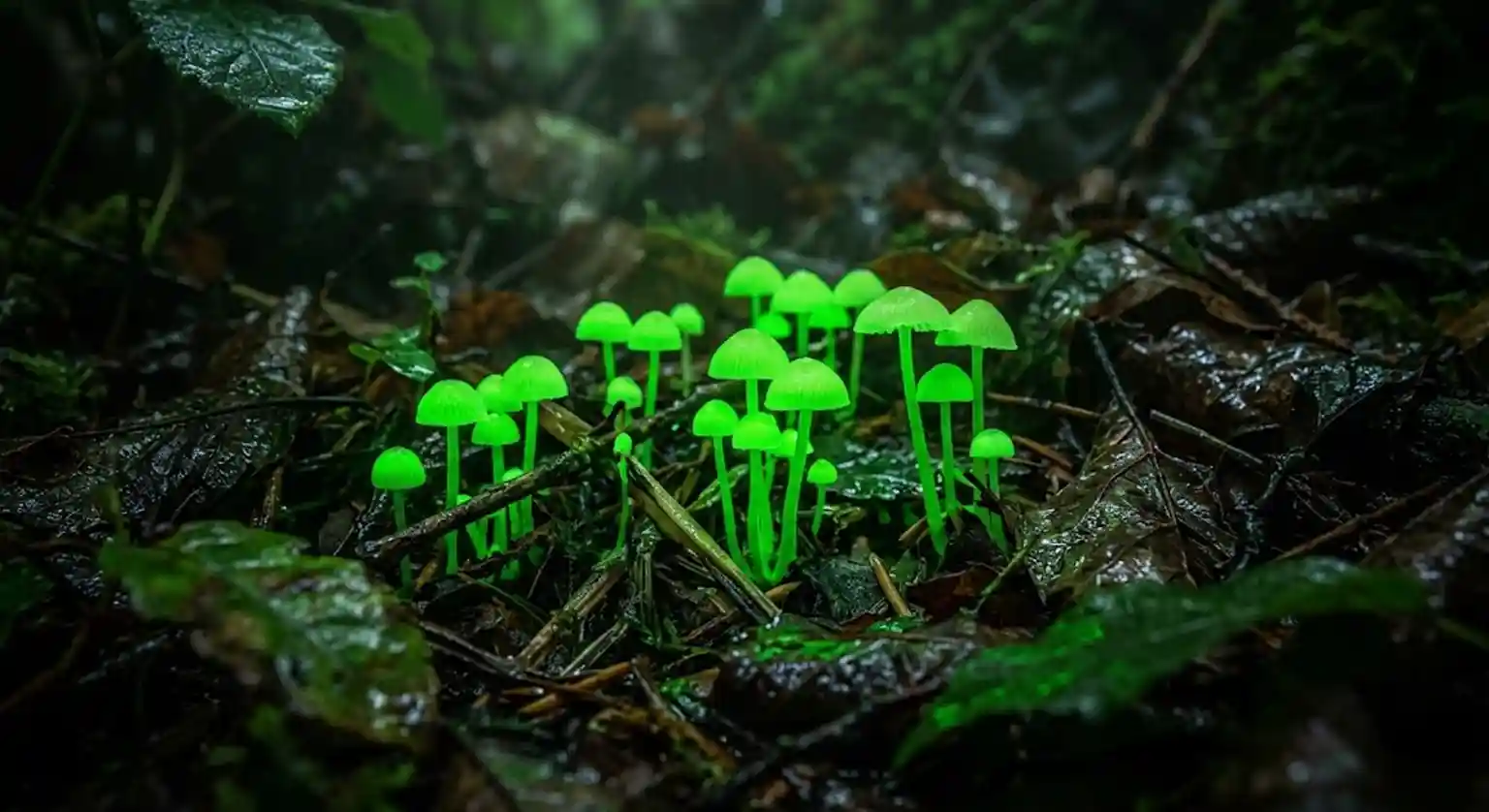
Only 100 of the more than 150,000 fungal species known around the world can produce their own light, and the Amazon is home to some of the most mysterious examples. Deep in the forests of Pará and Amazonas, bioluminescence turns the ground into a biological star map on nights of high humidity.
Unlike fireflies, these organisms maintain a steady greenish glow. The result is a visual spectacle that still challenges a complete understanding of modern biology. Science has not yet solved the exact reason this trait evolved, but laboratories around the world are showing rapidly growing interest in the Amazonian bioluminescent fungus.
The cold chemistry behind the glow
The glow of the mushroom that lights up the forest does not come from heat. It comes from a cold chemical reaction between a molecule called luciferin and an enzyme called luciferase. When it reacts with oxygen, luciferin releases visible-light photons, generally at wavelengths ranging from green to blue-green.
Although this process is common in marine animals, it has a structural complexity in terrestrial fungi that continues to puzzle geneticists worldwide. Studies published in Nature suggest that the metabolic pathway in these fungi is circular, allowing luciferin to be recycled continuously.
This energy efficiency makes luminous fungi from Pará ideal models for developing self-sufficient lighting systems in smart cities. Unlike LED bulbs, biological light does not use electricity and does not create toxic waste at the end of its useful life, because it naturally breaks down in the soil.
The light emitted by these organisms is strong enough to be captured by highly sensitive cameras from distances of dozens of feet (tens of meters) inside dense forest. That reach helps explain how the fungi can appear as tiny points of light in an environment where darkness otherwise dominates.
Attracting carriers or warning predators?
The central question remains open: why spend precious energy glowing in an environment where silence and concealment are often the best survival tactics? The most widely accepted hypothesis among mycologists is that the light attracts spore dispersers, such as nocturnal insects that mistake the glow for other biological signals.
When they land on the mushroom, those insects carry spores to other parts of the forest. In this way, they help guarantee the species’ reproduction in places where there is little wind. Under this hypothesis, the glow acts as a signal that expands the chances of dispersal.
Some researchers at Imazon, however, raise the possibility that the light acts as a warning of toxicity to terrestrial predators. In that scenario, the glow would be a form of aposematism, indicating that the fungus contains chemical substances that are dangerous if eaten by small mammals.
There is also a theory involving protection against oxidative stress. Under this explanation, the light would simply be a byproduct of neutralizing free radicals that are harmful to the organism. This possibility could explain why the mycelium, the structures that function like the fungus’ “roots,” also glows beneath the bark of fallen trees, where attracting insects would be less effective.
The fact that science still has no final verdict on the Amazonian bioluminescent fungus reinforces the urgent need to catalog these organisms before deforestation drives them to extinction. Each hypothesis illuminates part of the mystery, but none fully explains the function of the glow.
From the forest floor to the laboratory
The glow that fascinates river communities and researchers carries a genetic code worth billions of dollars to the advanced biotechnology industry. Scientists have already transferred fungal bioluminescence genes into terrestrial plants, creating the first “plants that glow in the dark” in history.
Those plants could replace streetlights on secondary roads or serve as biosensors. In that role, they would glow more intensely when they detected pollutants in the soil. The possibility of using visible signals produced by living organisms places luminous fungi at the center of a technological search for new forms of sustainable lighting and environmental monitoring.
In medicine, fungal luciferase is used as a marker in imaging diagnoses. It makes it possible to track cancer cells in real time inside living organisms. Fiocruz reports indicate that the use of natural biological markers reduces the need for aggressive chemical contrast agents in high-precision examinations.
The Amazon is the largest living laboratory for these applications, but access to its genetic heritage must follow strict rules to prevent international biopiracy. Valuing the traditional knowledge of local communities is also essential for locating these species, which often live in areas that are geographically difficult to reach.
INPA and the race to document the glow
Institutions such as Brazil’s National Institute of Amazonian Research, known as INPA, lead searches for new species in remote areas where artificial light has never arrived. In those places, darkness makes it possible to observe the phenomenon without interference and to find organisms that might otherwise go unnoticed.
Protecting these fungi is not only an aesthetic or ecological matter. It is also a technological race toward the next major innovation in sustainable lighting and medical sensors. Because the exact workings of fungal bioluminescence remain unclear, every species may carry scientific potential, particularly before it disappears without being studied.
When climate change dims the forest
Bioluminescence depends directly on ecosystem health and on specific microclimates marked by high humidity and stable temperatures. Prolonged droughts and rising global temperatures are drying the forest litter, the primary habitat of luminous fungi from Pará.
Without adequate moisture, the chemical reaction involving luciferase stops. The reproductive cycle of these fungi is also damaged, in ways that can be irreversible for the species. Losing these organisms would signal a silent collapse at the base of the decomposer food chain and affect nutrient recycling across the entire forest.
Monitoring these populations serves as a biological thermometer for the forest’s resilience as agricultural frontiers and mining advance. Federal institutions under IBAMA’s command face the challenge of protecting microscopic habitats that cannot be seen by satellite.
Preserving the fungi’s light means ensuring that the Amazon can continue revealing secrets humanity has not yet had the time or technology to read. Every mushroom extinguished by a wildfire represents decades of scientific research and medical possibilities lost forever in the ashes of Amazonian soil.
The forest’s light depends on our ability to keep its shadows intact.
Reporting: Anne Silva / Amazonia Mag

Editor, English Edition — Amazonia Mag
Anne Silva is the editor of Amazonia Mag, the English-language edition of Revista Amazônia. She curates, translates and adapts the outlet's science and environment coverage for an international audience, reporting on Amazon wildlife, flora, rivers, climate and research. Every story she edits is grounded in peer-reviewed studies, official data and on-the-ground reporting from the Revista Amazônia newsroom in Belém, Pará, Brazil. More by Anne Silva →