
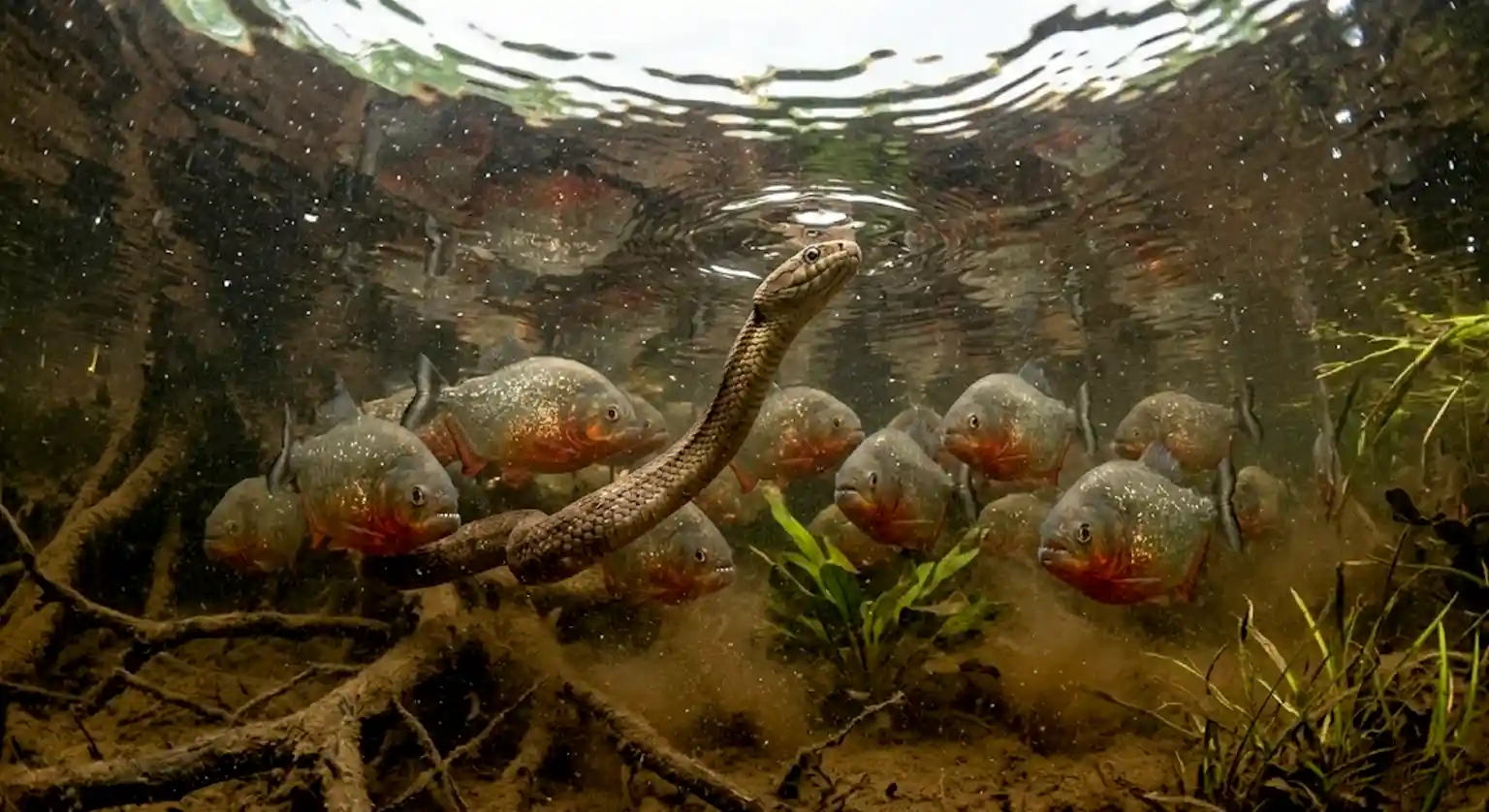
In Amazonian rivers, snakes in the genus Helicops appear to challenge one of the best-known rules of predation. For every ten piranha strikes against injured fish, these reptiles record zero fatal attacks under normal conditions of coexistence. That practical immunity places the Amazon water snake among the region’s most specialized evolutionary survivors, even though its adaptations remain poorly understood by the general public.
Bathers and river communities often mistake the animal for a young anaconda. Researchers, however, focus on a very different ability: the snake’s tactical skill in moving through waters filled with some of the sharpest teeth in Brazil’s freshwater basin. Unlike other predators that avoid areas with high piranha density, aquatic snakes in the genus Helicops use those same habitats to hunt efficiently.
According to researchers at Brazil’s National Institute of Amazonian Research, INPA, these animals help maintain population balance in ecosystems under extreme predation pressure. Their coexistence with piranhas is not a geographical accident. It is the result of millions of years of behavioral and chemical adjustments that protect the snake from being torn apart within seconds.
The secret of living alongside piranhas
The relationship between Helicops and piranhas is a biological equation that took time to explain. Piranhas detect vibrations and blood in the water with great precision, reacting almost instantly to signs of weakness or erratic movement. For a small fish or crustacean, a sudden change in direction can trigger a deadly pursuit.
The water snake, by contrast, has developed a hydrodynamic swimming style that minimizes turbulence. Its movement reduces the chance of activating the sensory systems associated with the piranhas’ lateral jaws. The adaptation is not simply a matter of speed. It is also about moving quietly through a space where a sign of weakness can attract an entire school.
Studies further suggest that the chemical composition of the snakes’ skin releases substances that do not trigger the frantic appetite of schools in the family Serrasalmidae. This chemical neutrality acts like a biological cloak of invisibility among some of the most voracious predators in both whitewater and blackwater rivers.
When the snake encounters a school, it does not necessarily flee. By avoiding an escape response, it does not activate the pursuit trigger commonly seen with smaller fish and crustaceans. Specialists at Imazon emphasize that preserving these species is essential for controlling populations of small fish that form the snake’s basic diet.
If the water snake disappeared, the resulting imbalance in local food webs could cause prey populations to explode and alter the entire dynamic of the igapós, seasonally flooded forests. The relationship with piranhas is therefore more than a curious survival story. It is part of how Amazonian floodplain environments function.
A dangerous mix-up with a young anaconda
The stigma of being a miniature anaconda costs thousands of aquatic snakes their lives every year at the hands of local communities. The green anaconda, Eunectes murinus, has a pattern of dark ocelli on an olive-green background. Helicops, meanwhile, has dorsal markings that can fool an untrained eye in muddy water.
The distinction is clear to a herpetologist. The water snake has eyes and nostrils positioned upward, a defining adaptation for a strictly aquatic life. This placement allows the animal to remain almost completely submerged, exposing only what is needed to monitor its surroundings and breathe without becoming an obvious target.
The anaconda is a large constrictor. Helicops uses opisthoglyphous teeth, located toward the back of the mouth, to immobilize fish and amphibians quickly. Its venom is effective against prey but does not pose a lethal risk to humans. The bite is nevertheless forceful and serves as a final line of defense against attackers.
The systematic destruction of these animals because of unfounded fear harms efforts to monitor river health. Aquatic snakes are excellent bioindicators of water purity. Reports from the Oswaldo Cruz Foundation, Fiocruz, indicate that improper handling of aquatic snakes increases incidents, although most cases are not clinically serious.
Social camouflage and sudden bursts of speed
Swimming among fish that could devour it within minutes is not an act of bravery. It is a social camouflage strategy. By blending into the movement of a school, the water snake dilutes its outline and becomes harder for birds of prey and other aerial predators watching the surface to identify.
Evolution has also given these reptiles powerful lateral muscles. They can use that musculature for explosive bursts that would leave a piranha behind in a short-distance contest. Unlike land snakes attempting to swim, Helicops has a slightly compressed tail that works as a rudder and provides superior maneuverability in strong currents.
This agility becomes especially important when river levels fall during the dry season. Competition for space and food then grows more intense among aquatic species. The snake’s scales are also stiffer than those of terrestrial snakes, offering additional physical protection against exploratory bites from young or inexperienced fish.
Data published in the journal Nature reinforce the idea that snake adaptations to environments with extreme predation are among the most promising fields in current evolutionary biology. The Amazon water snake is not merely a survivor. It demonstrates how biological intelligence can overcome the brute force of the region’s most famous jaws.
Why the snake matters to the river
Without these reptiles in river channels, the nutrient cycle between aquatic environments and riverbanks would suffer a drastic interruption. Aquatic snakes transport biomass by feeding in the water and eventually becoming prey for caimans and birds in transition zones.
Monitoring of these populations by IBAMA helps identify areas contaminated by heavy metals, including mercury from illegal mining. Because the snakes occupy the top of the food chain among small aquatic vertebrates, they accumulate toxins more rapidly and can serve as an early warning of environmental disasters.
The Amazon bioeconomy depends on maintaining these cycles. The health of commercial fish stocks is connected to the presence of natural predators at the base of the food web. Protecting Helicops ultimately means protecting the integrity of the water systems that support millions of people in Brazil’s North region.
Ignorance about the species fuels a cycle of extermination that removes one of nature’s most sophisticated and least understood engineers. Science has already shown that peaceful coexistence between these snakes and piranhas is a rule, not an exception based on luck or biological chance.
Drought, fragmented rivers and the future of Helicops
Climate change presents new challenges for the Amazon water snake, especially as more intense droughts isolate populations in shallow pools. Under this kind of stress, the nonaggression relationship with piranhas may be pushed to its limits by food shortages and a lack of oxygen in the water.
The retreat of flooded forests reduces breeding sites. Females usually give birth to young that are already prepared for aquatic life because they are viviparous. Warmer water also affects the metabolism of these ectothermic animals, requiring more energy for hunting and increasing their vulnerability to larger predators.
Integrated conservation projects need to treat river connectivity as an absolute priority for the survival of this and other aquatic species. The resilience of Helicops is remarkable, but it is not infinite in the face of the accelerating degradation of the critical habitats that make up the Amazon mosaic.
Uncontrolled infrastructure expansion, including dams and dredging, changes sediment flow and threatens the visibility the snake needs for its hunting tactics. Every preserved specimen is a living database of how evolution resolved deadly conflicts between predators in the most complex ecosystem on Earth.
Respect for this animal reflects a society’s maturity in dealing with Brazilian biodiversity without the bias of irrational fear or historical misinformation. The water snake is a silent sentinel beneath the surface, helping preserve the strength of Amazonian rivers. Nature’s intelligence can prevail over brute force.
Reporting: Anne Silva / Amazonia Mag

Editor, English Edition — Amazonia Mag
Anne Silva is the editor of Amazonia Mag, the English-language edition of Revista Amazônia. She curates, translates and adapts the outlet's science and environment coverage for an international audience, reporting on Amazon wildlife, flora, rivers, climate and research. Every story she edits is grounded in peer-reviewed studies, official data and on-the-ground reporting from the Revista Amazônia newsroom in Belém, Pará, Brazil. More by Anne Silva →