
A single Brazil nut tree can live for more than 500 years and reach 164 feet (50 meters) in height. Yet all that grandeur becomes biologically powerless when a small rodent and a specialized bee are not present at the same time. According to scientists observing the species, Bertholletia excelsa has one of the most distinctive and fragile reproductive systems on Earth.
The cycle works like a precision mechanism. If one part disappears, the species’ life cycle is interrupted. Without the long-distance flight of bees in the genus Eulaema, and without the persistence of an agouti’s incisors, the majestic queen of the forest becomes a living museum, a tree that breathes and produces but leaves no descendants for future generations.
A flower sealed behind a rigid cap
The reproductive journey begins with pollination, an event that requires physical strength and a highly specific anatomy. Brazil nut flowers are protected by a rigid hood that conceals the nectar. It functions like a botanical safe, one that accepts only a very particular key.
Only robust, long-tongued bees, including the mandaçaia bee and especially the bees known as orchid bees, can lift the cap and collect the nectar. The floral structure limits access and makes reproduction dependent on a small group of pollinators capable of doing the work.
The relationship does not end with the Brazil nut tree. These bees do not live only on Bertholletia excelsa. They also need native orchids to obtain fragrances used in mating. That creates an invisible link between the tree and the forest’s floral diversity.
For this reason, pollination fundamentally depends on the health of the surrounding forest. When vegetation loses its orchids and its floral diversity, the bees lose essential resources. The tree then loses one of the most important parts of its reproductive system.
Fifteen months until the fruit matures
After successful pollination, the tree takes about 15 months to mature its fruit, the famous ouriço. This woody capsule is extraordinarily tough, forming a barrier that no monkey or bird in the Amazon can break open.
The fruit can weigh up to 4.4 pounds (2 kilograms) and fall from heights greater than 98 feet (30 meters). When it hits the ground, it does so with enough force to pierce roofs. Inside each ouriço, protected by this wooden armor, are between 10 and 25 Brazil nuts.
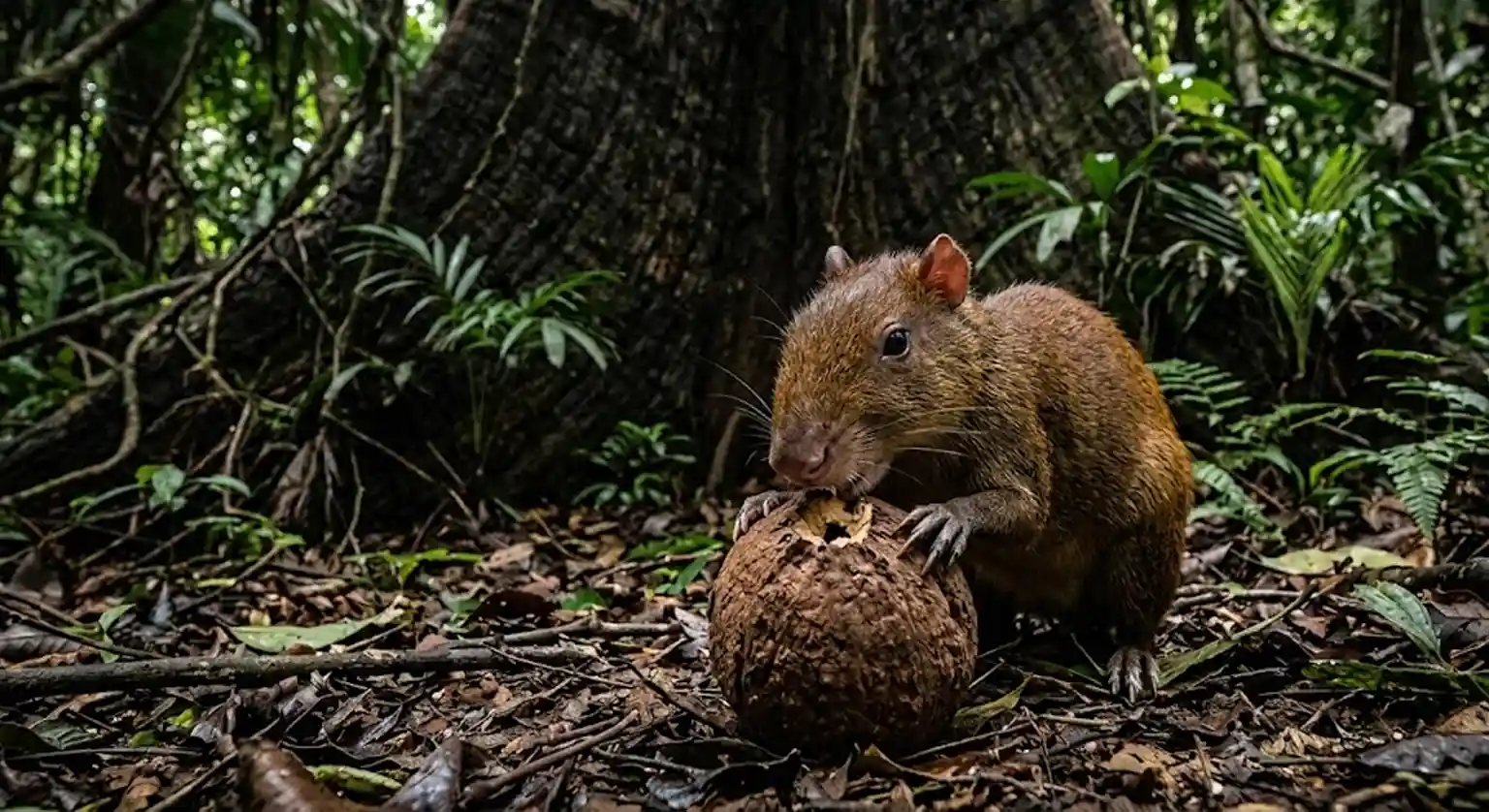
The fruit’s toughness makes it nearly inaccessible to most animals. The exception is the agouti, the only animal with the technique and patience needed to gnaw through the hardened shell. Its contribution begins after the ouriço reaches the ground and continues long after the rodent obtains its food.
The agouti, forest gardener
The agouti’s contribution goes far beyond eating Brazil nuts. These rodents have a habit of burying surplus food for periods of scarcity. In doing so, they act as the Amazon’s true gardeners and carry seeds away from the tree that produced them.
Often, an agouti forgets where it buried a seed. In other cases, a predator captures the rodent. When the nut remains buried in fertile soil, it can germinate and begin a new stage in the species’ life cycle.
The toughness of the ouriço and the agouti’s habit of storing food are connected. The fruit’s extreme protection ensures that only specialized dispersers can reach the nutritious prize inside. The hidden seed may then become a new tree, provided the forest allows it to develop.
The danger of isolated trees
Forest fragmentation creates the greatest challenge for Brazil nut reproduction. Isolated trees lose the ecological cooperation that has sustained the species over time. In pasture areas where scattered Brazil nut trees remain, it is common to see trees loaded with fruit that will never be opened.
In these places, agoutis may have fled into denser forest because of predators or a lack of shelter. The tree keeps its size and its ability to produce fruit, but it loses the animal capable of opening that fruit and dispersing its seeds.
Something similar happens to the bees. Without continuous forest to support native orchids, the bees disappear and the tree stops producing fruit. The loss of one part of the habitat affects the entire system, from flowers to seeds.
The result can be what is known as an empty forest. Adult trees remain standing, but there are no seedlings or young trees around them to replace them in the future. The landscape still appears to contain the species, even though its renewal has already stopped.
An ecological service with economic value
Science shows that managing the relationship among Brazil nut trees, bees and agoutis is a classic example of an ecosystem service. This interaction creates real economic value for traditional communities and for the international market.
Every kilogram of nuts collected by an extractivist is the final result of thousands of hours of pollinator flight and miles traveled by rodents across the forest floor. Protecting the Brazil nut tree without protecting the habitat of agoutis and bees is an incomplete strategy.
According to scientists, that partial approach condemns the species to functional extinction in the medium term. Adult trees could remain alive for years, but no new generation would be able to replace them. Conservation must preserve the connections that make reproduction possible.
Maintaining local biodiversity also allows nutrient cycles and biomass renewal to continue without costs to people. Understanding this three-way dependence changes how Amazon conservation is perceived. Keeping the trunk standing is not enough when the ecosystem around it is collapsing.
The Brazil nut tree teaches that strength does not come from size, but from the quality of the connections established with neighboring life. Every nut that reaches a table carries the story of a bee that found its flower and an agouti that planted a seed in the darkness of the soil.
Valuing this cycle is the first step toward ensuring that the forest canopy remains high and productive for many centuries. Preserving life on Earth is not an act performed by solitary heroes, but a collective dance in which the giant depends on the tiny to keep existing.
The wooden ouriço
The Brazil nut fruit is one of the most resistant structures in the plant kingdom. It can weigh up to 4.4 pounds (2 kilograms) and fall from heights greater than 98 feet (30 meters), striking the ground with enough force to pierce roofs.
Inside each ouriço, protected by that woody armor, are between 10 and 25 Brazil nuts. This extreme protection evolved precisely so that only specialized dispersers, such as the agouti, could reach the nutritious prize inside.
Reporting: Anne Silva / Amazonia Mag

Editor, English Edition — Amazonia Mag
Anne Silva is the editor of Amazonia Mag, the English-language edition of Revista Amazônia. She curates, translates and adapts the outlet's science and environment coverage for an international audience, reporting on Amazon wildlife, flora, rivers, climate and research. Every story she edits is grounded in peer-reviewed studies, official data and on-the-ground reporting from the Revista Amazônia newsroom in Belém, Pará, Brazil. More by Anne Silva →