
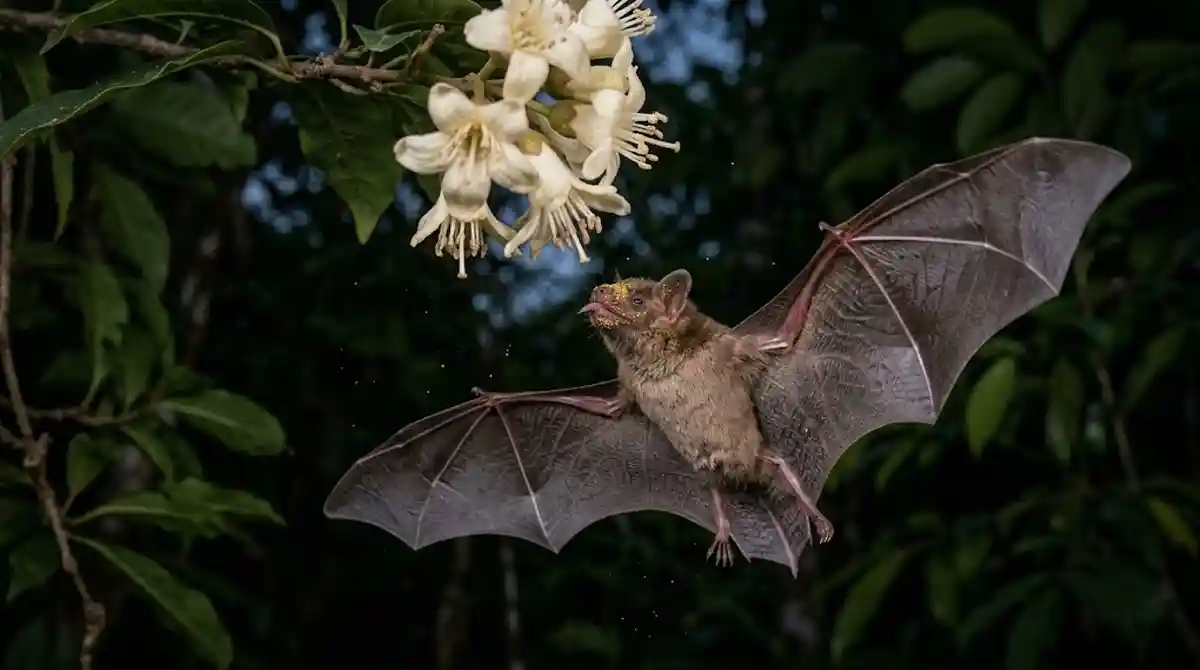
While much of the Amazon sleeps, a quiet force moves through the canopy, forest gaps and dense vegetation. Every night, a single bat colony can spread millions of seeds and pollinate more than 500 different plant species. That service helps regenerate areas that would take humans decades to reforest.
These flying mammals act as silent architects of the planet’s largest tropical rainforest. Their activity is rarely visible to people who observe the forest during daylight, yet its results appear in plant diversity, fruit production and the renewal of vegetation. Without their tireless work, iconic fruits such as cupuaçu and bacuri, as well as majestic trees such as the sumaúma, could simply disappear from the Brazilian landscape.
The popular image of bats, shaped by myths and horror movies, does not represent most Amazonian species. In the region, the great majority of chiropterans have a diet based on fruit, nectar and pollen. As they search for food, these animals perform functions that connect different plants and keep an essential forest process in motion.
Pollinators after sunset
Bats occupy a nighttime ecological niche that bees and birds leave open after sunset. While those daytime pollinators reduce their activity, chiropterans continue moving through the rainforest and visiting flowers that open specifically at night.
Some plant species evolved specifically to be pollinated by bats. Their flowers open their petals after dark and release strong scents that guide the animals through dense vegetation. This technical process, known as chiropterophily, is one of nature’s most fascinating symbiotic relationships.
The mechanism is simple and decisive. When a bat visits a flower to feed on nectar, a large amount of pollen collects in its fur. The animal then flies to another plant, carrying that genetic material to vegetation that may be located miles away.
The ability to fly long distances in a single night expands the reach of pollination. It also promotes genetic variability that is vital to the forest’s resistance to pests and climate change. In this way, the flight of a small mammal can influence the continuity of plants that form part of the rainforest’s structure.
Seeds, food and local economies
The role of chiropterans goes far beyond maintaining wild flora. The local economy and food security of river communities depend directly on this free environmental service. By spreading seeds and supporting plant reproduction, bats help maintain resources on which communities and producers rely.
It is estimated that hundreds of commercially and medicinally valuable plants in Brazil have bats as their main or only pollinators. This shows that protecting these animals is not an issue limited to wildlife. It is also connected to products, crops and uses that reach different parts of the economy.
When a bat population is wiped out through lack of understanding or habitat loss, the cascading impact can extend from a small cacao farmer to large cosmetics industries that use essential oils from the rainforest. The effect begins with fewer animals, but spreads to the plants that depend on their nighttime visits.
Forest fragmentation makes the problem worse by isolating bat populations. Once separated, colonies face greater difficulty maintaining pollination routes. As a result, the reproduction rate of trees that are fundamental to the structure of the rainforest declines.
Protecting shelters to conserve the forest
Science identifies the extermination of these animals as a systemic risk to the integrity of the biome. Chiropteran diversity is connected to processes that operate at many scales, from a single flower visit to the recovery of areas affected by damage caused by human activity.
For that reason, preserving caves and the resting habitat of bats is a conservation strategy as important as directly fighting deforestation. Protecting vegetation that can be seen during the day is not enough. The places that allow these animals to shelter and continue their nighttime routes must also be preserved.
Technology is helping researchers monitor this invisible movement. Ultrasonic recorders and satellite tracking make it possible to follow chiropterans and gather data about their activity. These tools reveal a part of Amazonian dynamics that takes place far from human sight.
The data confirm that the health of an ecosystem can be measured through bat activity. Where there is a diverse bat population, the rainforest is more resilient and better able to recover from anthropogenic damage. Understanding the importance of bat pollination in the Amazon is the first step toward changing public perceptions and ensuring that these guardians continue their vital work.
Tongues built for deep flowers
Many Amazonian bat species have tongues that can reach one and a half times the length of their own bodies. This extreme evolutionary adaptation allows them to reach nectar at the bottom of deep tubular flowers.
In certain rare Amazonian plants, that ability makes bats the only animals capable of carrying out pollination. The shape of the flower and the animal’s anatomy fit together in a relationship developed over a long evolutionary process, in which every nighttime visit may help the plant continue to exist.
The survival of the rainforest we know today was shaped over millennia by the beating wings of these small mammals beneath the moonlight. Giving visibility to these processes is also a way to recognize that conservation depends on creatures that rarely occupy center stage, even though they sustain the forest’s life night after night.
Positive-impact journalism seeks to illuminate precisely these connections. By showing how bats spread seeds, transport pollen and maintain ecological routes, it helps explain that the Amazon does not regenerate by itself in some abstract sense. Its renewal has concrete agents, and many of them fly silently when almost no one is watching.
Reporting: Anne Silva / Amazonia Mag

Editor, English Edition — Amazonia Mag
Anne Silva is the editor of Amazonia Mag, the English-language edition of Revista Amazônia. She curates, translates and adapts the outlet's science and environment coverage for an international audience, reporting on Amazon wildlife, flora, rivers, climate and research. Every story she edits is grounded in peer-reviewed studies, official data and on-the-ground reporting from the Revista Amazônia newsroom in Belém, Pará, Brazil. More by Anne Silva →