
For years, scientists studied evolution through small, isolated experiments. Those studies were useful, but they could not fully show how plants respond when they grow for several generations in real climates that differ sharply from one another.
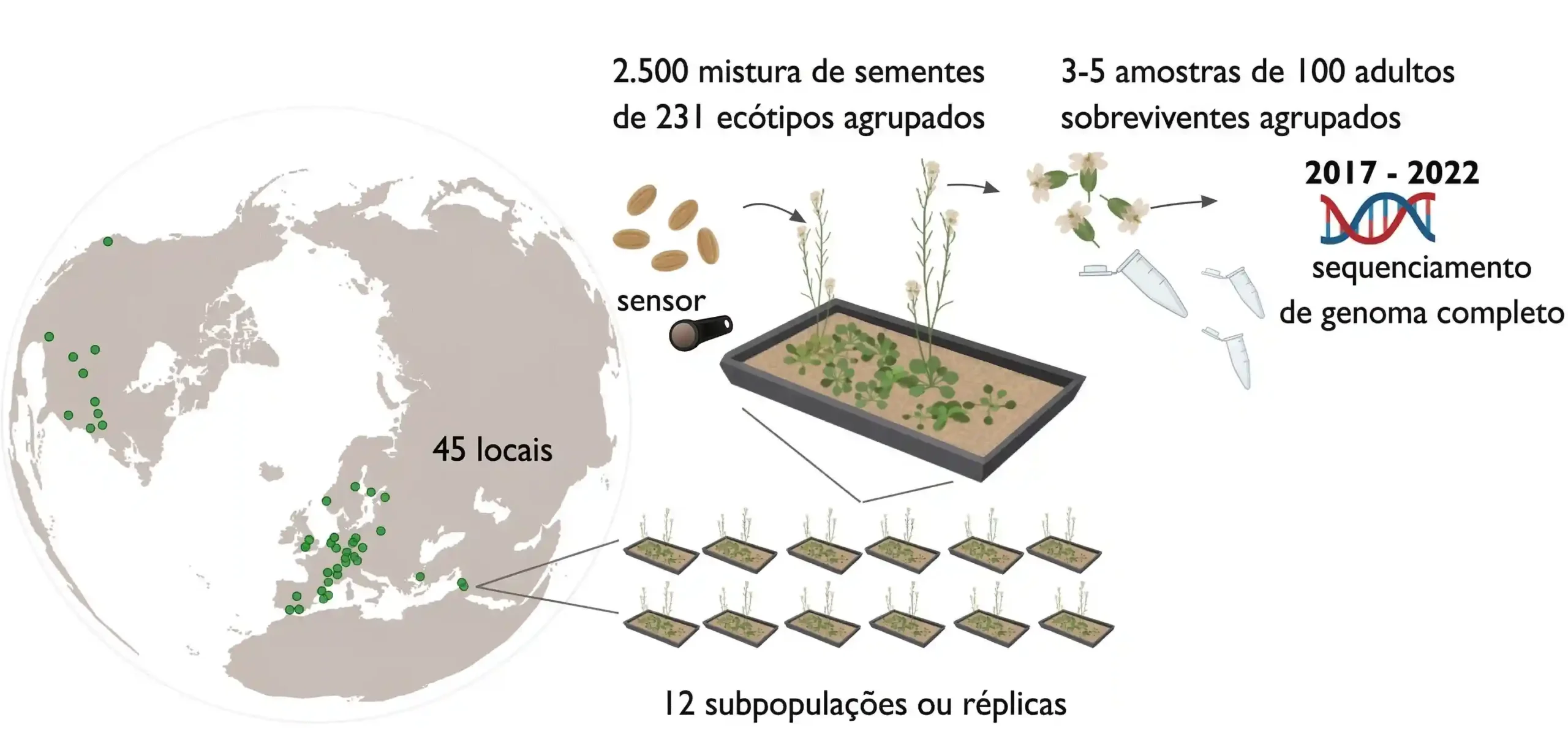
To address that problem, Moisés Expósito-Alonso of the University of California, Berkeley, worked with a large international team. Together, they created the GrENE network and planted Arabidopsis thaliana in 30 regions across Europe, the Middle East and North America.
Each site contained multiple groups of plants growing under natural climate conditions. That setup allowed the researchers to watch evolution unfolding in real time, across environments ranging from alpine to desert conditions. The central message is both encouraging and cautionary: plants can adapt quickly, but not always when climate stress becomes extreme.
A small plant with a wide genetic range
Arabidopsis thaliana is a small plant in the mustard family and a common species in scientific research. It grows quickly and has relatively simple genetics, making it useful for tracking changes across generations.
The species also grows across a broad range of climates. The study includes white-flowered Arabidopsis growing in beach sand near the Baltic Sea, as well as experimental populations established in many other natural settings. That geographic range helped the scientists work with substantial genetic diversity.
The researchers used 231 different natural varieties of Arabidopsis thaliana. They mixed the seeds and planted all of the varieties together, creating a highly diverse population. Genetic diversity matters because it gives plants more opportunities to respond to environmental pressures.
The GrENE-net design began with tubes containing approximately 5,000 mixed seeds. Each experimental tray was sown with three tubes, and seeds were planted every two weeks during the fall of 2017 to ensure establishment.
Each site started 12 trays as independent experimental replicates. A map recorded 43 gardens, or sites, where participants began the experiment. Of those, 30 sites successfully completed at least one generation and produced genomic data.
Evolution changed the populations within years
The study found that the plants changed their genetic composition in only a few years. Scientists tracked those changes by studying the DNA of thousands of plant samples collected in time series during the first three years of the experiment.
"Our main questions were: How fast is evolution? And when will it stop? What we were able to demonstrate is that, if there is enough genetic diversity, that pace can be three, four or five years," Expósito-Alonso said.
The genetic changes were not random everywhere. Many followed clear patterns linked to climate, and plants growing in similar climates showed similar genetic shifts. That repeatability indicates that natural selection played an important role.
The network brought together data from sharply different environments. Two examples were Würzburg, Germany, classified as a humid continental site, and Sde Boker in Israel’s Negev Desert, classified as an arid desert site. Daily temperature curves and precipitation were recorded during the first three years, along with photographs of the experimental populations in Germany and Israel during the spring of the first growing season.
Floral tissue was collected according to a time-series schedule for genomic sequencing during those first three years. The researchers also measured sample density across the calendar year by combining data from all three years.
Extreme heat can change the outcome
The plants adapted well at many sites, but not at all of them. In extremely hot areas, some populations failed to survive. Instead of showing useful and predictable genetic changes, those populations displayed random shifts and eventually disappeared.
"In the hottest environments, perhaps the most representative of future climates under global warming, populations with predictable evolutionary changes survived, while those with chaotic genetic changes went extinct," Expósito-Alonso said.
Populations in harsh climates also often became very small. Smaller populations have less genetic diversity, which makes later adaptation more difficult. The finding matters for species living in protected areas, because even plants conserved in natural parks will continue to face local climate change.
"All of these species that are under protection, for example in natural parks, will still suffer from local climate change, and we will need to develop some kind of strategy to understand their chances of adapting to climate on their own, or perhaps even help them," Expósito-Alonso said.
The experiment further showed that plants from warmer regions performed better at warm sites, while other plants struggled. Some plots were planted in cities, including a group of 12 near apartment buildings in Cologne, Germany.
That pattern reflects local adaptation, meaning that species already possess genetic traits suited to particular environments. However, some plants from warm regions performed better under slightly cooler conditions. This suggests that climate change may be moving faster than the ability of some populations to adapt.
Many genes contribute to survival
During the experiment, the scientists studied millions of genetic changes. They found that some genes became more common because they helped plants survive more effectively under particular conditions.
"What we are probably seeing is adaptation through pre-existing genetic variation that is reused in different ways. If a variant is adaptive in an environment, its frequency increases," said Xing Wu, the study’s lead author.
The researchers also found that many genes worked together rather than one or two genes explaining the entire response. Scientists call this a polygenic response, in which many small changes combine to support survival.
Some important genes were associated with heat stress, flowering time and seed behavior. These traits help plants respond to changes in temperature and seasonal conditions.
The genomic analysis included a principal component analysis of allele frequencies and samples across three generations, with up to 12 replicates per site and 738 samples. The sequenced founding population, shared by all of the experiments, was projected into that analysis space.
The researchers compared sites with low, intermediate and high evolutionary repeatability. At the allele level, they examined the 100 allele frequencies that increased or decreased most rapidly. At the accession level, they displayed all 231 accessions, ranked by temperature of origin from the coldest to the warmest.
Can researchers predict survival?
One of the study’s most important possibilities is the ability to anticipate whether a population will survive. By examining early genetic changes, researchers may estimate which populations are more likely to persist over time.
"With the knowledge we have from our Arabidopsis, we can make educated guesses about who is going to survive at which site," Expósito-Alonso said. Such information could help protect endangered species and guide conservation efforts.
The study assessed evolutionary predictability through leave-one-out cross-validation in 325 populations from 30 gardens. It also related those trends to population size over time, using the total number of individuals sampled during years one through three.
In another analysis, the scientists examined 16,656 linkage disequilibrium blocks. For each allele, they calculated the relationship between frequency change and temperature, highlighting the main gene associations. They also compared allele-frequency trajectories in warm gardens above 50°F (10°C) and cool gardens below 50°F (10°C).
The mean temperature of origin for all founding accessions was 49.3°F (9.6°C). Logistic regressions connected the predictability of evolutionary trends with survival in the first, third and fifth years, using 325, 243 and 139 populations, respectively, with averages calculated by garden.
Despite evidence of rapid evolution across several climates, evolutionary trends were unpredictable in a fraction of the gardens and experimental replicates. In the warmest environments, the repeatability of evolution during the first generations separated persistent experimental populations from those that became extinct.
The result suggests eco-evolutionary tipping points, where extreme selection overwhelms adaptive potential. Rapid climate adaptation is possible through pre-existing genetic variation, but understanding which environmental, genetic or species-specific conditions establish these limits will be essential for predicting biodiversity responses to climate change.
A changing nature beneath a stable surface
In one part of the study, Tatiana Bellagio explained that some populations showed evolution through genetic drift and stochastic changes, but not evolution driven by natural selection or natural climate pressures. Those populations often disappeared after a few years.
"Nature appears stable to human observers, but genotypes are constantly changing. So being able to observe that is, in a way, my dream," Expósito-Alonso said.
The researcher was photographed with the study’s two lead authors, Tatiana Bellagio and Xing Wu, while holding a tray of Arabidopsis seedlings. In other new experiments, Arabidopsis also grew at high density at Gill Tract, at UC Berkeley in Albany.
At Brixen im Thale, a town in the Kitzbühel Alps of western Austria, Arabidopsis thaliana plots were partially covered with snow. It was one of the 30 research sites in Europe, the Middle East and the United States where biologists planted 12 separate plots to study genetic evolution under the influence of climate change.
The genomic evolution analysis also included principal component plots, allele-frequency shifts across generations, within-garden correlations and Manhattan plots of genomic likelihood-ratio tests. The figures displayed the fastest increases and decreases in allele frequencies, accessions ranked by temperature of origin, and population trajectories estimated across years and replicates.
The work was published in the journal Science. Its findings show that evolution can be fast and, in some cases, predictable. They also show that genetic change alone does not guarantee survival when heat and other environmental pressures become too severe.
For wild species, understanding those limits will become increasingly important. Expósito-Alonso plans to study this process in wild plants next, with the goal of observing how genotypes change even when nature appears stable to human eyes.
Reporting: Anne Silva / Amazonia Mag

Editor, English Edition — Amazonia Mag
Anne Silva is the editor of Amazonia Mag, the English-language edition of Revista Amazônia. She curates, translates and adapts the outlet's science and environment coverage for an international audience, reporting on Amazon wildlife, flora, rivers, climate and research. Every story she edits is grounded in peer-reviewed studies, official data and on-the-ground reporting from the Revista Amazônia newsroom in Belém, Pará, Brazil. More by Anne Silva →