
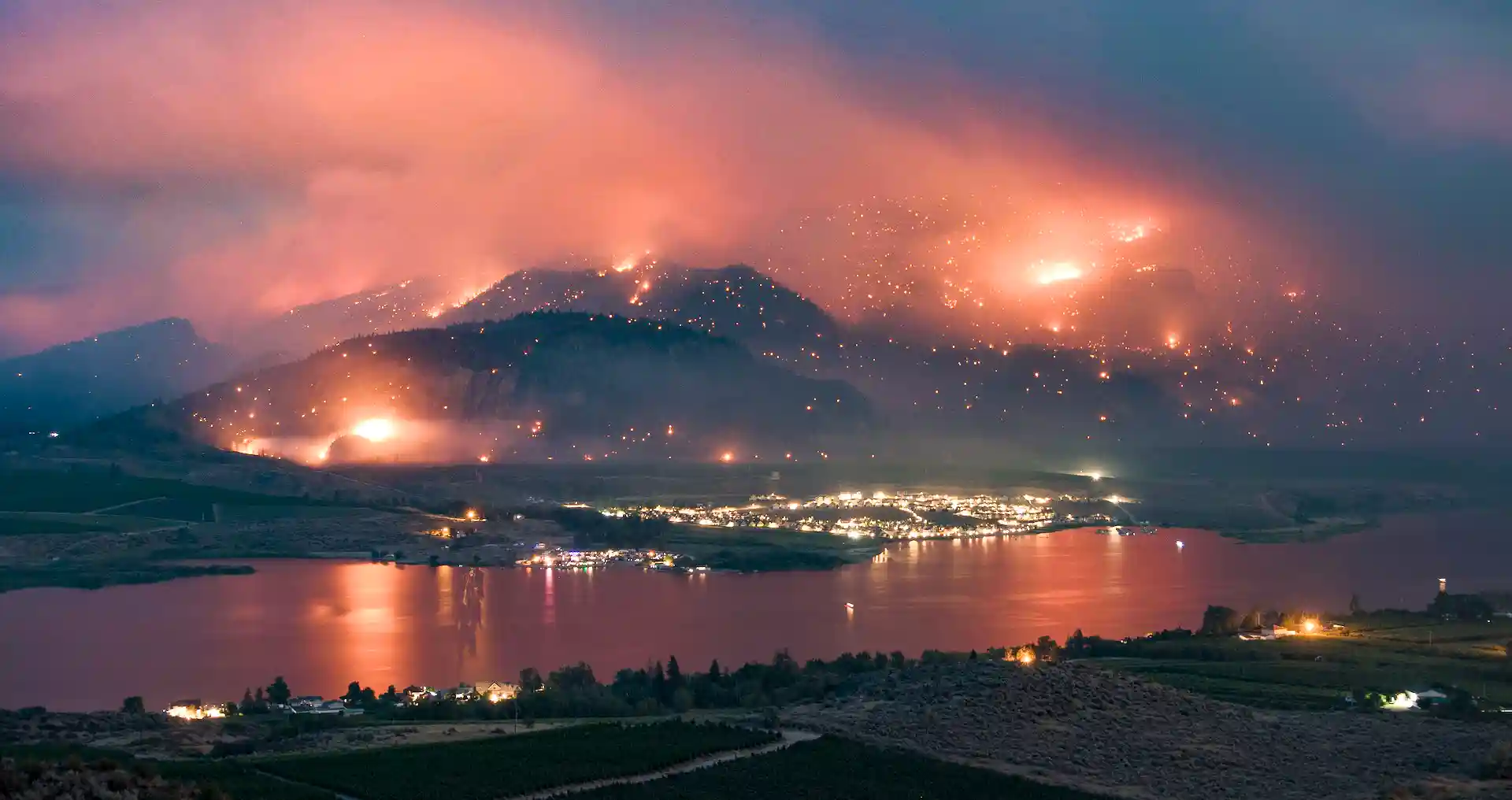
Canada’s drinking water can stay at risk long after wildfires burn out, according to a global review led by UBC (the University of British Columbia). The study found that damage to water quality often shows up months or even years later, rather than only in the immediate aftermath of a fire.
To reach that conclusion, the researchers examined 23 studies carried out across 28 watersheds around the world. They compared levels of sediment, nutrients, metals, organic carbon, ions and the chemicals used to fight wildfires, measuring each one before and after the flames passed through.
The pattern they found was consistent. Across different climates, contamination frequently grew worse over time rather than settling quickly. It intensified most when storms or melting snow washed stored ash and debris off the land and into the rivers, moving pollution that had been sitting in the soil into the waterways that communities rely on.
The findings carry particular weight for Canada, where wildfire activity has surged. In 2023, more than 37 million acres (15 million hectares) burned, more than double the previous national record. The study was published in the journal Science of The Total Environment.
The review focused on research that tracked water quality for at least six months, aiming to reveal whether the impacts fade or build over time. In most cases, the answer pointed toward contamination that lingers well beyond the initial burn.
“The same pattern of delayed contamination kept appearing,” said Raúl de León Rábago, an author of the study and a master’s student in civil engineering.
Cases in Alberta show just how long those effects can last. After the 2016 Fort McMurray wildfire, rivers carried elevated levels of sediment, nitrogen, phosphorus and lead, even in areas where less than a quarter of the watershed had burned.
The toll was financial as well. The Regional Municipality of Wood Buffalo raised its annual spending on chemical treatment by roughly 500,000 dollars to manage the changes to raw water caused by the fires.
In the Rocky Mountains of southern Alberta, phosphorus and nitrogen levels stayed high for years after the 2003 Lost Creek wildfire. Floods in 2013 then swept the accumulated ash and soil back into the rivers.
That surge pushed phosphorus levels seven to nine times higher, and some of those increases persisted for more than 14 years downstream. Similar long-term effects were documented in other countries.
“Imagine dumping a bucket of ash into a bathtub,” said Dr. Qingshi Tu, an assistant professor in the faculty of forestry and environmental management. “When the water is stirred, the ash comes back to the surface. That’s what can happen in watersheds after major fires.”
Smoke and the chemicals used to fight fires push the risk even higher. In the studies reviewed, wildfire activity raised the amount of sediment, nutrients, heavy metals and polycyclic aromatic hydrocarbons, substances that form when vegetation and other materials burn.
Smoke can also carry contaminants into watersheds that were never touched by the flames. In that way, the damage reaches water sources that appeared to have escaped the fire.
Canada leans heavily on long-lasting fire retardants such as Phos-Chek, used in British Columbia and Alberta. These products contain nutrients and trace elements that can feed algae blooms and drive up treatment costs. After the Fort McMurray wildfire, a higher dose of chemicals was needed to treat the fire-affected water.
Protecting communities through long-term monitoring
The researchers note that a water utility’s ability to respond depends on several factors: the intensity, duration and extent of the fire, what burned, the weather conditions and the design of the treatment system.
Not every system can adapt equally well. Smaller communities with limited budgets face greater risk because of the drawn-out impacts that appear after a fire, since the elevated treatment costs and prolonged contamination can stretch far beyond what a modest utility was built to handle.
To address that gap, the team is developing a model that links wildfire behavior, smoke and river systems, with the goal of helping Canadian utilities anticipate risks that can stretch across several years.
The authors argue that fire-prone provinces such as British Columbia and Alberta need coordinated, long-term water monitoring and preparedness planning, especially when fires break out near drinking water sources.
“Canada is entering a new era of wildfire risk,” said Dr. Loretta Li, the lead author and a professor of civil engineering at UBC. “If we want to protect drinking water, we need to treat wildfire impacts as long-term, not short-term.”
Reporting: Anne Silva / Amazonia Mag
This article is the English edition of reporting originally published by Revista Amazônia. Images: Revista Amazônia archive.

Editor · Amazonia Mag
Anne Silva is the editor of Amazonia Mag, the English-language edition of Revista Amazônia. She curates, translates and adapts the outlet's science and environment coverage for an international audience, reporting on Amazon wildlife, flora, rivers, climate and research. Every story she edits is grounded in peer-reviewed studies, official data and on-the-ground reporting from the Revista Amazônia newsroom in Belém, Pará, Brazil. More by Anne Silva →