
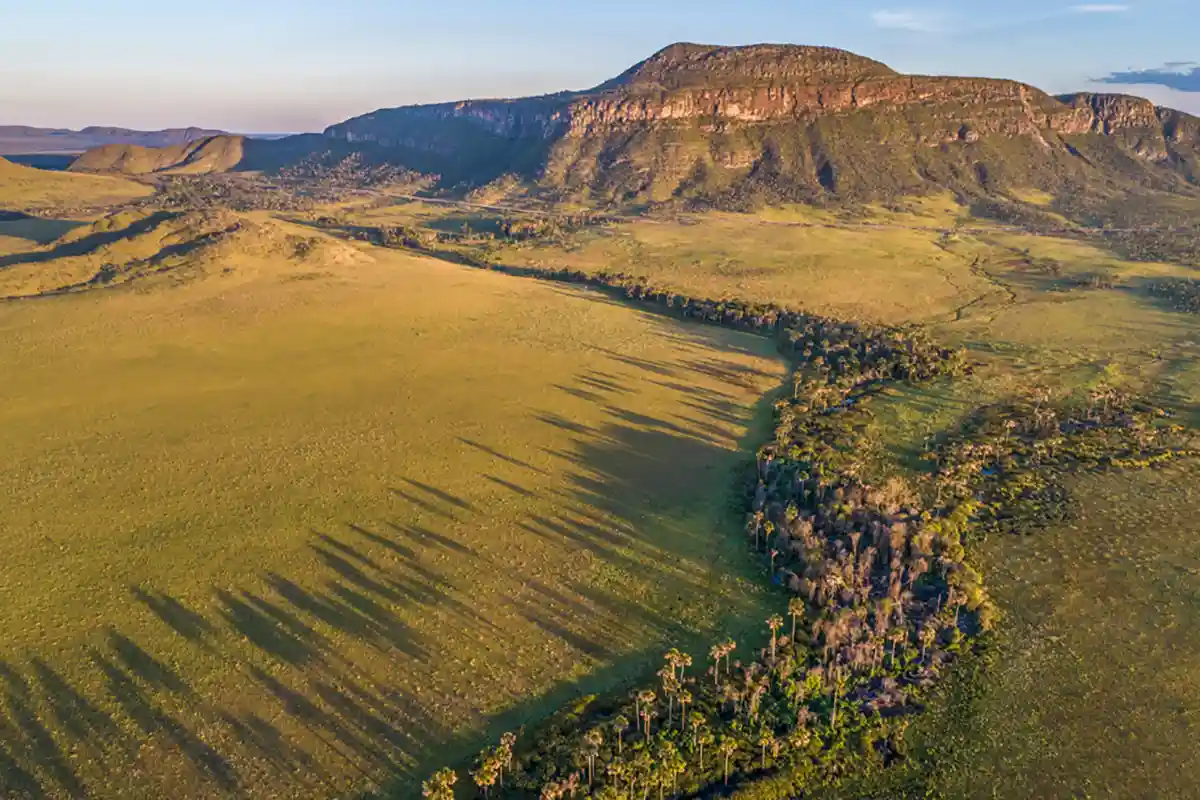
The Amazon always gets the credit. When scientists talk about carbon sinks, when politicians discuss protecting tropical ecosystems, they almost always mean the rainforest: vast, green and dark as a cathedral, holding an estimated 150 billion tons of carbon in its wood and soil. But a new study shows that another Brazilian biome, far less famous, hides a carbon store the world’s climate accounting overlooked entirely.
Larissa Verona spent years digging that story out of the mud. A technician at the University of Campinas (Unicamp) and now a researcher working with Amy Zanne at the Cary Institute of Ecosystem Studies, Verona has drilled soil cores across the Cerrado, the sprawling savanna that covers about a quarter of Brazil. She comes back from the field caked in mud, hauling a sensitive gas analyzer, the LI-COR Trace Gas Analyzer. “I fall over all the time in the field”, she says, “but as long as I protect the instrument, I don’t mind. It’s like my child”.
What she found, published in the journal New Phytologist, suggests the global carbon ledger has a sizable gap. Hidden in the Cerrado and fed by groundwater rather than rain lie patches of waterlogged grassland that locals call campos umidos and veredas. They are, in essence, wetlands. And their peaty soils store roughly 535 tons per acre (1,200 metric tons per hectare) of carbon. “That is about six times the average biomass carbon density of the Amazon rainforest”, Verona says.
The mechanism is not complicated. Peat builds up where water keeps oxygen from reaching dead organic matter, halting decay and letting carbon pile up layer by layer over thousands of years. “Wet conditions create a lack of oxygen, which slows decomposition”, Zanne explains. Colleagues at the Max Planck Institute for Biogeochemistry in Germany radiocarbon-dated the Cerrado peat and found the average carbon age was about 11,185 years, with some material sitting there for more than 20,000 years.
That time scale matters. Replanting a forest is, in principle, possible. Rebuilding 20,000 years of peat is not, not on any schedule that makes sense for today’s climate crisis. “This carbon accumulated over a very long period”, Verona says, “and if it is lost, we cannot build it back up the way we can replant a forest”.
The team reached deeper than earlier work to find it. While other studies sampled surface layers, from 8 inches to 3 feet (20 centimeters to 1 meter), the Unicamp researchers used metal tube probes known as a Russian Peat Auger to pull cores as deep as 13 feet (4 meters), which proved decisive. Some organic layers ran past 5 feet (1.6 meters) deep.
Estimating how much of this wetland exists proved harder than measuring what was inside it, because the patches are scattered rather than continuous. The team paired remote sensing with machine learning to map their likely spread, and the result surprised them: the wetlands may cover about 41 million acres (16.7 million hectares), an area at least six times larger than earlier estimates suggested. That is roughly 8% of the Cerrado, which itself makes up about 2% of Brazil. If the carbon density holds across that range, the wetlands could store the equivalent of about 20% of the carbon in all Amazon vegetation, though the researchers stress that far more sampling is needed to confirm it.
None of that carbon appears in standard global carbon budgets. “The Cerrado’s vast carbon store is not in our carbon budgets because, until recently, we did not know it existed”, Zanne says, adding that current protection strategies “tend to focus almost exclusively on forests and neglect ecosystems like this one”. Verona points to a frustrating political dimension: the Cerrado is widely treated as Brazil’s “sacrifice biome”, the ecosystem converted to soybean fields and cattle pasture so pressure on the Amazon eases. “Brazil wants to protect the Amazon”, she says, “but we also want to keep farming. So agribusiness drains these marshes or pulls their water for irrigation. And if we take the water out, we expose the soils to more air, driving more decay and carbon release”.
Rafael Oliveira, a professor in Unicamp’s Department of Plant Biology who coordinated the study and advises Verona, argues water and carbon cannot be separated here: “Land management cannot be only about plants. Water management and carbon management are, in this biome, the very same thing”.
The risk is concrete. About 70% of the annual emissions measured came during the dry season, when the water table drops and microbes reach carbon usually denied to them. The Cerrado is projected to grow hotter and drier, which would push more of these ancient reserves into the atmosphere. There is a hydrological dimension too: the Cerrado holds the headwaters of roughly two-thirds of Brazil’s major river systems, including, ultimately, the Amazon. “Sacrificing the Cerrado for the Amazon actually puts the Amazon at risk as well”, Zanne warns.
Brazilian law technically protects groundwater-fed wetlands. But in some regions up to 50% have already been degraded, protections are enforced unevenly, and the wetlands themselves are poorly mapped. Part of the Cerrado’s problem is its invisibility: it lacks the charismatic canopy of a rainforest and is mostly just grassland, easy to overlook. Other tropical peatlands, such as those in the Congo basin, store even more per hectare, some topping 2,000 metric tons, so the Cerrado is not a record holder. What may matter more is its fragility: spectroscopic analysis suggests its carbon is chemically less stable than that of wetter peatlands, and thus more likely to break down fast when conditions change.
“When we talk about carbon in Brazil, we talk about forests”, Verona says. “But the Cerrado matters too for its large long-term carbon stores, and we need to fight for it as well”. The science is getting sharper. The policy, for now, lags behind.
Reporting: Anne Silva / Amazonia Mag
This article is the English edition of reporting originally published by Revista Amazônia. Images: Revista Amazônia archive.

Editor, English Edition — Amazonia Mag
Anne Silva is the editor of Amazonia Mag, the English-language edition of Revista Amazônia. She curates, translates and adapts the outlet's science and environment coverage for an international audience, reporting on Amazon wildlife, flora, rivers, climate and research. Every story she edits is grounded in peer-reviewed studies, official data and on-the-ground reporting from the Revista Amazônia newsroom in Belém, Pará, Brazil. More by Anne Silva →