
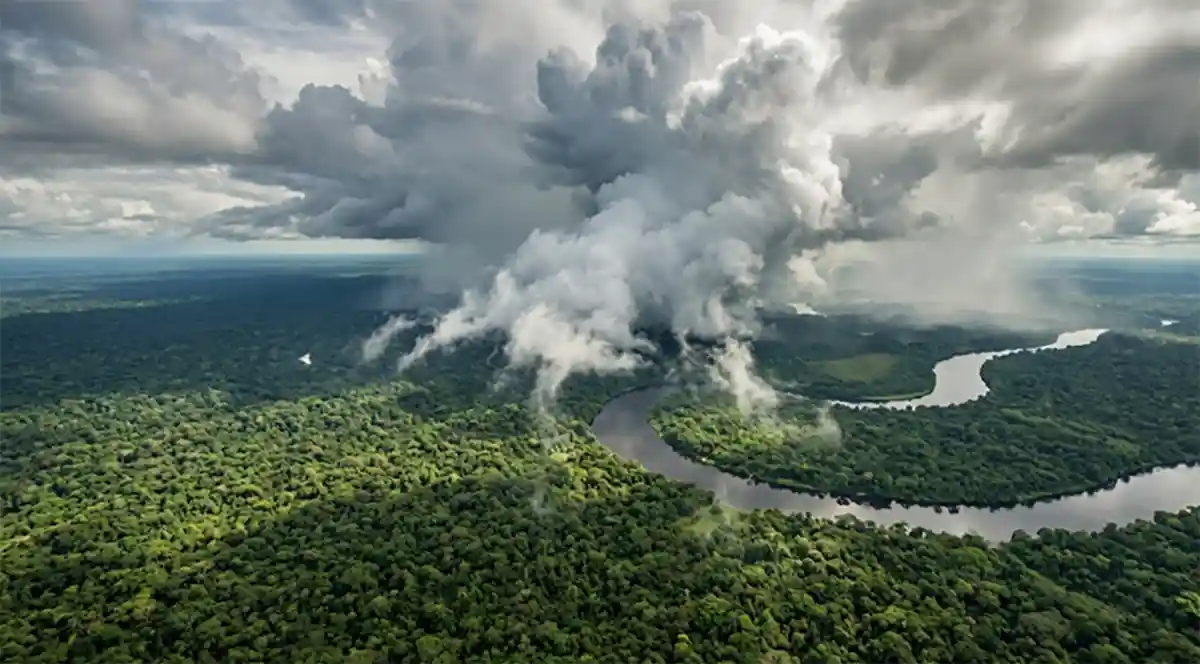
On Saturday, March 21, the world turns its attention to the International Day of Forests. The date, created by the United Nations, works as a maximum alert for the largest tropical forest on the planet. In the Amazon, the debate is not only about trees, but about the basic conditions for human existence in Brazil.
For professor Leandro Juen, of the Institute of Biological Sciences at UFPA (the Federal University of Pará), the risk is immediate. He coordinates elite research centers, such as CISAM and INCT-SinBiAm, and states categorically that the disappearance of the forest is the disappearance of our own quality of life. When the forest suffers, the impact reaches the cities quickly.
The science produced at the Federal University of Pará shows that we do not only lose scenery. We lose the climate stability that regulates the rains and the water security that supplies our homes. It is an invisible mechanism that sustains the daily life of millions of Brazilians, from the countryside to the big urban centers.
Flying rivers: the invisible engine of the economy
The Amazon works as a hydrological power plant on a continental scale. Through evapotranspiration, the trees release water vapor that forms the so-called flying rivers. These airborne flows carry the moisture needed to generate rain in other regions of Brazil and South America.
This dynamic sustains national agribusiness and strategic sectors of the economy. Essential crops such as soybeans, corn, cotton, and wheat depend on that stability coming from the North. Without the forest standing, the cycle breaks and economic damage becomes inevitable for the country.
Protecting the region is a masterstroke for the water security of the coming decades. When deforestation advances, the soil loses its capacity to hold water and the transport of moisture fails. The result appears in the form of extreme events, with prolonged droughts that make food and energy more expensive.
The direct impact on your health and your wallet
The end of native vegetation creates the so-called heat islands in cities. Without the coolness of the forest, temperatures rise, the use of air conditioning soars, and the electricity bill weighs more heavily on family budgets. In addition, air quality worsens drastically during periods of criminal fires.
Environmental degradation also opens the door to new diseases and urban pests. Unbalanced ecosystems make it easier for disease vectors that were once isolated in the forest to migrate into populated areas. Researcher Leandro Juen stresses that keeping the forest conserved is, in fact, a strategy for public health and collective security.
The climate crisis does not pick an address. Changes in the water cycle can compromise public supply and increase vulnerability to natural disasters. The balance that the Amazon provides is what protects us from a future of scarcity and severe climate uncertainty.
Bioeconomy and the new Brazilian plate
Brazil’s food security is connected to the integrity of the forest. Conserved areas keep the soil fertile and reduce the need for poisons and chemical inputs in agriculture. In the Amazonian floodplains, the cycle of the rivers naturally fertilizes the land for thousands of riverside families.
The future of the region runs through the bioeconomy and agroforestry systems. Models of sustainable management and carbon markets prove that it is viable to generate income while keeping the jungle intact. The challenge now is to ensure that these economic benefits reach the peoples of the forest and local communities.
The science done across the Pan-Amazon, led by UFPA through PPBio AmOr and CAPACREAM, is what guides these solutions. The knowledge produced here engages with the greatest powers in the world. To research the Amazon is to produce intelligence to save the future of the global climate.
A strategic decision for our existence
The International Day of Forests serves as a mirror of our dependence on nature. Forests guarantee the water we drink, the climate we can endure, and the basis for producing everything we eat. Conserving these resources is not an ideological choice, but a decision about survival.
As professor Juen points out, every 2.5 acres (1 hectare) destroyed is a threat to the conditions that allow human life. The Amazon is the heart of the system that regulates our existence. Keeping that heart beating is the only path to a future with health, abundance, and dignity.
Preserving the forest means ensuring that tomorrow is still possible for all of us. The responsibility is collective and the urgency is now. What we do today for the Amazon defines the Brazil we will have in the coming decades.
Reporting: Anne Silva / Amazonia Mag
This article is the English edition of reporting originally published by Revista Amazônia. Images: Revista Amazônia archive.

Editor · Amazonia Mag
Anne Silva is the editor of Amazonia Mag, the English-language edition of Revista Amazônia. She curates, translates and adapts the outlet's science and environment coverage for an international audience, reporting on Amazon wildlife, flora, rivers, climate and research. Every story she edits is grounded in peer-reviewed studies, official data and on-the-ground reporting from the Revista Amazônia newsroom in Belém, Pará, Brazil. More by Anne Silva →