
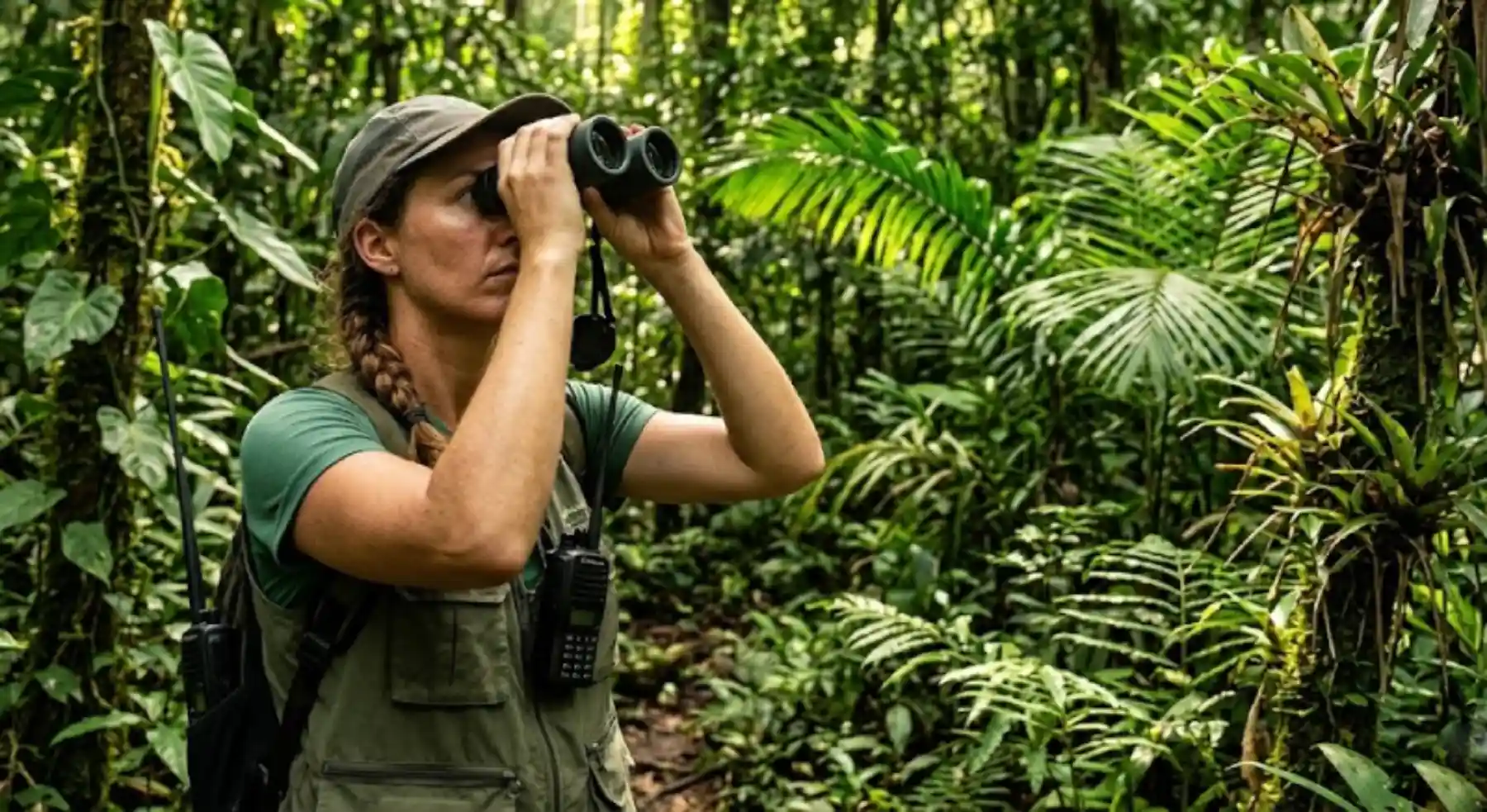
Birds are the first creatures to signal that an ecosystem is beginning to fail. They work as biological sensors of extraordinary precision, reacting to minimal shifts in air quality and in the composition of the surrounding flora. In the Amazon, research on threatened species has revealed something that surprises even veteran field biologists: certain understory birds are so acutely sensitive that they will abandon entire territories if the average forest temperature rises by a single degree Celsius. That behaviour works as an early warning, showing that the biome is reaching a point of thermal stress long before the effects become visible in the tall vegetation.
A living laboratory of methods
Protecting threatened birds in the Amazon is not only an effort to save particular species. It is above all a living laboratory where conservation methods are tested before they travel to other continents. The lesson field teams repeat most often is that the survival of a rare bird depends on a multiscale approach. Protecting a single nesting tree is not enough: the integrity of biological corridors has to be guaranteed so that fledglings can disperse into new areas once they become independent. Anyone protecting only the exact spot of the nest is protecting one generation, not a population.
Local communities hold the method together
Consolidated research shows that the success of bird conservation programmes rests on one central pillar: the participation of local communities. In the Amazon that means turning scientific monitoring into a tool of empowerment for riverside and Indigenous populations. Once those communities begin acting as guardians of the wildlife around them, rates of hunting and illegal capture fall sharply. The methodological lesson is uncomfortable for certain management models: environmental conservation and social wellbeing cannot be separated, and any project that treats forest dwellers as obstacles rather than partners tends to collapse over the medium term.
Bioacoustics: listening instead of chasing
Advanced monitoring technology applied in the Amazon has been generating data that is already being replicated in other biomes. Bioacoustics, the recording and analysis of forest sound through artificial intelligence, makes it possible to identify rare species that are almost never seen by the human eye. The technique helps delimit priority protection areas without the constant physical intervention that stresses wildlife. The shift in mentality runs deep: instead of chasing an animal to prove that it exists, the team learns to listen for it.
Umbrella species and limited budgets
These methods mirror the success of studies carried out in distant ecosystems, from the Esteros del Iberá to the tropical forests of Indonesia. The exchange of information between research centres around the world established that protecting umbrella species is the most efficient way to invest limited resources. By concentrating on a bird with large territorial requirements, scientists manage, through a kind of conservation osmosis, to protect thousands of insects, plants and fungi that share the same space. The choice is strategic before it is sentimental: with short budgets, every protected hectare has to deliver the maximum possible in ecological function.
Genetics against functional extinction
Advances in genetic sequencing opened a new understanding of threatened populations. Many species once considered abundant turn out to be genetically distinct groups that require specific management strategies. Modern conservation relies on germplasm banks and genomic mapping to avoid what scientists call functional extinction: the situation in which living individuals still exist, yet genetic diversity is so low that the species can no longer evolve or adapt to new threats.
Studies indicate that maintaining genetic variability is what allows Amazonian birds to resist parasites and atypical seasonal changes. That is why captive breeding programmes and later reintroduction into natural habitat, when carried out with scientific rigour, remain crucial tools. These wildlife management lessons are exported to global recovery projects and serve as a model for restoring bird populations on oceanic islands and in fragmented ecosystems across Europe and North America.
The genetic work also reframes what counts as a conservation victory. A population that looks stable in a headcount may already be confined to a narrow genetic corridor, which makes numbers alone a poor measure of safety. Pairing the classic survey with genetic sampling has therefore become standard practice in the region, and it stands among the most transferable contributions Amazonian science offers to conservation teams working anywhere else.
Birdwatching is also economics
Birdwatching has emerged as one of the most profitable and sustainable conservation strategies available to the Amazon. The search for endemic and threatened species attracts enthusiasts from all over the world and generates revenue that justifies keeping the forest standing in the eyes of governments and investors. This model of a biodiversity economy demonstrates that the value of a living bird in its habitat far exceeds the immediate profit of extracting natural resources.
Scientific and contemplative tourism also creates an economic barrier against deforestation. In regions where sighting rare birds has become the main source of income, the community itself monitors and reports illegal activity. The lesson applies to the whole planet: biodiversity will only be fully protected once it is understood as an economic and cultural asset that tropical nations cannot develop without.
Borders that birds do not recognise
Birds do not recognise political borders. Many Amazonian species make seasonal migrations that carry them across several South American countries and even to other continents. Conservation therefore demands robust environmental diplomacy. International treaties protecting migratory species are essential to guarantee that the effort made in Brazil is not lost the moment a bird crosses into a jurisdiction with more permissive legislation.
International cooperation strengthens research networks and allows advanced technology to be shared. When a neighbouring country adopts management protocols developed in the Brazilian Amazon, the global protection network grows stronger. Bird science reveals how thoroughly we are connected by flight routes: the health of a forest in the interior of Pará can influence the climatic and biological balance of regions thousands of kilometres away.
Specialists, generalists and an increasingly similar forest
In the Amazon many birds are classified as habitat specialists, meaning they depend on very specific conditions to survive, such as one particular kind of tree for nesting or a restricted group of insects for food. That specialisation makes them extremely vulnerable to any environmental change. When a forest is degraded, generalist birds, which eat almost anything and live almost anywhere, take over the space left by the specialists. The loss of those rare birds produces a process known as biotic homogenisation: forests around the world end up holding the same few common species, which sharply reduces global biodiversity and the resilience of ecosystems facing natural disasters.
Persistence as a method
The study of threatened birds teaches that conservation is an act of persistence and collaboration rather than a campaign with a closing date. Every species that manages to leave the threatened list represents a collective victory and a step towards the ecological stability of the planet. Protecting these creatures is ultimately a survival strategy for our own species, because we depend on the environmental services they help to maintain.
What remains is to widen support for the organisations working on the front line of conservation and to demand public policies that put the integrity of the biomes first. The next time you hear a bird singing, remember that the sound is the voice of a complex system fighting to stay alive.
Reporting: Anne Silva / Amazonia Mag. Source: Revista Amazônia, BirdLife International, SAVE Brasil.

Editor, English Edition — Amazonia Mag
Anne Silva is the editor of Amazonia Mag, the English-language edition of Revista Amazônia. She curates, translates and adapts the outlet's science and environment coverage for an international audience, reporting on Amazon wildlife, flora, rivers, climate and research. Every story she edits is grounded in peer-reviewed studies, official data and on-the-ground reporting from the Revista Amazônia newsroom in Belém, Pará, Brazil. More by Anne Silva →