
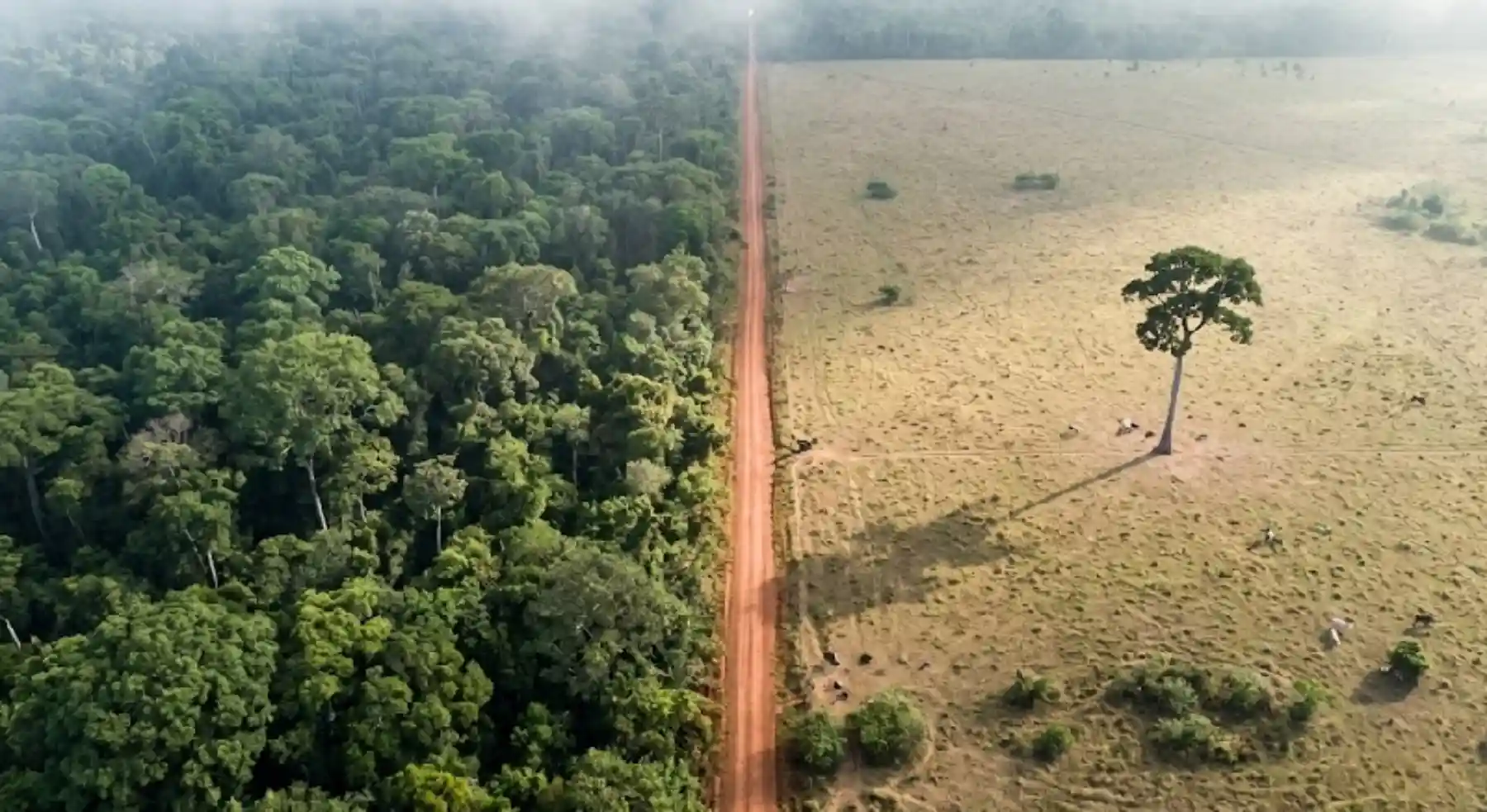
A dirt road ten meters wide can work like a wall. In the Amazon rainforest, hundreds of bird and insect species avoid direct sunlight and simply refuse to cross that bright, open gap. The phenomenon has a name: the edge effect. Open a clearing and humidity drops, temperature climbs and wind pushes into a place that used to hold only shade and stillness. What was once a stable refuge turns hostile. And for large predators, those scars in the forest fabric are not merely physical obstacles: they are the start of a slow biological suffocation that can end in local extinction within a few decades.
Forest fragmentation is the process behind it. It happens when a continuous block of forest is cut into smaller, separated pieces by roads, pasture, crops or settlements. The total area of trees on a satellite map may still look substantial, yet the forest no longer behaves as one living system. The edge effect is what fragmentation does to the newly exposed margins of each piece: sunlight, heat, wind and dryness penetrate the interior, and the conditions that made the rainforest a rainforest begin to unravel from the outside in.
Islands of forest in a sea of pasture
When ranching or farming carves up a large forest block, the result is a set of vegetation islands surrounded by pasture or monoculture. At first, biodiversity looks intact. Science, however, records a slow degenerative process. Geographic isolation blocks gene flow, meaning animals can no longer move between fragments to find unrelated mates. Over time, inbreeding weakens the health of populations and leaves them more exposed to disease and to climate shifts.
The impact hits large-bodied animals hardest. A top predator such as the jaguar (Panthera onca) or the harpy eagle (Harpia harpyja) needs continuous stretches of territory to sustain its prey base. When habitat shrinks to scattered patches, the supply of prey becomes insufficient. The predator is then forced to venture across open ground, where the risk of conflict with people and of retaliatory killing rises sharply. Biodiversity loses its natural regulators, and a domino effect impoverishes the whole structure of the jungle.
The fragility of the giants
The biology of the Amazon’s large predators is tuned to vast, shaded environments. The jaguar is an outstanding swimmer and climber, but its hunting strategy depends on the camouflage that dense vegetation provides. In small forest fragments the cat loses the advantage of surprise, and the scarcity of animals such as the white-lipped peccary (Tayassu pecari) and the tapir (Tapirus terrestris) pushes it to change its diet or to look for food on neighboring farms.
Field research shows that fragmentation also reaches the microfauna holding up the base of the food pyramid. Pollinating insects and small amphibians are extremely sensitive to temperature changes along forest edges. If pollinators disappear, fruiting trees stop producing, which cuts the food supply for rodents and primates. Without that prey, top predators vanish. Biodiversity is not a collection of separate items but a web of connections: when fragmentation cuts one thread, the whole weave starts to fray.
Ecological corridors: stitching the landscape back together
To soften the damage, modern ecology points to ecological corridors as the most workable answer. A corridor is a strip of vegetation that links two or more forest fragments and lets wildlife move safely between them. Studies indicate that strategic reforestation, even with fast-growing species or through agroforestry systems, can significantly raise landscape connectivity and let biodiversity flow again.
Restoring degraded land along rivers and slopes does more than protect water resources: it works as a natural highway for wildlife. For a large cat or a bird of prey, a corridor means the chance to find new territory and to keep the genetic diversity of the species alive. Without those routes, forest fragments become living cemeteries, where the remaining species are condemned to fade out for lack of space and resources.
What happens in the first hundred meters
The edge effect is one of the most insidious consequences of forest fragmentation in the Amazon. In the first hundred meters of forest measured from an open area, sunlight exposure increases, drying out the soil and killing tall trees that are not adapted to strong winds. Those dead trees open artificial gaps, change the botanical composition and favor invasive species or climbing vines that smother native vegetation.
For predators, that shift in microclimate means losing resting and nesting sites. The harpy eagle picks the tallest trees in the forest to build its nest. If the forest edge advances into its territory, the host tree becomes exposed and can fall during tropical storms. Excess light also harms nocturnal and crepuscular species, whose eyes are built for the gloom beneath the canopy. Amazonian biodiversity is essentially a biological technology of soft light and high humidity: change those parameters and the entire system loses its calibration.
Conservation beyond protected area boundaries
Conserving Amazonian biodiversity in the twenty-first century demands a view that reaches past the boundaries of protected areas. Preservation has to be integrated with sustainable rural development. Private landholdings that keep their Legal Reserves and Permanent Preservation Areas connected to neighboring forest deliver an invaluable service to the planet. Brazilian law, through the Forest Code, sets the basis for that protection, though effective implementation still runs into economic and political barriers.
Projects that encourage strategic planting of native trees on degraded pasture have shown that connectivity can be recovered without sacrificing agricultural productivity. Satellite monitoring and GPS collars fitted to animals allow scientists to pinpoint the critical spots where fragmentation is blocking wildlife movement. That data is essential for infrastructure planning: roads, for instance, should include wildlife crossings, whether tunnels or green bridges, to keep populations from being cut off.
Sentinels of environmental health
In conservation planning, the jaguar and the harpy eagle are classified as umbrella species. Their territorial and ecological requirements are so broad that protecting the area needed for a single breeding pair indirectly shelters thousands of smaller species: insects, plants, amphibians and birds sharing the same ground. Focusing protection on large predators is therefore an efficient management strategy, because it safeguards the integrity of the whole biome and makes better use of the money invested in conservation.
Readers who want to follow the state of tropical forests closely will find updated material in the reports published by IPAM Amazônia and in the monitoring data of the PRODES program, run by Brazil’s National Institute for Space Research, INPE. Those are the sources that separate impression from hard measurement and track, year after year, how the mosaic of cuts advances over the largest tropical forest on Earth.
Amazonian biodiversity is running against the clock. Every fragment lost or isolated stands for the silent extinction of evolutionary lineages thousands of years in the making. Top predators act as sentinels of environmental health, warning us when something has gone wrong: the disappearance of a large predator from a region is the definitive sign that the ecosystem is collapsing. Preserving the Amazon is not only about preventing total deforestation, but about keeping the forest functional, connected and resilient. Nature’s capacity to regenerate is remarkable when it is given a chance, and investment in connectivity and landscape restoration remains the most powerful tool available to ensure that tropical biodiversity stays Brazil’s greatest asset.
Reporting: Anne Silva / Amazonia Mag. Source: Revista Amazônia, IPAM Amazônia, INPE PRODES program.

Editor, English Edition — Amazonia Mag
Anne Silva is the editor of Amazonia Mag, the English-language edition of Revista Amazônia. She curates, translates and adapts the outlet's science and environment coverage for an international audience, reporting on Amazon wildlife, flora, rivers, climate and research. Every story she edits is grounded in peer-reviewed studies, official data and on-the-ground reporting from the Revista Amazônia newsroom in Belém, Pará, Brazil. More by Anne Silva →