
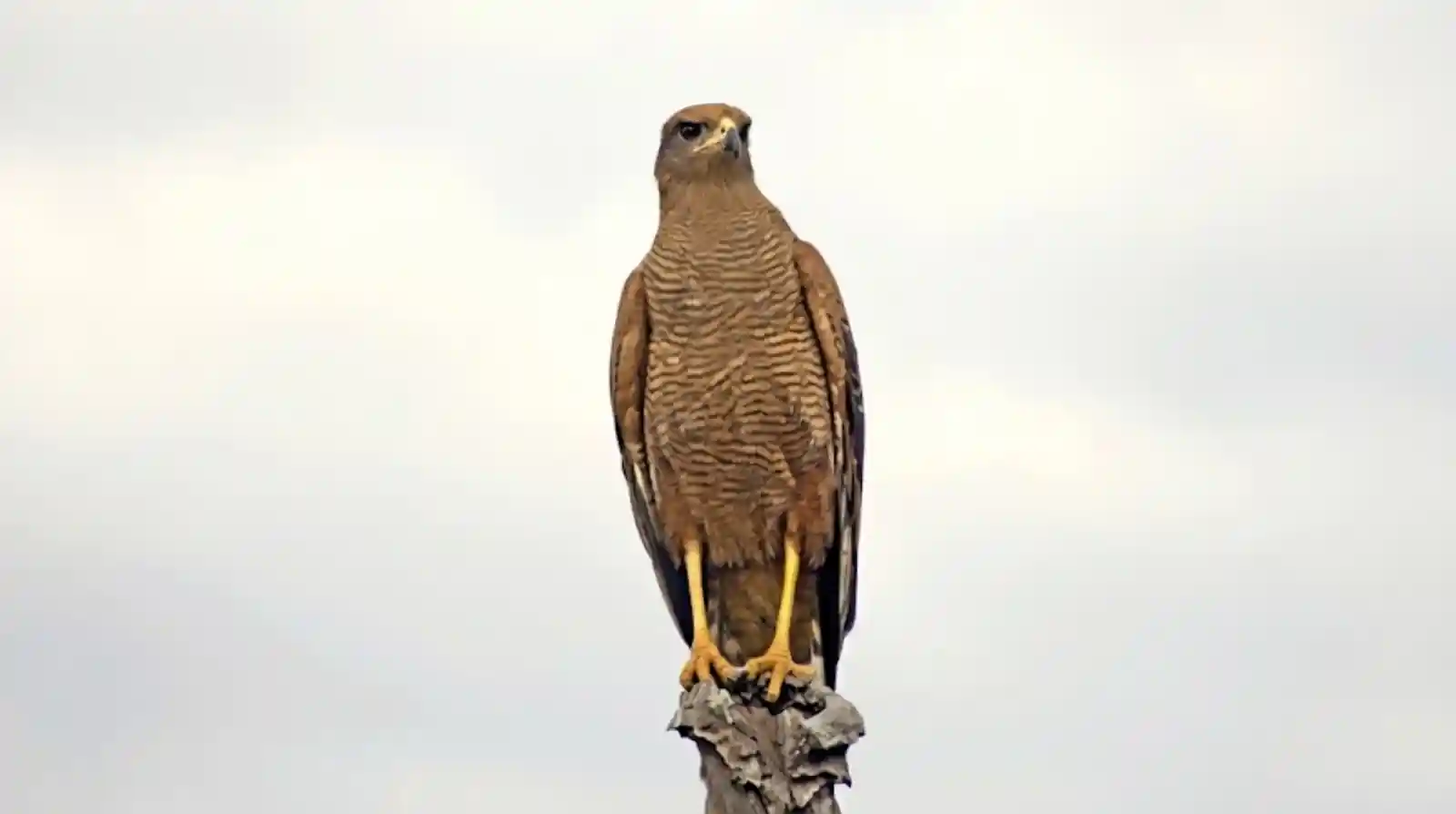
This is not the harpy eagle, and it is not a vulture. Both have already had their share of headlines in Amazonian wildlife coverage. The bird at the center of this story is a very different creature: far more discreet, far more common and almost never given a second look. It is the savanna hawk (Buteogallus meridionalis), known in Brazil as gavião-caboclo, a raptor of roughly 50 to 60 centimeters that is quietly staging one of the most remarkable urban adaptation stories among South American birds of prey. Native to open country such as grasslands and savannas, the species keeps surprising biologists by colonizing city centers, where it deploys efficient hunting strategies to catch prey as unlikely as snakes in the middle of a residential block.
Human occupation and the spread of cities drive drastic changes in the natural landscape, and in most cases those changes mean a loss of biodiversity. Yet a handful of species show a striking behavioral plasticity and manage not only to survive but to thrive in these artificial environments. The savanna hawk case goes well beyond ecological curiosity: it represents a fundamental shift in the niche of the species. The bird is rewriting its own natural history, turning rooftops into lookout perches, utility poles into launch platforms and backyards into hunting grounds, and proving that wildlife can be surprisingly resilient when confronted with urbanization.
The biology of an open country generalist
To understand that success, it helps to look at the biological roots of the species. It measures between 50 and 60 centimeters in length and is easy to recognize by its predominantly rufous coloring, a deep reddish brown, along with a finely barred belly and long yellow legs. Its original habitat is scrubby grassland, pasture, the Cerrado savanna and the edges of wetlands, not the interior of dense closed forest.
Unlike raptors that depend on thick woodland, the savanna hawk evolved to hunt across wide open spaces. According to research into its biology, its body is adapted to soar on rising currents of warm air while it scans the ground for prey. Long legs and sturdy tarsi let it walk easily through low vegetation or across bare soil, taking small vertebrates and large insects. That generalist build, shaped for versatility in open country, turned out to be a perfect tool for navigating the uneven, obstacle filled terrain of the urban landscape.
The city as a new hunting ground
Urban colonization happens in stages. At first the bird settles on the outskirts, where the city meets remnants of Cerrado or stretches of pasture. Over time, the bolder individuals push into residential neighborhoods and even reach leafy central districts.
The adaptability of the species shows up most clearly in its new hunting strategies. Instead of natural perches such as tree branches, these hawks use human structures. Power poles, water tanks, television antennas and the roofs of tall buildings all serve as privileged observation points. Sharp eyesight lets them track any movement on the ground, in yards and across public squares. Once prey is spotted, they either drop into a fast stoop or come down to the ground and chase the target on foot, a tactic inherited from their open country ancestors.
There is an atmospheric factor at work as well. Studies indicate that the slightly higher temperature of cities, the familiar urban heat island effect, can actually make gliding flight easier for these birds, optimizing the energy they spend on every patrol. A built environment that produces warm rising air, combined with a dense grid of elevated perches, effectively recreates the physics of an open field in the middle of the concrete.
The surprise on the menu: urban snake specialists
What most intrigues biologists is how often the savanna hawk catches snakes inside cities. Its diet is naturally varied and includes rodents, lizards, amphibians and insects, but the degree of specialization in snakes within the urban setting points to an ecological opportunity the species learned to exploit.
Contrary to what many people assume, urban zones shelter populations of several snake species. Some are non venomous, such as sleep snakes and false coral snakes, and some are venomous, including the lancehead known in Brazil as jararaca. All of them find refuge in vacant lots, gardens, storm drains and piles of construction material. With its ground based hunting technique and the protection offered by the tough scales on its legs and tarsi, the hawk is an effective natural predator of these reptiles. Biologists have been recording and documenting a growing number of successful attacks in residential yards and public squares, behavior that helps keep urban snake populations in check and lowers the risk of accidents for people and domestic animals alike.
The hawk that follows the fires
Another striking behavioral trait, also visible in rural areas near cities, is the attraction of this bird to fire. In some regions of Brazil it is popularly called gavião-fumaça, meaning smoke hawk, or gavião-casaca-de-couro. According to research, the species is able to follow columns of smoke from grassland burns in order to hunt the small animals fleeing the flames in panic. It perches on branches ahead of the fire front, or walks just behind the flames, picking off insects and vertebrates that are dying or trying to escape, and turning the chaos into a meal.
Coexistence and the challenges of the concrete jungle
The presence of the savanna hawk in cities is a success story of coexistence between wildlife and people, but it is not free of problems. Urbanization brings concrete hazards: collisions with high tension wires, strikes against the glass of buildings and the danger of being hit by vehicles when the birds hunt at street level.
Environmental contamination is a constant concern on top of that. As a top predator in the urban food chain, the bird can bioaccumulate toxins carried by its prey, including rodent poisons and the pesticides applied in gardens and empty lots. Conserving the species in urban environments therefore demands more than protecting green areas and ecological corridors inside cities. It also requires public awareness about sustainable pest management and basic respect for local wildlife.
The savanna hawk is living proof that biology is never static. Its ability to turn the concrete jungle into a new habitat is an invitation to reassess the relationship we keep with nature inside our cities. Valuing and protecting these birds is a way of guaranteeing that the urban landscape stays alive and full of movement, even when the star of the scene lacks the size and the fame of the harpy eagle.
Reporting: Anne Silva / Amazonia Mag. Source: WikiAves and the Chico Mendes Institute for Biodiversity Conservation (ICMBio).

Editor · Amazonia Mag
Anne Silva is the editor of Amazonia Mag, the English-language edition of Revista Amazônia. She curates, translates and adapts the outlet's science and environment coverage for an international audience, reporting on Amazon wildlife, flora, rivers, climate and research. Every story she edits is grounded in peer-reviewed studies, official data and on-the-ground reporting from the Revista Amazônia newsroom in Belém, Pará, Brazil. More by Anne Silva →