
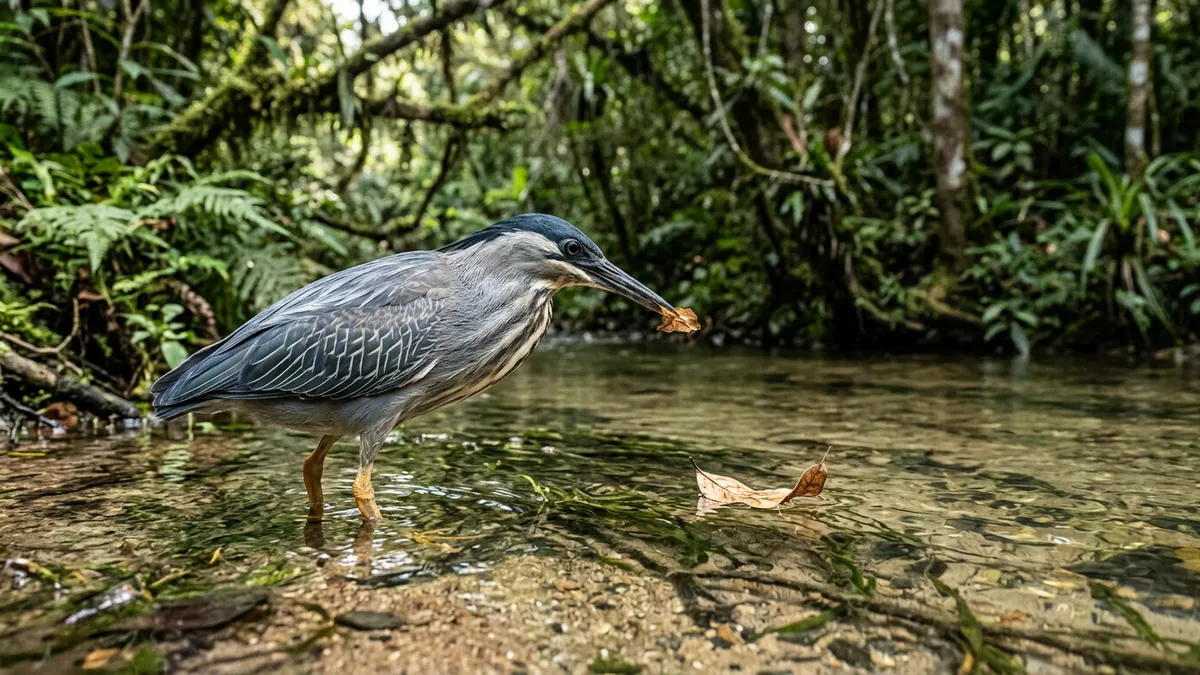
The striated heron, called garça-socozinho in Brazil, can drop a feather, a leaf or another small floating object onto the water to attract fish. When the material drifts on the surface, the bird stays close, watches the prey approach and delivers a quick stab with its bill. The behavior is known as baiting, and it is among the examples of tool use recorded in birds.
The strategy combines three actions that depend on one another. First, the heron picks a spot in shallow water and waits without abrupt movements. Then it places the object on the surface and follows the fish that rises to investigate it. Finally it triggers its neck, which works like a spring, driving the head forward before the prey can escape.
The bait turns the surface into a meeting point
The feather or leaf works as an object of interest for the fish, not as a trap that holds it. When it touches the water, the material can produce small ripples and shadows, and it may drift with the wind or the current. These signals change the surface and can encourage the approach of fish that investigate new or potentially edible items. The heron stands beside or behind the bait, keeping its body relatively still so as not to scare off the prey.
The resource is especially useful when the water lets the bird see the bottom and the fish has to come close to the bank or to the surface to examine the object. The bird does not need to chase prey over long distances. Instead, it creates an opportunity for the fish to approach and waits for the right moment. The bait can also be abandoned and replaced, because its function depends on movement and on the fish’s response, not on any fixed property of the material.
A spring-like neck concentrates force in the strike
The strike of the striated heron depends on its elongated neck and on the ability to hold it folded before the attack. While waiting, the bird can draw part of its neck into a compact curve, reducing the visible movement of its head. That posture stores the distance that will be covered in the stab. When the fish enters range, the head shoots forward, and the narrow bill closes on the prey.
The shape of the bill helps to hold slippery fish, while the legs and toes keep the bird balanced on the bottom or on a nearby edge. The attack has to be coordinated with the position of the fish, because water distorts the perception of distance and depth. For that reason the strike is not just a fast movement. It brings together waiting, visual judgment and control of the neck, with the bait shortening the distance between the heron and its target.
Long waiting lowers the cost of a catch
Standing still for a long time may look like a passive attitude, but it is a central part of the technique. The heron saves energy by avoiding frequent movements, short flights and chases through the water. Waiting also reduces the chance that the fish will notice the bird before coming within reach of the bill. In shallow environments, where prey can find shelter among roots, submerged leaves and stones, a chase tends to offer less control.
The moment of attack is chosen when the fish comes close enough for the head movement to be short and precise. If the prey stays far away, the heron can keep waiting or change position. If the fish darts past too quickly, the strike may be cut short. This ability to wait and react keeps each attempt from costing a great deal of energy. The bait, therefore, does not replace hunting, but helps set up the distance needed for it to happen.
The behavior depends on an available object
The heron does not need to carry a tool made for this purpose. Leaves, feathers and other fragments already present in the environment can be used when they float and are visible on the water. This flexibility allows the bird to use different materials depending on the bank, the current and the surrounding vegetation. The chosen object must be light enough to stay on the surface, yet noticeable to the fish that approaches.
Baiting also requires the bird to recognize the relationship between the object and the response of the prey. It holds the material in its bill, positions it on the water and keeps its attention on the movement below the surface. In some cases the item can be repositioned to sit closer to the hunting field. The behavior does not mean the heron understands the tool as a human artifact, but it shows a flexible sequence of choosing, placing and striking.
Shallow water favors sight and control of the attack
The behavior occurs in places where the heron can reach the water with its bill and watch the movement of fish, such as river banks, creeks (igarapés), lakes, channels and flooded areas. The depth must allow the bird to stand or advance safely without losing sight of the object. Marginal vegetation, low branches and stretches with little current can offer waiting spots close to the surface.
By using a leaf or feather, the heron takes advantage of elements produced by the bank itself. Vegetation supplies part of the material that reaches the water, while wind and current can help move it. The fish responds to the object and ends up changing its position, creating the opportunity the bird exploits. This interaction ties plants, water, fish and predators together in a single feeding scene.
The striated heron also hunts without bait, watching the water directly, walking slowly or staying at a waiting point. The tool is an alternative, not a condition for survival in every capture. Its advantage shows when the object raises the probability of an approach without requiring a chase. A variety of techniques lets the bird switch strategy according to the clarity of the water, the presence of current and the behavior of the available prey.
Watching a heron use bait challenges the idea that tools depend on hands or on manufactured objects. The bird combines perception, patience and movement in a setting where every centimeter counts. The drifting leaf and the feather touching the water have no value of their own to the fish, but they come to mediate the encounter between predator and prey. On the bank, the intelligence of the behavior shows up less as spectacle and more as a steady adjustment to the opportunities the environment offers.
Reporting: Natália Santos / Amazonia Mag

Editor · Amazonia Mag
Anne Silva is the editor of Amazonia Mag, the English-language edition of Revista Amazônia. She curates, translates and adapts the outlet's science and environment coverage for an international audience, reporting on Amazon wildlife, flora, rivers, climate and research. Every story she edits is grounded in peer-reviewed studies, official data and on-the-ground reporting from the Revista Amazônia newsroom in Belém, Pará, Brazil. More by Anne Silva →