
Between the late nineteenth and the early twentieth century, the world was going through an industrial acceleration without precedent, driven by the arrival of the automobile and by the popularity of the bicycle. At the centre of that process sat one essential and highly prized raw material: rubber. The global monopoly on natural latex, tapped from the rubber trees (Hevea brasiliensis) native to the Amazon rainforest, produced one of the greatest concentrations of wealth on the planet. It turned Manaus, until then a small colonial outpost lost between rivers and forest, into a luxurious and ultramodern city known as the Paris of the Tropics.
That period, recorded in history as the Rubber Boom, completely reshaped the geography, the demography and the culture of northern Brazil. Capitals that had been little more than isolated colonial outposts went through monumental urban reforms and adopted the most advanced infrastructure and sanitation available in Europe, long before much of the rest of the country did. Manaus is the most extreme case of that transformation, because its leap happened in the middle of the continent, thousands of kilometres away from the Atlantic coast.
From river outpost to electric city
The wealth generated by rubber exports to Europe and to the United States created a local elite of rubber estate owners and barons with extravagant consumption habits. French and British cultural influence shaped daily life in the city. It was common for rich families to send their clothes to be laundered in Paris, and for buildings to be raised entirely out of imported materials.
According to historical research on the urbanisation of the Amazon, iron from Scottish foundries, marble from Carrara, crystal chandeliers from Bohemia, French roof tiles from Marseille and Portuguese ceramic tiles were unloaded straight onto the river docks. Manaus and Belém were the first Brazilian capitals to have electric trams, modern public lighting, piped water networks and sewage systems designed by foreign engineers. The contrast between European technological sophistication and the dense tropical forest all around the city was a phenomenon that astonished visitors of the time.
The Amazon Theatre, the peak of the opulence
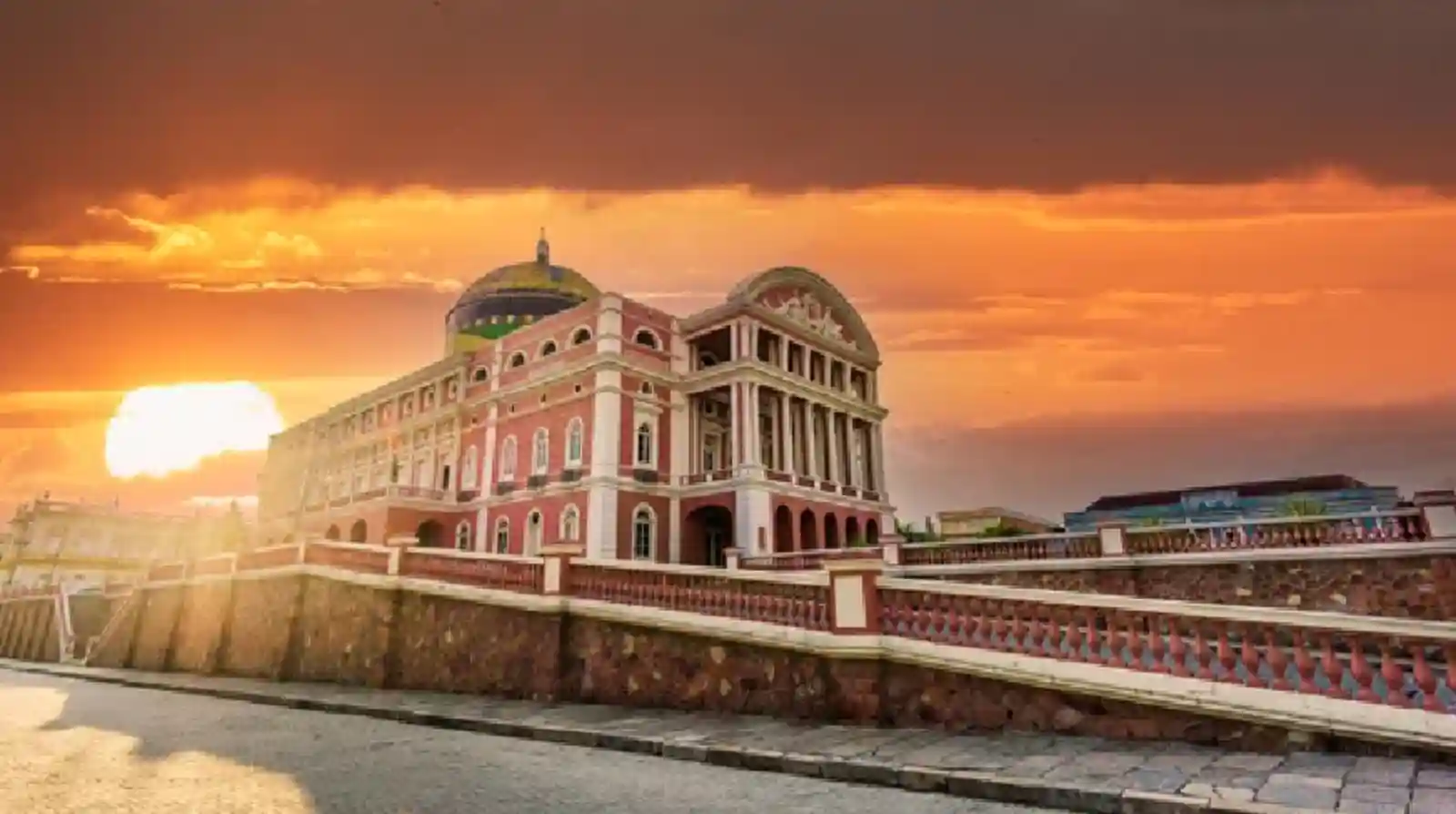
The greatest symbol of that monumental wealth is, without any doubt, the Amazon Theatre. Opened in 1896, it was conceived to receive the leading lyric opera companies of Europe. Its external dome, made of 36,000 glazed ceramic tiles in the colours of the Brazilian flag and imported from Alsace, became the visual landmark of the Amazonian Belle Époque and remains the most recognisable image of the city today.
The interior works as a showcase of the luxury of those years, with cast iron columns shipped from Glasgow and ceilings painted by European artists with allegories of the forest. The obsession with detail reached extremes that are rare in urban history. At the height of the boom, the local elite was bothered by the noise that the iron wheels of the carriages and the horseshoes of the horses made on the stone pavement of the streets near the theatre, because the racket spoiled the acoustics of the opera performances. As a solution, the rubber barons ordered stretches of those streets to be paved with special cobblestones made of compacted rubber. That innovative acoustic paving reduced the noise of urban traffic and secured the silence the artistic shows required.
Beyond the theatre: iron, market and palace
The modernisation of Manaus did not stop at the opera house. The Rio Negro Palace, once the residence of a prosperous German rubber baron, and the Adolpho Lisboa Municipal Market, built with iron structures designed by the famous firm of Gustave Eiffel in Paris, show how European industrial architecture was adapted to the climate and to the supply needs of an Amazonian city. This was not only about importing beauty: the iron frames, the ventilation and the wide openings were also answers to the equatorial heat and humidity that define the region.
Belém and hygienist urban planning
While Manaus rose as the epicentre of wealth deep inside the continent, Belém consolidated its position as the main gateway of the rubber trade on the Atlantic. Under hygienist urban reforms, inspired by the great transformations carried out by Baron Haussmann in Paris, the capital of Pará expanded with wide tree lined avenues, monumental squares and rainwater drainage systems.
Belém gained the imposing Theatro da Paz, designed in neoclassical style and opened in 1878, along with luxurious residential mansions decorated with facade tiles that helped soften the heat and the humidity of the equatorial climate. The massive planting of mango trees along the new avenues, a trademark that still earns the city the title of City of Mango Trees, was a brilliant piece of urban design that combined European aesthetics with natural thermal regulation under the intense Amazonian sun.
Who paid for the party
Reading that architecture only as a golden age leaves out an uncomfortable part of the story. The fortune that raised domes, palaces and avenues was concentrated in a small elite of rubber estate owners and barons, and the latex that sustained it did not come from the city: it came from the rubber groves, deep inside the forest, far away from the opera halls and from the rubber cobblestones. The urban opulence rested on an extraction chain that did not share its profits with the people who tapped the trees. The heritage built in those years is valuable precisely because it tells both sides of the story: the imported splendour and the inequality that made it possible.
The sudden collapse
The age of opulence ended abruptly and dramatically around 1912. Rubber tree seeds smuggled out of the Amazon years earlier were successfully cultivated in organised and scientifically controlled plantations run by the British in Asia, mainly in Malaysia. With cheaper, more efficient and large scale production, Asian rubber flooded the global market and destroyed the Brazilian monopoly almost overnight. The Amazonian economy collapsed and the northern capitals entered a long period of economic stagnation.
What is still standing
The wealth was fleeting, but it left indelible physical marks that still define the identity of the northern capitals today. That historic and architectural heritage is the testimony of a time when the fate of the industrial world depended directly on the rainforest. Conserving that legacy, however, faces serious challenges given the fast pace of urban growth and the shortage of resources to maintain old mansions.
Revitalisation projects in historic centres, such as those that recovered the historic core of Manaus and the surroundings of the Ver-o-Peso market in Belém, are essential to keep that memory alive. Preserving this architecture is not only about holding up monuments of iron and concrete, but about valuing the history and the identity of the people who built and lived through that era. The Rubber Boom shows that the Amazon has always been connected to the great global flows of technology and innovation. Understanding that history is fundamental for thinking about the future development of the region, valuing its urban past while looking for sustainable answers to present day challenges.
Reporting: Anne Silva / Amazonia Mag. Source: Revista Amazônia; Instituto do Patrimônio Histórico e Artístico Nacional (IPHAN); Fundação Joaquim Nabuco (Fundaj).

Editor · Amazonia Mag
Anne Silva is the editor of Amazonia Mag, the English-language edition of Revista Amazônia. She curates, translates and adapts the outlet's science and environment coverage for an international audience, reporting on Amazon wildlife, flora, rivers, climate and research. Every story she edits is grounded in peer-reviewed studies, official data and on-the-ground reporting from the Revista Amazônia newsroom in Belém, Pará, Brazil. More by Anne Silva →