
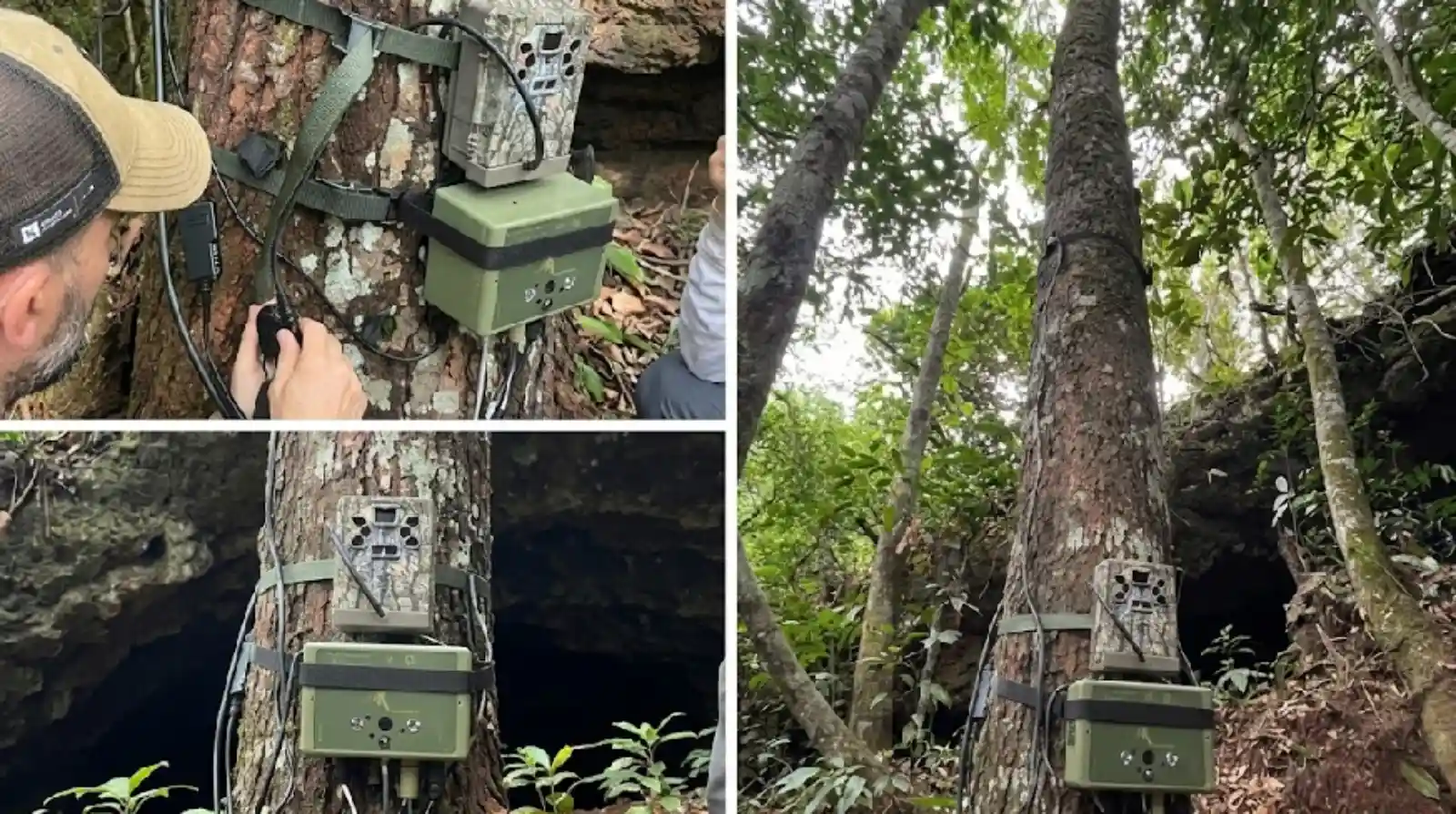
Real-time passive acoustic monitoring allowed scientists in the Amazon to detect rare bird species that had not been sighted for decades, without trapping a single animal and without mounting an expedition. All it took was the analysis of gigabytes of forest sound. The finding matters for the species it recovered, but it matters more for what it says about method. Listening to the forest turned out to be cheaper than walking through it, and it produced information no conventional field campaign would have gathered in the same window of time. That is the argument at the centre of this story: scientific monitoring of wild fauna has stopped being a budget line to be justified and started behaving like an investment that returns more than it costs.
From charity spending to biological asset
The traditional view of conservation as a purely philanthropic activity is being replaced, and quickly, by a strategic investment approach. Monitoring wildlife is not counting animals for its own sake. It is measuring the health of the ecosystems that sustain human life. Healthy animal populations work as indicators of clean water, clean air, efficient pollination and fertile soil. The data produced by long-term programmes should therefore be read as biological assets, information that tells investors, governments and society where the risks and the opportunities sit in a world changing at climate speed. Whoever holds the historical series knows what is being lost before it is gone, and that head start carries real economic value.
Marine species tracking illustrates the shift well. The reappearance of a right whale known as Changuita, after seven years of absence from the coasts of South America, revived hope for its species and validated decades of work protecting migratory routes, as reported by the Argentine newspaper Diario Uno. A single confirmed sighting, logged and matched against an existing archive, is what makes it possible to adjust fishing practices and shipping lanes. Without that archive the reunion would have been an anecdote. With it, the sighting becomes usable evidence about where and when a vessel should slow down.
The method: cameras, collars and microphones
The future of conservation is inseparable from technology. The era of the lone researcher writing observations in a field notebook is giving way to ecology assisted by artificial intelligence. Camera traps fitted with image recognition algorithms identify species, and sometimes specific individuals, in seconds. Drones and satellites watch vast stretches of habitat and raise alerts for deforestation or illegal hunting. Satellite telemetry follows the continental migrations of birds and mammals with accuracy measured in metres, revealing ecological corridors that nobody had previously mapped.
The advantage of this toolkit is not only the quality of the data. It is the ratio between that data and its cost. A team deployed in the field consumes allowances, fuel, boats and salaries for every single day it stays in the forest. A sensor installed once keeps working at night, in the rain, for months, in places where no researcher could remain. The spending is concentrated at the start and then spreads thin across the whole time series. High upfront cost and low marginal cost is precisely the profile of an infrastructure investment, not of a recurring expense.
Precision conservation
The resulting flood of data enables what can fairly be called precision conservation. Instead of drawing generic reserves on a map, environmental managers can now design protected areas that match the movement and breeding needs of target species exactly. Organisations such as the Wildlife Conservation Society, which operates globally and in Brazil, use these technologies to maximise the impact of every dollar spent in the field, turning raw data into management decisions that keep species from disappearing. Protecting the right hectare costs the same as protecting the wrong one, and that distinction is the entire difference between a programme that works and one that merely consumes its budget.
Environmental DNA makes inventory cheaper
One of the most promising frontiers is environmental DNA, usually shortened to eDNA. The technique lets researchers identify the presence of aquatic or terrestrial species simply by collecting and analysing samples of river water or forest soil. Animals shed traces of genetic material into their surroundings through skin, faeces and urine, and modern sequencing technologies detect those signatures with high sensitivity. In the Amazon, eDNA is already being used to monitor migratory fish and freshwater turtles in areas that are hard to reach, with no need to capture or even sight the animals. A jar of water replaces weeks of survey work and changes how biodiversity is inventoried in complex ecosystems.
Who collects the data matters too
The most effective monitoring tends to be the kind that involves local people. In the Amazon, community management of the pirarucu, Arapaima gigas, is a globally recognised success precisely because riverside communities carry out the annual fish count themselves. That traditional knowledge, combined with scientific rigour, does more than guarantee sustainable fishing: it turns communities into guardians of their own territory. Monitoring becomes a tool of social development, generating income and local pride in biodiversity, while cutting the cost of keeping permanent observers in remote places.
Citizen science pushes in the same direction. Applications where anyone can record the sighting of a bird or an insect build continental databases that would be impossible to assemble any other way. iNaturalist, a global initiative with a strong presence in Brazil, shows how public enthusiasm for nature converts into rigorous science, letting researchers follow shifts in species distribution in real time. Measured against the geographic coverage it delivers, the cost of that distributed network has no serious competitor.
What it costs not to measure
Investing in wildlife monitoring means investing in the maintenance of the ecosystem services that hold up the global economy. Pollination by insects and birds is vital to agriculture. Seed dispersal by large mammals is crucial to the regeneration of forests that capture carbon. The cost of losing those services is infinitely greater than the cost of monitoring and protecting the animals that provide them. Leading companies already fold biodiversity monitoring into their sustainability reporting, having understood that their own future depends on the health of the ecosystems they use or cross.
Bioprospecting, the search through nature for solutions in medicine and industry, depends on knowing where species are and how they behave. In monitoring wild fauna we are, strictly speaking, taking inventory of a library of biological solutions we do not yet fully understand. Monitoring is the key that unlocks that tropical bioeconomy, generating value from standing forest and from wildlife left intact.
A new pact with the planet
The point bears repeating: monitoring wild fauna is not a luxury, it is an existential necessity. It hands us the mirror we need to see the impact of our own actions and the compass to steer towards a sustainable future. Every data point gathered in the field, every biosensor switched on, is a vote of confidence in humanity’s capacity to coexist with nature rather than consume it.
The real investment, in the end, is not only in technology or logistics. It is in our capacity to listen to what biodiversity is telling us and to act on it while the information still has time to be useful. By funding long-term monitoring we are signing a new pact with the planet, one in which knowledge replaces extraction and preservation becomes the engine of prosperity rather than an obstacle to it.
Reporting: Anne Silva / Amazonia Mag. Source: Revista Amazônia, Wildlife Conservation Society, iNaturalist, Diario Uno.

Editor · Amazonia Mag
Anne Silva is the editor of Amazonia Mag, the English-language edition of Revista Amazônia. She curates, translates and adapts the outlet's science and environment coverage for an international audience, reporting on Amazon wildlife, flora, rivers, climate and research. Every story she edits is grounded in peer-reviewed studies, official data and on-the-ground reporting from the Revista Amazônia newsroom in Belém, Pará, Brazil. More by Anne Silva →