
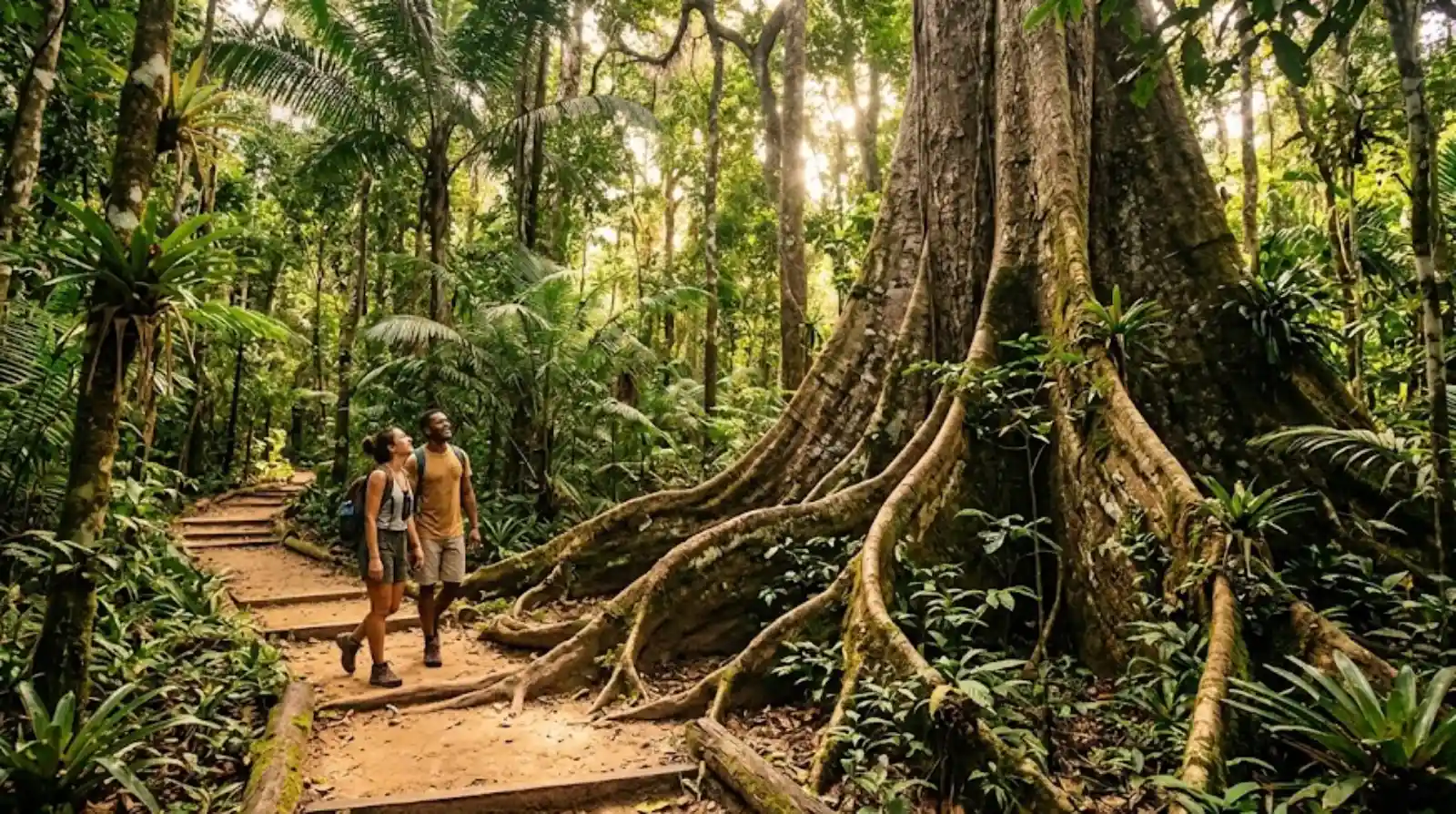
In the western part of Pará state, in the Brazilian Amazon, the Tapajós National Forest stretches across more than 527,000 protected hectares between the right bank of the Tapajós River and the BR-163 highway, in the Lower Amazon region, a few hours from the city of Santarém. Trees older than 500 years grow there, among them the legendary kapok, or samaúma (Ceiba pentandra), whose root systems are so vast that visitors say they can hear them “talking” when the trunks are gently tapped. It is one of the few places on the planet where a person can touch a living being that was already standing before Europeans reached the Americas.
The reserve, known in Brazil as Flona do Tapajós, is far more than a biodiversity bank. It works as a living museum of Brazilian natural history, with a network of trails that brings the public close to the essence of primary rainforest in a safe and educational way. That orderly access, rather than threatening the forest, has become one of the most effective tools for keeping it intact.
Trails that tell the story of life
The visitation system at the Tapajós National Forest was designed to keep environmental impact to a minimum while maximising ecological education. Routes range from easy walks to expeditions lasting several days, and they are led by local guides, many of them residents of the 28 communities and Indigenous villages that live inside the reserve. Walking these trails amounts to a hands-on lesson in forest stratification, as hikers watch upland terra firme forest give way to the seasonally flooded várzea areas. Careful technical management of the routes ensures that the flow of tourists does not interrupt wildlife corridors, allowing leisure and wild fauna to coexist.
Standing in front of a tree that has lived for half a millennium changes the human perception of time and nature. These giants regulate local microclimates and act as massive carbon reservoirs, which makes the preservation of the reserve a strategic piece of the climate commitments made by Brazil. Support from institutions such as ICMBio, the federal agency responsible for protected areas, is decisive in sustaining enforcement against illegal logging. In that context tourism becomes a protective barrier: where there are attentive eyes of visitors and guides, the forest remains standing.
Community based tourism and social inclusion
One of the great distinguishing features of the Tapajós National Forest is its commitment to accessible ecotourism fully integrated with local populations. Unlike isolated parks, it is a Sustainable Use Conservation Unit, a category that allows traditional communities to make a living from the forest without destroying it. Latex handicrafts from communities such as Jamaraquá, along with meals prepared with ingredients from the regional sociobiodiversity, including andiroba oil and honey from native bees, generate a circular economy that benefits the guardians of the forest directly.
For travellers seeking a full immersion, the Amazonas Sustainable Foundation highlights community based tourism models that can be applied across the region. Inside the Flona, the visitor is not a mere spectator but an agent who finances conservation. The money spent on guides, lodging and local food is what guarantees that families do not have to fall back on degrading activities in order to survive. It is economic sustainability proving a simple point: the forest is worth far more when it is conserved and shared with the world.
That equation matters because the alternative is well known across the Amazon. Where standing forest generates no income, pressure grows for logging and land clearing. By turning visitors into a steady source of revenue for households inside the reserve, ecotourism makes conservation the most rational economic choice available to the people who actually live there, and it does so without pushing them out of the territory they have always occupied.
Science beneath the canopy
Beyond leisure, the Tapajós National Forest is a hub of international scientific research. Several studies on forest regeneration and biomass dynamics are carried out beneath its centuries old trees. Researchers from the LBA, the Large Scale Biosphere Atmosphere Experiment in the Amazon, use monitoring towers to understand how the forest “breathes” and how it responds to changes in global temperature. Those 500 year old trees are genuine climate archives, storing in their growth rings precious data about the droughts and rainy seasons of the past.
A visit also opens a window onto the social technology developed by riverside populations. The management of açaí (Euterpe oleracea), the harvesting of Brazil nuts and the production of vegetable leather show how human ingenuity can work with biological cycles instead of forcing them. The EcoBrasil portal offers guidelines on responsible tourism and restates the old rule of leaving nothing but footprints and taking nothing but photographs. The Tapajós reserve is a perfect example that the Amazon can be opened to the world in an ethical and sustainable way.
Indigenous cosmology and wellbeing in nature
Many Indigenous villages inside the Flona, including those of the Munduruku people, understand the great trees as spiritual beings. For them conservation is not merely a technical matter, it is sacred. Respectful ecotourism allows visitors to approach that worldview and to experience a form of wellbeing that only deep contact with nature can provide. Recent studies on forest bathing, the Japanese practice of shinrin-yoku, indicate that time spent under the canopy of ancient trees significantly reduces stress and strengthens the human immune system, turning the reserve into a destination for health and renewal.
Over its 25 years, Revista Amazônia has followed the transformation of the Tapajós National Forest from an area marked by extraction into an admired conservation model. The success of this unit proves that with serious public policy and community engagement it is possible to reverse cycles of destruction. The centuries old trees of the Tapajós are witnesses of the past, yet through conscious ecotourism they become bridges to a future in which humanity finally learns to walk with the forest instead of against it.
The future of conservation in the Lower Amazon
The current challenge lies in maintaining connectivity between the Flona and other protected areas, creating biodiversity corridors that allow the movement of species such as the jaguar (Panthera onca) and the harpy eagle (Harpia harpyja). Strengthening regional tourism in nearby towns, including Santarém and Alter do Chão, weaves a protective network that values the integrity of the whole landscape. The Tapajós National Forest is the beating heart of that system, and its health is vital to the resilience of the entire Amazon basin.
A guide for responsible visitors
Getting there and when to go. Visitors to the Tapajós National Forest are advised to hire guides accredited by local community associations such as ACCOTAP. The main access is usually from Santarém, in Pará, either along the BR-163 highway or by river along the Tapajós. The best months for walking the upland trails run from July to December, the so called Amazonian summer, when rainfall decreases. Closed shoes are mandatory, as is full respect for the codes of conduct set by the Federal Government for conservation units.
Walking among centuries old trees is an exercise in humility and hope. These giants have survived centuries of political and climatic change, standing firm and silent, and they teach that real wealth is the kind that grows slowly and benefits everyone. In the Tapajós National Forest every step along the trails is a reconnection with our deepest biological roots, and Amazonian sustainability stops being an abstract concept: it becomes something you can touch by resting a hand on the root of a tree that watched the world change while the forest kept it safe.
Reporting: Anne Silva / Amazonia Mag. Source: Revista Amazônia, ICMBio, LBA, EcoBrasil, ACCOTAP.

Editor · Amazonia Mag
Anne Silva is the editor of Amazonia Mag, the English-language edition of Revista Amazônia. She curates, translates and adapts the outlet's science and environment coverage for an international audience, reporting on Amazon wildlife, flora, rivers, climate and research. Every story she edits is grounded in peer-reviewed studies, official data and on-the-ground reporting from the Revista Amazônia newsroom in Belém, Pará, Brazil. More by Anne Silva →