
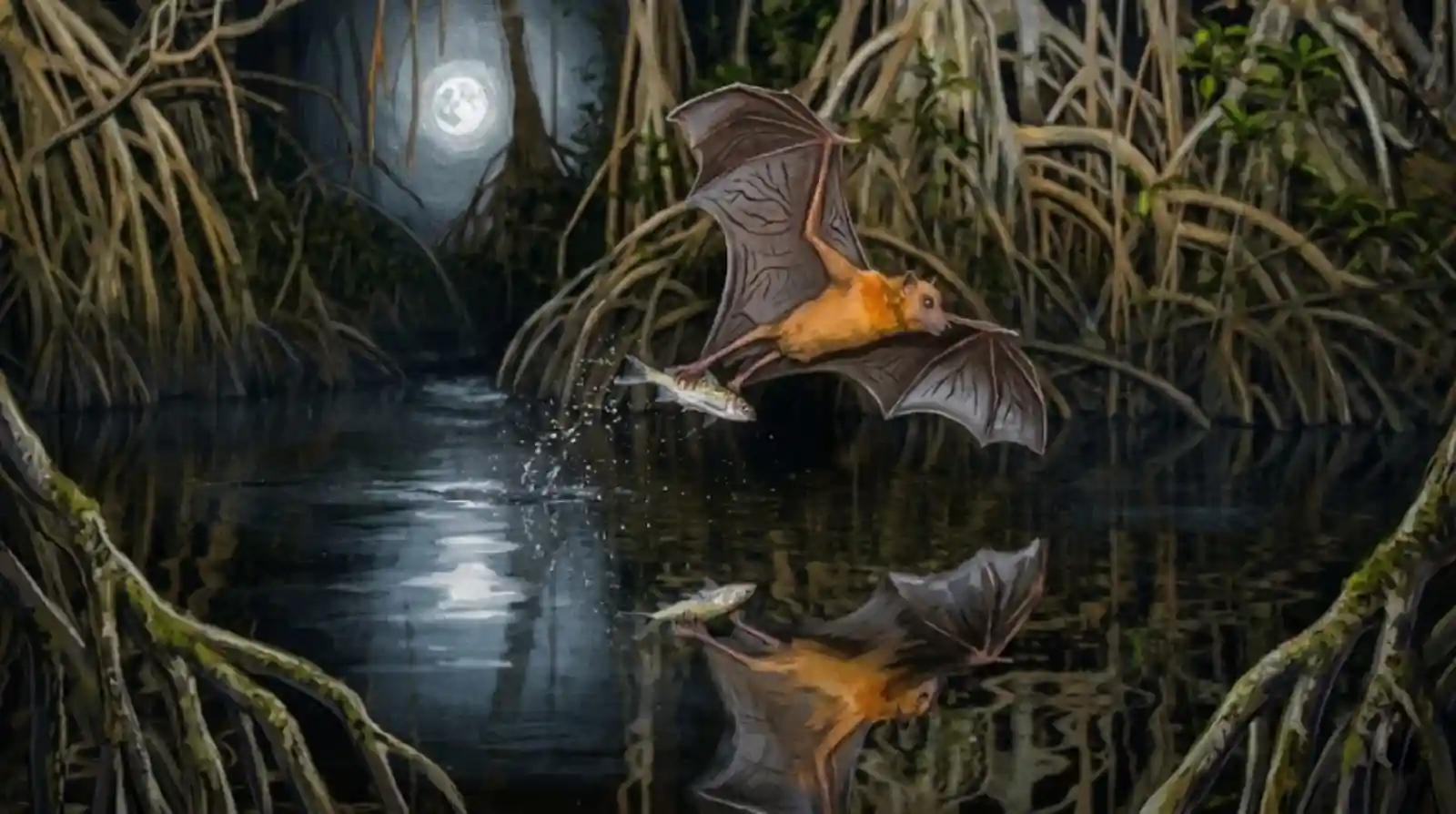
A ripple no taller than a human hair is all it takes to give a fish away to the Amazon fishing bat. In the total darkness of a river night, when no sight based predator can tell water from air, this flying mammal finds its meal by reading the skin of the river. The species, known scientifically as Noctilio leporinus, is one of the most striking cases of evolutionary specialisation in the animal kingdom. While most of its relatives feed on insects or fruit, this one learned to turn sound into fish.
A low pass over lakes and flooded forest
Science recognises that the adaptation of these animals to aquatic life is unique among bats. With proportionally long legs and feet armed with curved claws as sharp as fish hooks, the fishing bat works like a biological machine built for precision. It does not dive after its prey, which is what many people assume when they first hear the name. Instead, it flies extremely low over the calm water of lakes and igapós, the seasonally flooded forests of the Amazon, holding a steady line while it waits for the right signal.
When its aquatic echolocation system detects a disturbance on the water caused by the movement of a fish, the animal drops its hind legs and drags its claws across the surface. The capture happens in a fraction of a second, with an agility that is difficult to follow even for a trained observer. From detection to the climb back up with the prey secured, the whole sequence unfolds without the bat losing altitude or stability, a manoeuvre the forest repeats night after night above Brazilian rivers.
How sound reveals a fish that is under water
Echolocation sits at the centre of life for Noctilio leporinus. By emitting high frequency sound pulses that bounce off objects, the bat builds a detailed mental map of everything around it. Fishing, however, runs into an awkward physical problem: sound does not easily pass into water when it travels from the air. Much of the energy is reflected back the moment it strikes the surface, which means a submerged fish is effectively invisible to a sonar beam fired from above.
To get around that barrier, the fishing bat learned to interpret what specialists call surface echoes. Studies indicate that it responds to the small waves and bubbles fish leave behind when they rise to breathe or feed near the boundary between the two worlds. It is not hunting the fish itself. It is hunting the mark the fish leaves on the water. That is a demonstration of biological intelligence that turns noise into food, and it explains why the stillness of a flooded forest pool is the best hunting ally this animal has.
The system is refined enough to let the bat tell a floating branch apart from the fin of a real fish, a subtle difference that separates a successful night from a wasted one. Through the Amazon night, when visibility drops to nothing for almost every other hunter, the fishing bat has the water to itself. It can take dozens of small fish in a single hunting run, storing them in cheek pouches so it can process them later rather than interrupting the flight after every catch.
An anatomy built to grip scales
The physical structure of the fishing bat deserves attention of its own. Its feet are large and its claws have a hydrodynamic shape that reduces drag while they cut across the water, letting the animal hold its speed at exactly the critical instant. The wings are long and narrow, which produces the stable, powerful flight needed to carry the extra weight of soaked prey. Even the fur is distinctive: short and often reddish or orange in tone, it sets the species apart at a glance from the smaller bats that share the same stretches of forest.
The claws on the hind feet are extraordinarily sharp and grow in a way that makes it easier to lock instantly onto fish scales. During the low pass, the bat closes its feet with an automatic mechanical pressure the moment it feels the impact on the water, without needing a conscious decision. That morphological adaptation is what allows it to capture prey weighing up to a third of its own body weight without losing balance in mid air, a feat of physical control that is rare among flying mammals.
The fisher that links the river to the forest
As a top predator within its niche, the fishing bat helps regulate populations of small fish and large aquatic insects. Its nocturnal activity keeps energy flowing steadily between the aquatic and the terrestrial ecosystem. Because it feeds on the river and rests in trees or in hollow trunks, it moves nutrients efficiently through the forest, and that quiet transfer contributes to the natural regeneration of the permanently protected areas that ring the large bodies of water in the region.
Watching Noctilio leporinus has also become a valuable tool for environmental education. Dismantling the fear many people feel towards bats is far easier when the remarkable abilities of the Amazon fisher are put on display. It is not a threat to human beings. It is an ally in maintaining biodiversity and a bioindicator of environmental quality. Where the fishing bat is actively hunting, there is a clear sign that the river system remains alive and productive, supporting a complete and functional food chain.
Clean water and silence keep the sonar working
Protecting the rivers and the gallery forests along them is essential to the future of the species. The fishing bat depends on clean water free of noise pollution so its sonar can operate without interference, because any added sound can erase the faint signal it needs to read. In places where the mirror of the water stays intact, its hunting success rate becomes extremely high. That reinforces a broader point: the health of Amazon waters is directly tied to the survival of species that live in the air above them.
Researchers acknowledge that a great deal remains unknown about the social communication and local movement patterns of these animals. Acoustic monitoring technology has allowed scientists to follow hunting routes without interfering with the natural behaviour of the species, gathering data that would be impossible to collect by direct observation in the dark. Safeguarding igapó and várzea areas is the most effective strategy for keeping the sound of Noctilio leporinus echoing over the water for generations to come.
That conservation effort is not only about wildlife. The same habitat that shelters the bat sustains the fish stocks that riverside communities depend on, which means protecting one supports the other. Investing in knowledge about Brazilian fauna is a way of valuing what the country holds that is most authentic, and the fishing bat is proof that evolution rarely follows obvious paths.
The harmony between flight and water shows that, in nature, the boundaries between elements are simply invitations for life to find new ways of shining in the dark. The Amazon still holds natural solutions that human engineering is only beginning to understand, and this small nocturnal fisher is one of the clearest examples of that.
Reporting: Anne Silva / Amazonia Mag. Source: Revista Amazônia.

Editor · Amazonia Mag
Anne Silva is the editor of Amazonia Mag, the English-language edition of Revista Amazônia. She curates, translates and adapts the outlet's science and environment coverage for an international audience, reporting on Amazon wildlife, flora, rivers, climate and research. Every story she edits is grounded in peer-reviewed studies, official data and on-the-ground reporting from the Revista Amazônia newsroom in Belém, Pará, Brazil. More by Anne Silva →