
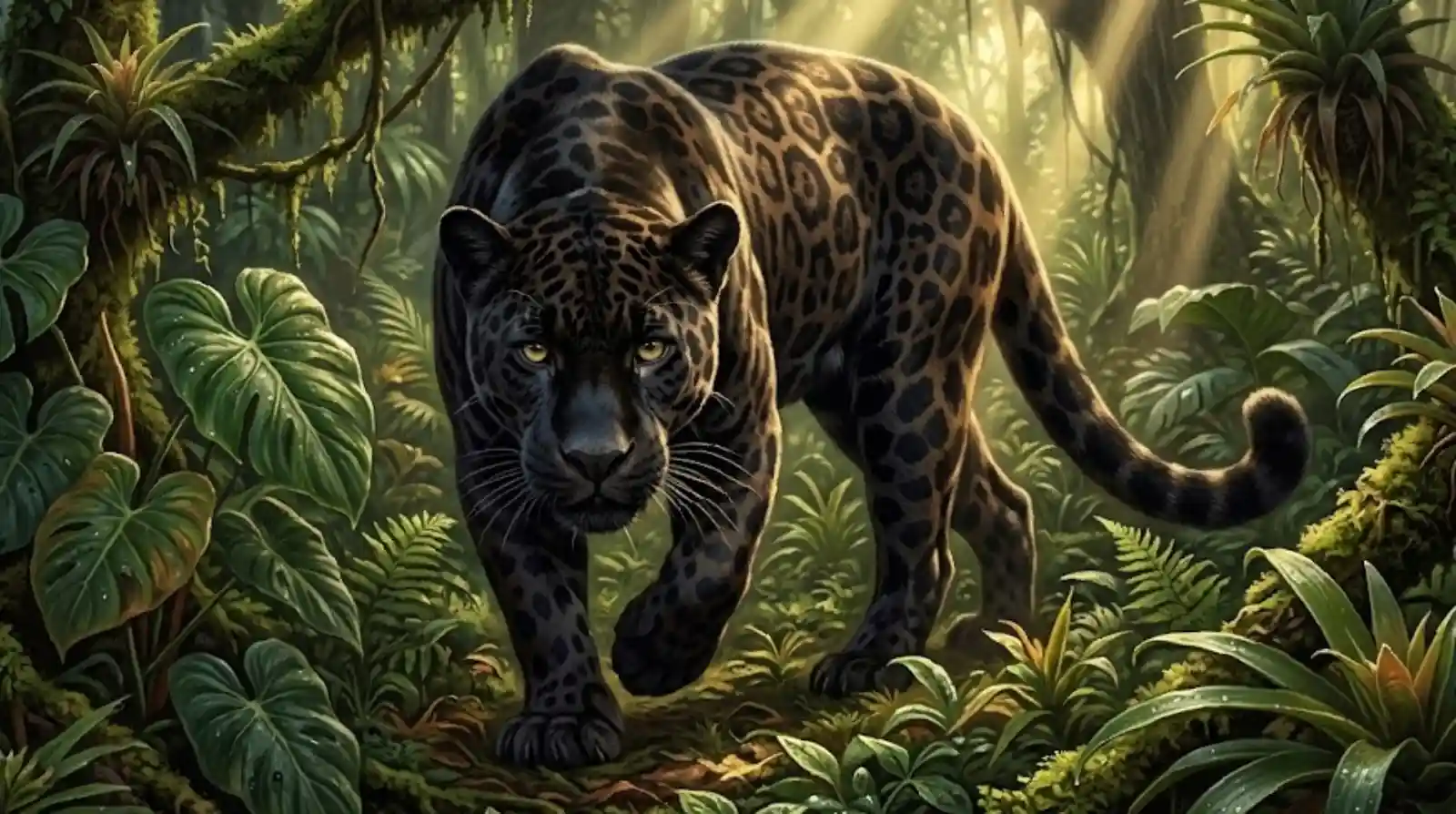
For centuries, the completely dark cat that slips through the shadows of the tropical forest fed the suspicion of a separate creature, a secret species that science had somehow failed to name. The real answer is simpler and, at the same time, far more interesting: the animal belongs to no distinct lineage at all. It is a jaguar, Panthera onca, carrying a genetic variation that hides its famous rosettes beneath a dense layer of pigment. The phenomenon is called melanism, and it springs from a mutation in the melanocortin receptor gene, which drives an excessive production of melanin in the coat.
Despite the popular name, the black panther of the American continent does not exist as a species. It is the same jaguar as always, with the same anatomy, the same behaviour and the same place in the food chain, simply dressed in another colour. The apparent absence of markings is an optical illusion. Under direct sunlight, a careful observer can still make out the characteristic spots of the species, present as ever, working like a unique fingerprint beneath the black cloak that has fascinated travellers and researchers for generations.
A mutation, not a new species
Science estimates that melanism appears in roughly 6% of the global population of these cats, and that it is a dominant inherited trait. The practical consequence surprises most people who hear it for the first time: a single litter can contain cubs with the traditional yellowish coat alongside siblings with a dark coat, born to the same parents, raised in the same territory, fed by the same mother. No separation between them is possible, neither biological nor ecological.
That coexistence inside one family says a great deal about the genetic plasticity of South America’s big cats. Nature does not produce the dark colour as an isolated accident, but as one of many variations circulating inside a healthy population. When gene flow works, when animals can move, meet and breed with individuals from other groups, those variations stay alive and keep surfacing generation after generation across different ecological niches of the forest.
The exact reverse of albinism
The clearest way to understand melanism is to picture it as a mirror image of albinism. If albinism is the total absence of pigment, melanism is its peak, the point of full saturation. In the case of the jaguar, that genetic condition carries no harm to the health of the animal, does not alter its social behaviour and does not interfere with its hunting skills. A melanistic jaguar hunts, defends territory and raises cubs exactly as any other jaguar does.
There are even signs of advantage. Several studies indicate that the dark colouring can offer adaptive benefits in dense, closed forest environments where very little light reaches the ground. Under those conditions, the melanistic animal blends with the shadows of the foliage even more efficiently than spotted individuals, becoming a practically invisible predator at dusk, precisely at the hour when hunting pays off most.
Two continents, two genetic routes
One detail that usually goes unnoticed reveals how far evolution works by independent trial: the gene responsible for melanism in the jaguar is not the same gene that produces the equivalent effect in leopards across Africa and Asia. Two distinct lineages, on separate continents, arrived by different genetic routes at a result that looks almost identical to the human eye.
That phenomenon, known as convergent evolution, underlines how effective the dark coat is as a survival tool. When two separate paths lead to the same solution, it is a strong sign that the solution works. In the Amazon, records of melanistic individuals also read as an indicator of the genetic health of the local population, showing that the exchange of genes remains active and that rare traits can still persist in the landscape.
The rosettes that sunlight reveals
For nature photographers and field biologists, few moments match the instant when the markings emerge from the black. When light strikes the fur at a specific angle, the contrast between the different textures of melanin allows the rosettes to appear sharply. Some specialists call them ghost markings, and they are far more than an aesthetic curiosity.
Because the rosette pattern is unique to each individual, much like a human fingerprint, researchers can identify and catalogue specific black jaguars even when the animals look identical from a distance. Camera traps installed in the forest depend on that detail for population surveys. Without such differentiation there would be no way to know how many distinct animals roam an area, nor to track the health of melanistic populations over time.
What the black jaguar demands of the forest
Whatever the colour of its coat, the jaguar plays the role of sentinel species and apex predator. Its presence certifies that the entire ecosystem below it remains in balance. To sustain a cat of that size, the forest needs healthy populations of peccaries, tapirs, capybaras and caimans. Protecting the territory of an animal that requires enormous areas to live means automatically protecting thousands of species of plants, insects and small vertebrates.
Deforestation and habitat fragmentation are the greatest enemies of that genetic diversity. When groups are isolated on small islands of forest, the chances that beneficial or neutral mutations such as melanism will pass to the next generations fall sharply. Every national park and every extractive reserve created in the Amazon works, in that sense, as a shelter for the genetic heritage of the planet.
From fear to admiration
Traditional knowledge also reveres the black jaguar as a figure of power and mystery. In many riverside and Indigenous communities, an encounter with a melanistic animal is recounted with an almost sacred respect, passed on orally across decades. That connection between genetics and cultural perception is precisely what sustains conservation efforts over the long term.
Explaining the biological reality of these animals to new generations helps replace fear with admiration. The jaguar stops being a vague threat and becomes a symbol of pride and an icon of wildlife watching tourism, an activity that generates sustainable income for local communities. Looking at a photograph in which the spots surface under the glare of the sun means receiving a living lesson in how life adapts and diversifies beneath the canopy.
The beauty hidden in the rosettes of a melanistic jaguar teaches a final lesson worth keeping: nature always holds deep layers of secrets for anyone willing to look with patience and respect. The black jaguar is not a rarer creature than the spotted one, only a differently lit version of the same animal, and its survival depends on the same forests, the same prey and the same corridors that every other jaguar needs.
Reporting: Anne Silva / Amazonia Mag. Source: Revista Amazônia.

Editor · Amazonia Mag
Anne Silva is the editor of Amazonia Mag, the English-language edition of Revista Amazônia. She curates, translates and adapts the outlet's science and environment coverage for an international audience, reporting on Amazon wildlife, flora, rivers, climate and research. Every story she edits is grounded in peer-reviewed studies, official data and on-the-ground reporting from the Revista Amazônia newsroom in Belém, Pará, Brazil. More by Anne Silva →