
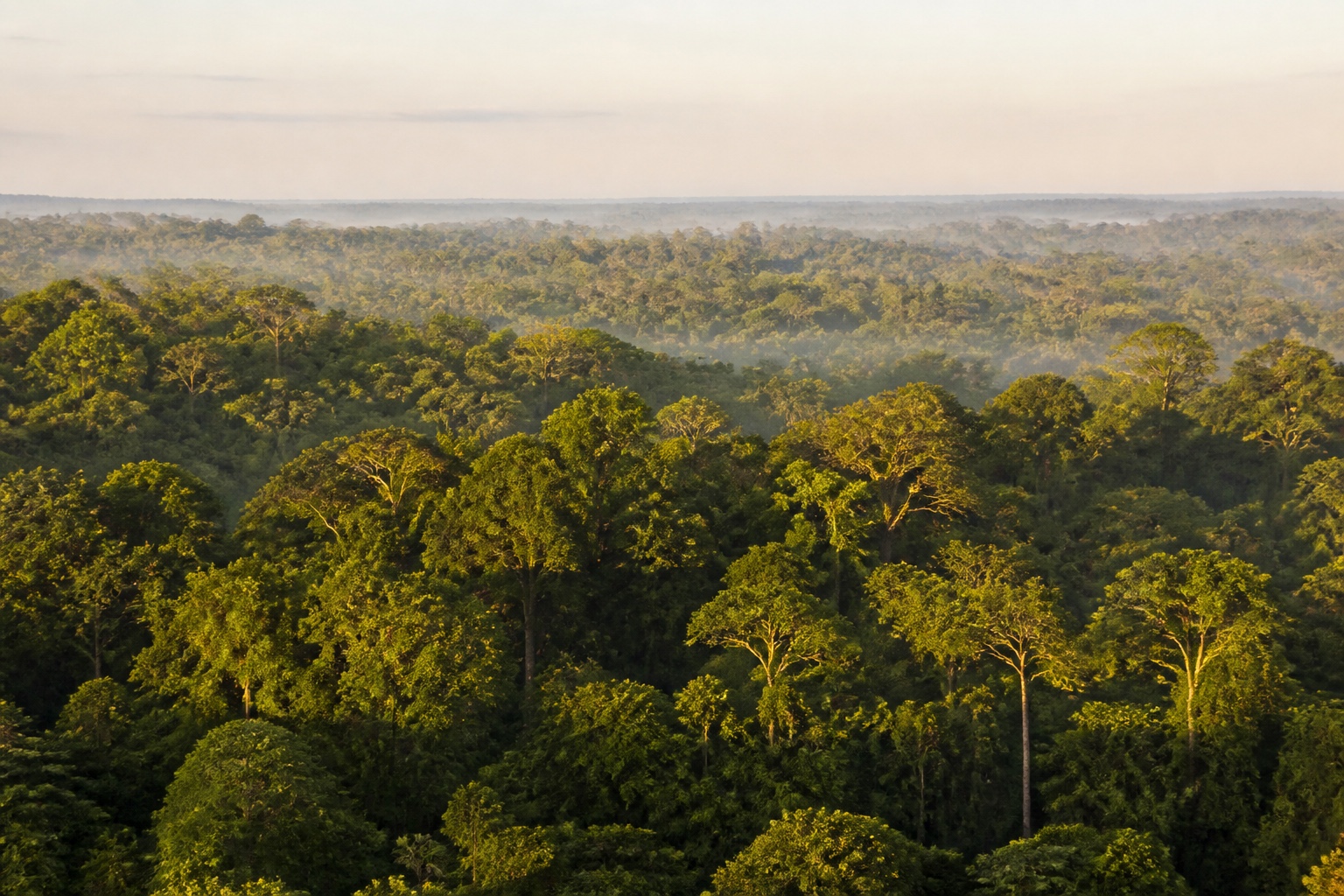
A forest under drought does not fall silent: it changes vocabulary. Between 2023 and 2024, when El Niño pushed the Amazon basin into one of the most severe dry spells ever recorded there, a group of researchers stopped looking only at fallen leaves and dead trunks and started measuring the air instead. What they found was a clear shift in the mixture of volatile molecules that trees release into the atmosphere, a set of compounds linked to plant stress.
The work measured three families of substances: isoprene, monoterpenes and sesquiterpenes. These are compounds that vegetation emits routinely, but whose proportions move when environmental conditions change. The results were published in the journal Communications Earth and Environment. Those molecules play a role in the defence of trees and, at the same time, interfere with the chemistry of the air surrounding the forest.
One point deserves clarifying at the outset, because it is easy to misread. When people say the forest speaks during a drought, that is a scientific metaphor and not an acoustic phenomenon. Nobody recorded new voices or noises among the trees. What changed was the chemical signature of the air, meaning the combination and the intensity of the molecules given off by the vegetation. Calling that a language is a way of describing an exchange of chemical information, not an audible sound.
The smell of the forest is not a subjective impression
Plants release molecules for many reasons: to attract pollinators, to drive off herbivores, to signal stress and to respond to temperature. The mixture varies with the species, the available light, the water the roots manage to draw from the soil and the presence of damage on the leaves. There is no single smell of the forest, only a shifting composition that reassembles itself over the course of a day.
For a person walking beneath the canopy, some of these compounds arrive as the scent of leaves, resin or wet earth. For the atmosphere, by contrast, they are ingredients in chemical reactions able to form particles, alter air quality and influence the way the forest interacts with solar radiation. The same compound that the human nose barely registers can carry considerable weight in the physics of the region.
As drought deepens, every plant faces a physiological dilemma. Opening the stomata lets carbon dioxide in, which photosynthesis requires, but it also speeds up water loss through transpiration. Closing them protects the water reserve and limits energy production. The release of volatile compounds is part of that complex adjustment, which is why measuring it offers a reading of the internal state of the vegetation.
What El Niño made visible
The 2023 and 2024 period offered an uncommon opportunity to observe forest chemistry under pressure. The phenomenon altered temperature, rainfall and humidity across large areas of the Amazon and created a setting no laboratory could reproduce at that scale. Instead of counting only dead trees or fallen leaves, the team followed responses that occur before visible signs of collapse appear.
That point is central. The molecules recorded do not work as a simple thermometer: a higher concentration does not automatically mean the whole forest is in danger, because different species respond in different ways. The value of the data lies in the set of changes taken together and in the comparison with conditions observed in earlier periods.
Air chemistry does not depend on the trees alone either. Wind, humidity, radiation and fires all shape what reaches the sensors. A plume of smoke can distort the results and make it harder to separate what the vegetation emitted from what arrived from an outside source. Continuous measurement is therefore far more informative than an isolated sample taken on a single date.
The tree’s defence reaches the sky
A plant under stress can release compounds that work as a warning to neighbouring organisms. Some molecules help repel herbivores; others attract the natural enemies of the insects attacking the leaves. The effect is not sealed inside plant tissue and does not stop at the edge of the crown.
In the atmosphere, those compounds react with oxidants and can contribute to the formation of aerosols. Aerosols in turn influence clouds and suspended particles, although the final effect varies with the quantity emitted, the composition of the mixture and the meteorological conditions at the time.
This is where plant physiology and climate meet. The tree responds to its environment, and its response modifies that same environment. The forest is not merely a surface that receives rain and heat: it takes an active part in the chemistry that helps organise the regional atmosphere. Understanding a drought therefore also means looking upward.
A chemical signal that could become monitoring
Sensors for volatile compounds can complement satellite imagery, rainfall data and carbon flux measurements. A map may show vegetation that is still green while the chemistry of the air indicates that the plants are already facing a different regime of stress. That gap between what is seen and what is measured is precisely what makes the tool useful.
The chemical alert does not replace fieldwork, however. It is necessary to know which species are present in the area, how the soil stores water and whether there was fire or selective logging nearby. The signal only makes full sense once it is connected to local ecology and to the history of land use in the territory.
There is also a practical consequence worth stating plainly. Most drought indicators currently in use describe damage that has already happened, whether that is a burned scar, a thinning canopy or a fallen tree. A measurement taken from the air belongs to a different category, because it registers an adjustment while the plant is still adjusting. That does not turn it into a forecast, and no single reading can announce what a forest will look like next season, but it does move the observation earlier in the sequence of events.
The study reveals a quiet peculiarity of the Amazon: during a drought, the forest may change its smell before the change is perceived as landscape. The molecules released by the trees work as a conversation with the air and also as a clue that the climate crisis is advancing on a scale invisible to the human eye.
The journalistic value of this finding lies in bringing an invisible measurement close to an everyday scene. A stretch of woodland can look silent and green while it is reorganising its chemical strategies in order to keep functioning. Measuring the air helps tell that part of the story before the drought leaves marks that are easier to photograph.
Reporting: Anne Silva / Amazonia Mag. Source: Revista Amazônia, revistaamazonia.com.br.

Editor, English Edition — Amazonia Mag
Anne Silva is the editor of Amazonia Mag, the English-language edition of Revista Amazônia. She curates, translates and adapts the outlet's science and environment coverage for an international audience, reporting on Amazon wildlife, flora, rivers, climate and research. Every story she edits is grounded in peer-reviewed studies, official data and on-the-ground reporting from the Revista Amazônia newsroom in Belém, Pará, Brazil. More by Anne Silva →