
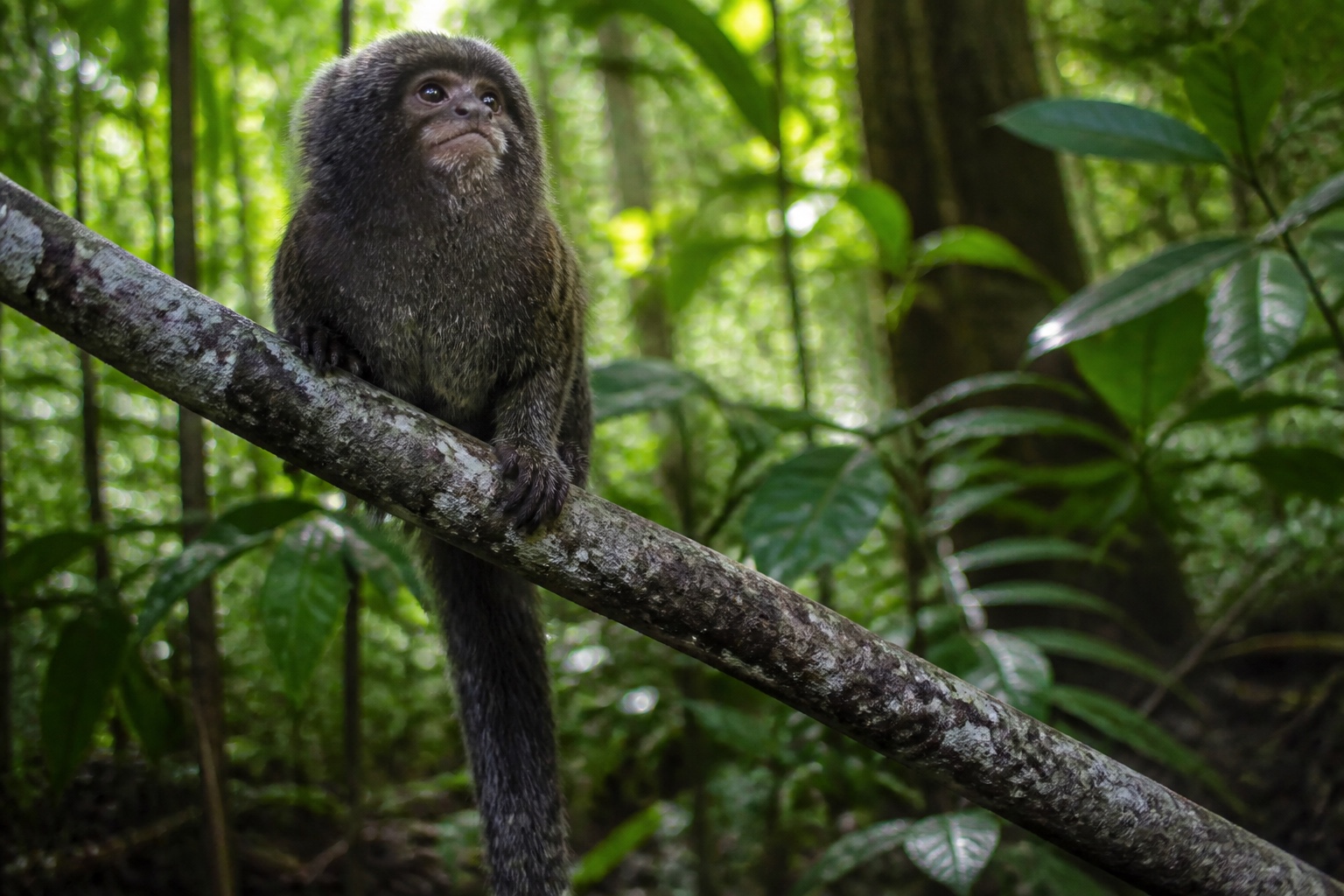
Goeldi’s monkey, known to science as Callimico goeldii, is one of the small primates tied to the forests of the upper Amazon. Its dark coat and its group life are the first things anyone notices, yet a recent study looked at something far less visible: the animal’s internal clock shifts along with the conditions around it. Activity recorded in captivity varied in step with daylight, with atmospheric pressure and with biological events inside the group itself.
The research, published in the journal Scientific Reports, followed how individuals moved over time. It never set out to reproduce the full complexity of a rainforest. The goal was narrower and more useful: to see how environmental factors can shape behavior. That difference matters, because it lets researchers pull apart questions that usually get tangled together. Is the animal moving more out of need, out of habit, out of reproduction or because something in its surroundings has changed?
The day starts before the first movement
For a forest primate, light is not merely illumination. It helps organize the search for food, the rest periods, the social interaction and the time spent watching for danger. In dense habitat, the brightness that reaches the understory can be very different from what an instrument measures in open ground. The body reads those changes through physiological rhythms that owe nothing to an artificial clock.
The team tracked motor activity and compared the records against environmental variables. Atmospheric pressure, to take one example, can shift before the weather itself does. It would not be accurate to say that the primate forecasts a storm the way a person checks an app. What can be said is that the organism responds to physical conditions that happen to precede changes in the environment.
That distinction rules out an easy but sloppy narrative. Animals do not need to be aware of a phenomenon in order to react to it. Humidity, brightness, temperature and pressure act on the body, on the availability of food and on how safe it is to move through the canopy. Behavior emerges from several forces working at once, not from a single trigger acting alone.
Measuring activity continuously carries an obvious advantage: it captures what a single snapshot loses. A few hours of observation might suggest that the animal is busiest in the morning. A long series reveals variation across days, weeks and seasons. It is at that larger scale that the overlaps between behavior and environment become visible, and it is also there that coincidence can be ruled out with some confidence.
A birth reorganizes the routine as well
One of the most compelling parts of the study was following the relationship between activity and birth. The arrival of an infant alters the group’s routine, the use of space and the attention of the adults. An animal that used to move in a fairly predictable way now belongs to a social structure built around protection, feeding and parental care.
That stretch of time helps explain why averages of movement can mislead. A daily curve does not describe the weather alone. It also carries the events of group life. Reproducing, caring for an infant, competing for food or adjusting a position within the hierarchy are all capable of reshaping the observed pattern while every environmental variable stays exactly where it was.
What captivity shows, and what it hides
Studies in captivity make it possible to follow individuals precisely, to repeat measurements and to control part of the variables. Doing the same in the forest is far harder, because the canopy, the distance and the darkness keep the animals out of sight. At the same time, an enclosure is not an Amazonian landscape. The supply of food, the absence of predators and the size of the territory change the animal’s experience in ways that cannot be ignored.
The value of this kind of work lies in identifying relationships that can later be tested in the wild. If a change in pressure lines up with a change in activity inside an enclosure, researchers know to look for the same signature in field records. If the pattern fails to appear out there, that too is information: the forest is adding stimuli the experiment never reproduced.
Why a small primate matters for conservation
Smaller species tend to vanish from the conversation whenever conservation is measured only by large mammals. Yet their schedules, their routes and their social ties reveal how the forest is functioning at understory level. A shift in the light regime or in the supply of fruit can register in their activity long before it produces any obvious signal in satellite imagery.
That detail has practical consequences for anyone designing protected areas and ecological corridors. A forest can still be standing and yet deliver a very different light to the understory once the canopy has opened up. If the animals’ clock answers to brightness, then the structure of the vegetation stops being a matter of scenery and becomes a conservation variable worth measuring.
Goeldi’s monkey is also a reminder that climate does not act on trees and rivers alone. It interferes with the daily calendar of animals. Gradual changes can reach reproduction, rest and feeding, especially when they arrive together with forest fragmentation and the loss of continuous habitat.
A clock built from light, pressure and social ties
The most provocative finding is not the discovery of one master switch for movement. It is the realization that behavior grows out of the combination of environment and social life. The small primate reacts to brightness, to the air, to the birth of an infant and to the company of its group. Each factor bends the others, and none of them explains the whole scene by itself.
There is also a clear agenda ahead. Comparing what was seen in captivity with records gathered in the field, widening the number of individuals followed and checking whether the same factors weigh as heavily in other small primate species are the natural next steps. None of that demands a spectacular breakthrough. It demands observation time, which is precisely what tends to be scarce in the science of Amazonian biodiversity.
Watching this clock is a way of enlarging what biodiversity means. A forest is not simply an inventory of species: it is a sequence of routines tuned to the physical world. When the Amazon changes, the earliest signals may show up exactly in the hours when its animals stop doing what they have always done.
Reporting: Anne Silva / Amazonia Mag. Source: Scientific Reports.

Editor, English Edition — Amazonia Mag
Anne Silva is the editor of Amazonia Mag, the English-language edition of Revista Amazônia. She curates, translates and adapts the outlet's science and environment coverage for an international audience, reporting on Amazon wildlife, flora, rivers, climate and research. Every story she edits is grounded in peer-reviewed studies, official data and on-the-ground reporting from the Revista Amazônia newsroom in Belém, Pará, Brazil. More by Anne Silva →