
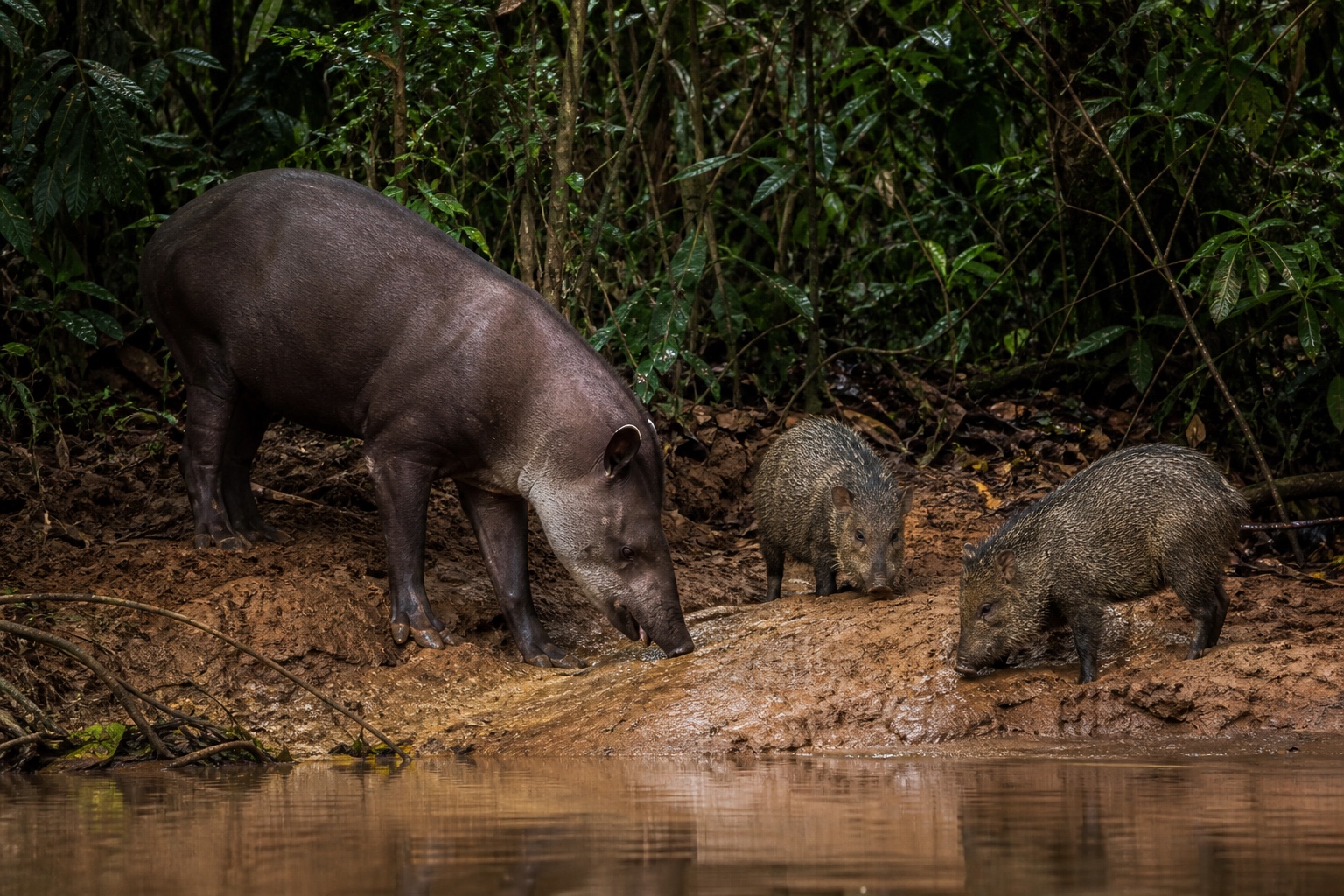
In certain corners of the Amazon, the ground itself becomes food. Along eroded riverbanks, exposed slopes and small openings in the understorey, mammals arrive to lick or swallow soil. Biologists call these places salt licks, or mineral licks. In the Spanish speaking Amazon they are known as colpas or saladeros, and in Brazil as barreiros. Every name points to the same thing, a patch of terrain where the earth concentrates minerals and attracts animals that, in theory, live on leaves and fruit. The behaviour has a technical name as well: geophagy, the deliberate eating of soil. To anyone who pictures the rainforest as a world of foliage, the scene looks strange. To tapirs, peccaries, deer and monkeys, it is simply routine.
A study published in the journal Scientific Reports examined the factors that drive large Amazonian mammals to visit these places. The research did not treat the behaviour as an isolated curiosity or a piece of field anecdote. The aim was to understand what actually exists at those points, and why they can matter so much to animals with very different diets, body sizes and physiological demands.
A rich forest that concentrates minerals in tiny spaces
Amazonian soil is known for the low availability of certain nutrients across much of the landscape. That does not mean the forest is poor in life. Quite the opposite: its plant and animal diversity depends on extremely efficient cycles, in which leaves, roots, fruit, microorganisms and water constantly redistribute the elements that are available. Even so, some minerals turn up more concentrated in specific spots on the ground, and those spots are not spread evenly through the forest.
Salt licks work as meeting points because they offer an uncommon combination of access, moisture and soil composition. Location matters just as much as chemistry. A bank exposed by erosion, a slope near a river or a gap in the understorey can be far easier to reach than a mineral layer buried under roots and leaf litter. Geology decides what lies below, but geography decides who manages to get there.
The research showed that a visit does not depend on the presence of salt alone. The size of the animal, the kind of food it eats and the dynamics of the surrounding landscape all shape the decision to approach. A fruit eating mammal may seek out a lick for reasons quite different from those of an animal that swallows large quantities of leaves or hard seeds.
Why eating soil can make sense
One hypothesis is that the soil helps supplement minerals missing from the diet. Another possibility is the adsorption of compounds found in plants, especially when animals feed on leaves or fruit containing substances that are difficult to process. These explanations are not mutually exclusive, and their weight can shift between species, between seasons and between sites separated by only a few kilometres.
The behaviour may also be tied directly to digestion. Large herbivores take in fibre, tannins and other plant compounds in considerable amounts. Geophagy could play a part in the chemical regulation of what has been swallowed, although the exact mechanisms still depend on analyses carried out species by species and soil by soil.
It is worth resisting the temptation to turn a hypothesis into a certainty. Watching an animal press its mouth against a bank does not by itself reveal which substances it is after. To answer that question, researchers need to compare samples of soil, dung, plants and tissue, and to track how often the visits happen and at which times of year they cluster.
A meeting point that also exposes
Salt licks carry another clear ecological effect: they concentrate individuals of different species within a very small area. That can favour the exchange of information and the early detection of predators, but it also creates a situation of risk. A predictable feeding place can be watched by hunters, particularly when it sits close to trails, navigable rivers or roads.
For that reason, protecting a lick is not a matter of fencing off a bank of earth. It means conserving the surrounding forest, keeping escape routes open, avoiding the opening of new access paths and understanding how the water level changes the way animals come and go. The site only exists ecologically because it is connected to a much larger landscape.
An open window for conservation
A visit to a lick can be used as an indicator that species which are hard to observe directly are still present. Tracks, digging marks, dung and camera trap records help estimate which animals use the site. When those data are combined with information on hunting, deforestation and rainfall patterns, the bank of earth becomes a window onto changes across the wider territory.
The study also reinforces a simple idea: apparently odd behaviour can reveal fundamental needs. The tapir that seems to be merely licking a bank is interacting at the same moment with geology, with vegetation and with its own digestive system. The monkey that visits the same point takes part in a web of relationships that appears on no map of forest cover.
Reading the same clue across many forests
There is also a methodological lesson buried in the finding. Because visits vary with body size, diet and landscape, a single lick observed over a single season says very little on its own. What gives the behaviour meaning is comparison: the same kind of site watched in different soils, at different water levels, with different assemblages of animals arriving. That is slow work, and it is the sort of work that rarely produces a dramatic headline, yet it is exactly what separates a plausible story from an established pattern.
The detail that changes how the Amazon is read
Knowing about geophagy prevents Amazonian wildlife from being reduced to a list of species. Each animal uses the forest in a particular way, and those choices can indicate the quality of the environment around it. An abandoned lick may signal disturbance, but it may equally reflect a rising river, a shift in the supply of fruit or the recent presence of a predator.
The most valuable information lies in repetition and in context. The Amazon does not have a single type of soil, a single season or a single kind of forest. Understanding why its animals eat earth therefore requires comparing places and periods without erasing the differences between them. The mystery of the salt licks is not an anomaly: it is a clue about how life finds nutrients in one of the most complex environments on the planet.
Reporting: Anne Silva / Amazonia Mag. Source: Scientific Reports.

Editor, English Edition — Amazonia Mag
Anne Silva is the editor of Amazonia Mag, the English-language edition of Revista Amazônia. She curates, translates and adapts the outlet's science and environment coverage for an international audience, reporting on Amazon wildlife, flora, rivers, climate and research. Every story she edits is grounded in peer-reviewed studies, official data and on-the-ground reporting from the Revista Amazônia newsroom in Belém, Pará, Brazil. More by Anne Silva →