
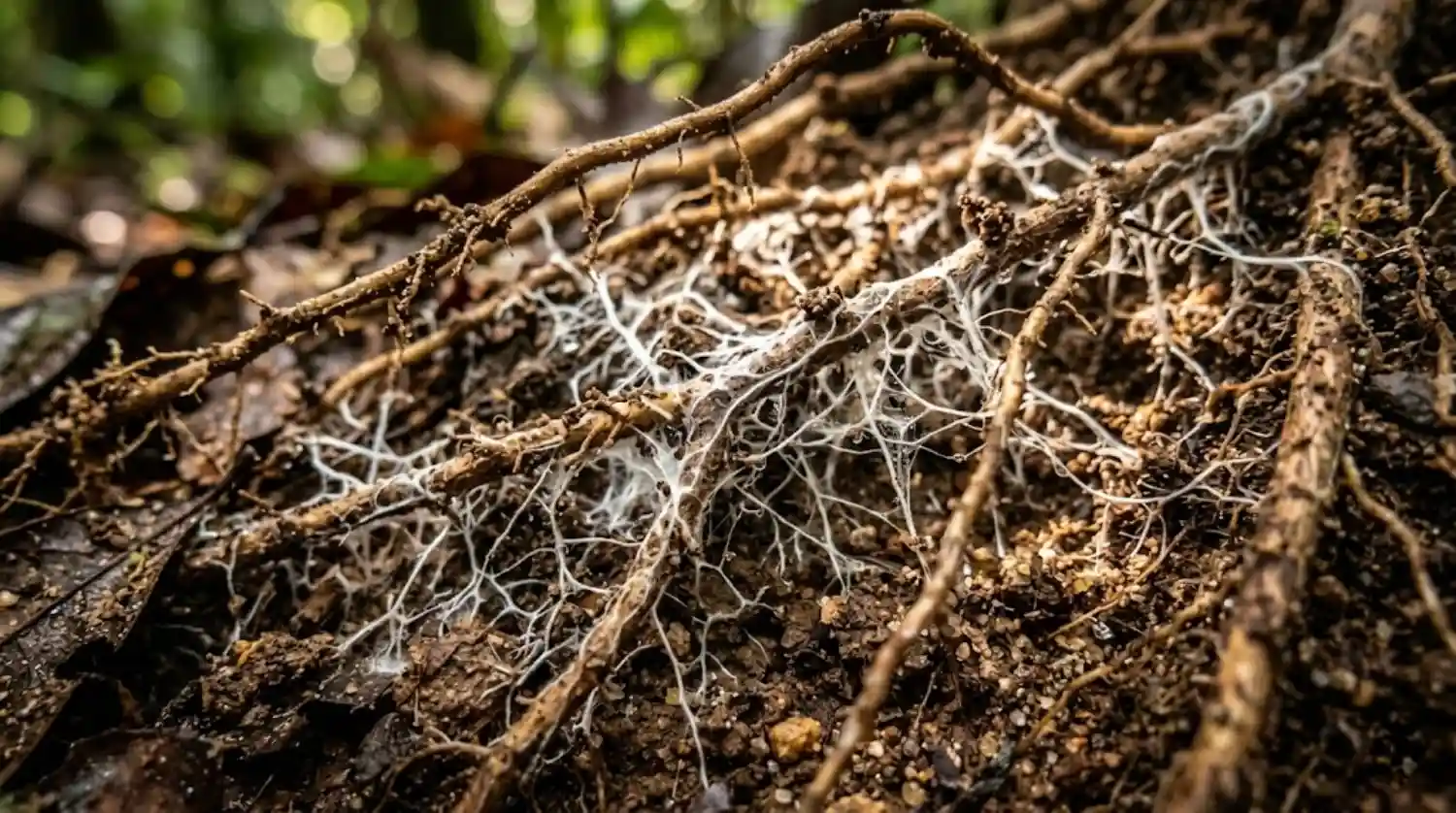
Kilometres of fungal threads packed into a single cubic centimetre. Beneath the Amazonian leaf litter runs a biological infrastructure that no satellite image can capture: the mycorrhizal network. In the soils of Pará, that dense tangle of fungi turns the Brazil nut tree (Bertholletia excelsa) into far more than a giant of the canopy. It becomes a distribution node, a genuine hub that takes in, processes and hands out phosphorus and nitrogen to neighbouring trees in exchange for the sugars it makes through photosynthesis.
This partnership is not a laboratory curiosity. It is the backbone of the forest’s climate resilience. Recent research carried out in soils across Pará showed that trees plugged into the underground network survive at a rate 30% higher during periods of extreme drought than isolated individuals. The decisive difference is not in the leaves or the trunk. It sits a few centimetres below the surface, out of sight of every monitoring programme built around the canopy.
A biological toll that pays back a thousandfold
The exchange works like a taxation system. The Brazil nut tree hands over as much as 20% of its carbon production to the fungi that colonise its roots. In return, those fungi extend the plant’s root reach a thousand times over, tapping mineral deposits that no conventional root would ever touch. It is an expensive investment and still a profitable one: without it, the tree would depend entirely on whatever fertility happens to sit in the ground immediately around it.
Hyphae, the filaments that make up the body of the fungus, physically link the root systems of different species. The result is a market of chemical exchanges in which the surplus of one tree covers the deficit of another. Ecologists named that architecture the forest’s internet, the Wood Wide Web, and in the eastern Amazon the Brazil nut tree occupies the position of central server.
What researchers found in the soils of Pará
Scientists at INPA and at Embrapa Amazônia Oriental, in Pará, identified Brazil nut trees as the main connection hubs of that network. The species owes the role to its colossal size and its longevity: a tree that stays standing for centuries anchors the whole system and provides a base for entire communities of microorganisms that settle around it and renew themselves over generations.
The study also revealed a specific affinity between the Brazil nut tree and fungi of the genus Scleroderma, specialists in solubilising phosphorus in acid soils. Once absorbed, that phosphorus does not stay inside the tree that captured it. It circulates through the network towards smaller species, which means the productivity of the forest stops depending exclusively on the natural fertility of the patch of ground where each plant happened to germinate.
Published in Nature, the finding rewrites the way forest restoration is planned. Planting seedlings is no longer enough. Without the inoculation of mycorrhizal fungi, a new forest is born disconnected from the underground brain of the original ecosystem, and it grows slower, weaker and far more exposed to any prolonged water stress.
Mother trees and the logistics of the shade
The network also solves a problem of internal logistics. Older trees, known as mother trees, send nutrients to seedlings growing in the gloom of the understorey, where sunlight is not enough for full photosynthesis. Without that support arriving through the soil, the natural regeneration of the forest in clearings would be dramatically slower and far less efficient.
Chemical communication goes beyond food. When a Brazil nut tree is attacked by insects, it releases alarm signals through the underground network. Neighbouring trees pick up the warning and begin producing defensive toxins before the invader has even reached them, switching on something close to a collective immune system in a coordinated way.
When the network is cut
The damage is immediate once the web is broken. Fragmented deforestation and the ploughing of soil physically sever the fungal filaments and leave the remaining trees stranded. A disconnected Brazil nut tree burns 40% more energy simply to keep its basic metabolism running, and that extra cost turns it into easy prey for pests it would otherwise resist.
The rupture creates what researchers describe as zones of silence: areas where alarm communication stops altogether. On degraded land, trees become solitary individuals competing for resources, stripped of the cooperation that kept them alive for millennia. Rebuilding a broken mycorrhizal network can take decades before it recovers anything like its original complexity.
Imazon warns that fragmentation does not only shrink the green area on the map. It destroys the internal cohesion of the biome. The loss of the mycorrhizal network is one of the invisible causes behind the slow exhaustion of forest fragments that still look intact from orbit while they are already failing biologically on the inside.
Bioeconomy and the price of living soil
Any attempt to build value around the Brazil nut tree in the Amazonian bioeconomy has to start by protecting its root system. Sustainable harvesting of Brazil nuts depends directly on the health of these fungi: soils rich in mycorrhizae produce larger fruits with higher nutritional value, and that difference shows up in the price paid at the point of sale.
Agroforestry systems designed to respect the underground network have been posting better returns. By keeping mulch on the ground and avoiding chemicals that kill fungi, producers cut spending on artificial fertilisers and gain resilience against the thermal swings that hit the region year after year.
Biofertilisers made from native fungi are the current frontier of regenerative agriculture in the Amazon. Instead of fighting nature, science is now trying to replicate the sharing model of the Brazil nut trees, building crop systems that behave like integrated, self-sufficient biological communities rather than fields kept alive by external inputs.
A conservation policy that looks downwards
Conservation policy urgently needs to change its angle of view. Protecting visible biodiversity without guaranteeing the integrity of the mycorrhizal network is like trying to keep a city running after cutting every power and internet cable. The buildings remain standing, and the forest remains standing too, but neither of them still functions the way it did.
The Brazil nut tree is not merely a monument of Brazilian flora. It is the central component of a machinery of collective survival, and its performance is measured underground rather than in the canopy. Understanding that the wellbeing of a colossal tree depends on the health of a millimetric fungus is the lesson in humility the Amazon imposes on anyone who tries to manage it from a distance.
The forest survives because it learned to share. Without the underground network, the Amazon would be little more than a crowd of vulnerable trees standing side by side. The strength of the biome lies in that invisible connection, a pact of cooperation that challenges our own idea of individuality. The fate of the Brazil nut tree and its fungi is the fate of the forest itself.
Reporting: Anne Silva / Amazonia Mag. Source: Revista Amazônia, with data from INPA, Embrapa Amazônia Oriental, Imazon and a study published in Nature.

Editor, English Edition — Amazonia Mag
Anne Silva is the editor of Amazonia Mag, the English-language edition of Revista Amazônia. She curates, translates and adapts the outlet's science and environment coverage for an international audience, reporting on Amazon wildlife, flora, rivers, climate and research. Every story she edits is grounded in peer-reviewed studies, official data and on-the-ground reporting from the Revista Amazônia newsroom in Belém, Pará, Brazil. More by Anne Silva →