
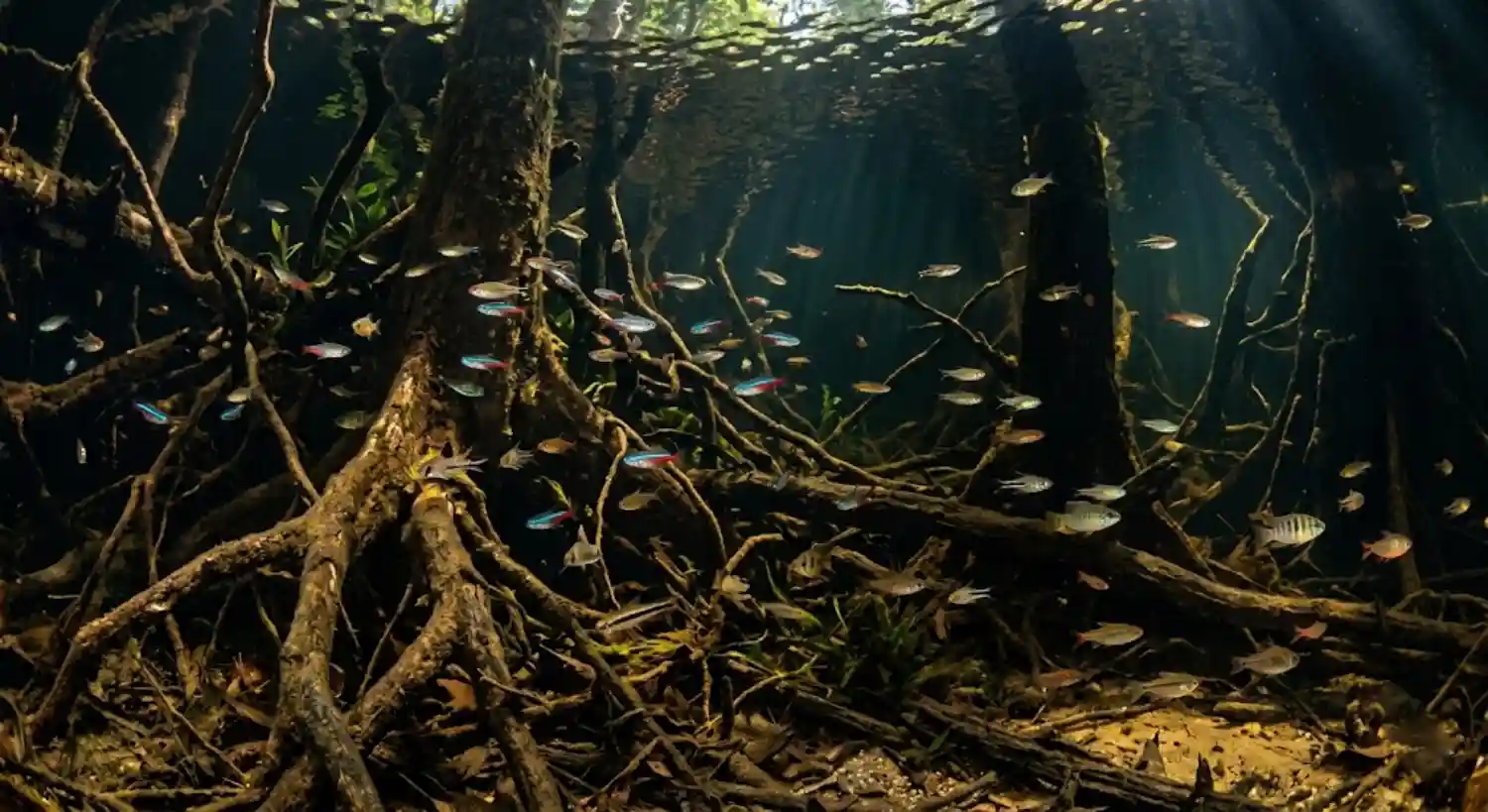
Deep inside the Amazon there is a forest that spends several months of every year underwater. It is called igapo, the blackwater flooded forest: woodland drowned by rivers stained dark and acidic by the decomposition of leaves, fruit and branches falling from the canopy. It is not a swamp and it is not a lake. It is genuine forest, with trunks, roots and crowns, simply submerged for a large part of the calendar. In that improbable setting lives one of the best kept secrets of tropical evolution: roughly two hundred fish species that occur nowhere else on Earth.
Why igapo is not varzea
The distinction starts with the water itself. Varzea, the Amazon’s other great floodplain, is fed by rivers loaded with fertile sediment carried down from the Andes, which makes it rich in nutrients. Igapo has no such mineral inheritance. Its blackwater rivers, the Rio Negro chief among them, run nutrient poor and dark, saturated with humic and fulvic acids produced by the forest’s own leaf litter. The result is an environment of very low fertility and acidic pH, where life is sustained not by abundance but by extreme specialisation. Only those that learned to live on very little manage to thrive.
That unusual chemistry produces effects that surprise first time visitors. The acidity suppresses mosquito breeding, so blackwater shorelines tend to be far quieter and more bearable than white water ones. What counts as a comfort for the traveller, though, is an impassable border for the fish. Igapo species are so finely tuned to that acidic medium that many of them do not survive if moved into the white or clear waters of neighbouring rivers, sometimes only a few kilometres away.
Fish that feed on trees
In a system this poor in plankton, the pantry is not in the water but overhead, in the canopy. The dietary base is made of fruit, seeds and insects dropping from the flooded vegetation, and from that fact grows one of the most elegant relationships in tropical ecology: river and forest stop being separate entities and start behaving as a single organism. Iconic species such as the peacock bass, genus Cichla, and the arowana, Osteoglossum bicirrhosum, illustrate the dependence clearly. Yet endemism peaks somewhere else entirely, among small ornamental fish and lesser known characids, the ones that rarely make it into photographs while quietly holding the whole system together.
The flood season as a nursery
When water levels rise, the behaviour of these fish changes completely. They abandon the main channels and push deep among trunks and the roots of aquatic macrophytes, in a migration that runs horizontally and vertically at the same time. That movement is essential for species recruitment: dense forest offers shelter from large predators and suitable spawning grounds. Without the shade and the protection of submerged roots, survival rates for juvenile fish would collapse, and the balance of the entire river basin would be pushed off course.
Environmental DNA to map the invisible
The monitoring programme led by Brazil’s National Institute for Amazon Research, the INPA, a world reference in tropical ecosystems, has been producing decisive data on how this fish fauna responds to climate change and to human interference. Researchers pair tracking technologies with the collection of environmental DNA, known as eDNA, which detects a species from the genetic material it leaves suspended in the water. The most unsettling finding concerns scale: many species hold extremely restricted home ranges, sometimes confined to a single stretch of river.
That single detail rewrites what conservation means here. Protecting riparian vegetation stops being an aesthetic concern or a matter of erosion control and becomes the only practical way to safeguard the genetic code of hundreds of organisms that act as custodians of regional water health. A cleared stretch of riverbank can mean, quite literally, the disappearance of a species science had not finished describing.
What is lost when the riverside forest falls
The gravest threat to that balance is deforestation along the margins and the removal of igapo for farming, cattle or mining. When the forest goes, the fish loses its canteen and its nursery in the same stroke. The absence of shade raises water temperature and shifts the pH, turning the environment hostile precisely for the specialists that evolved under conditions of millennial stability. Human pressure on blackwater riverbanks sets off a cascade that silences underwater life long before those species can be catalogued or studied in any depth.
Conservation built with river communities
There are open paths, even so. Strengthening sustainable development reserves and community based management shows the equation is not lost. Valuing ornamental fish harvested responsibly by riverside families generates income and supplies a concrete economic reason to keep the forest standing, evidence that development and conservation can move together when the decision rests with the people who actually live there.
There is a scientific argument for urgency as well, and it reaches beyond the region. An ecosystem that concentrates hundreds of species inside very narrow ranges works as a natural laboratory for understanding how specialisation arises and how quickly it can be undone. Losing igapo would not only erase Amazonian fish, it would erase the evidence of how those fish came to exist at all.
The igapo is, in the end, a mirror of the Amazonian character: a place where water learned to be forest and fish learned to be part of the trees. Preserving every square metre of flooded forest means making sure the silent chorus of those two hundred endemic species keeps sounding beneath the water mirror of the largest rainforest on the planet.
Reporting: Anne Silva / Amazonia Mag. Source: Revista Amazônia, original Portuguese edition, with data from Brazil’s National Institute for Amazon Research (INPA).

Editor, English Edition — Amazonia Mag
Anne Silva is the editor of Amazonia Mag, the English-language edition of Revista Amazônia. She curates, translates and adapts the outlet's science and environment coverage for an international audience, reporting on Amazon wildlife, flora, rivers, climate and research. Every story she edits is grounded in peer-reviewed studies, official data and on-the-ground reporting from the Revista Amazônia newsroom in Belém, Pará, Brazil. More by Anne Silva →