
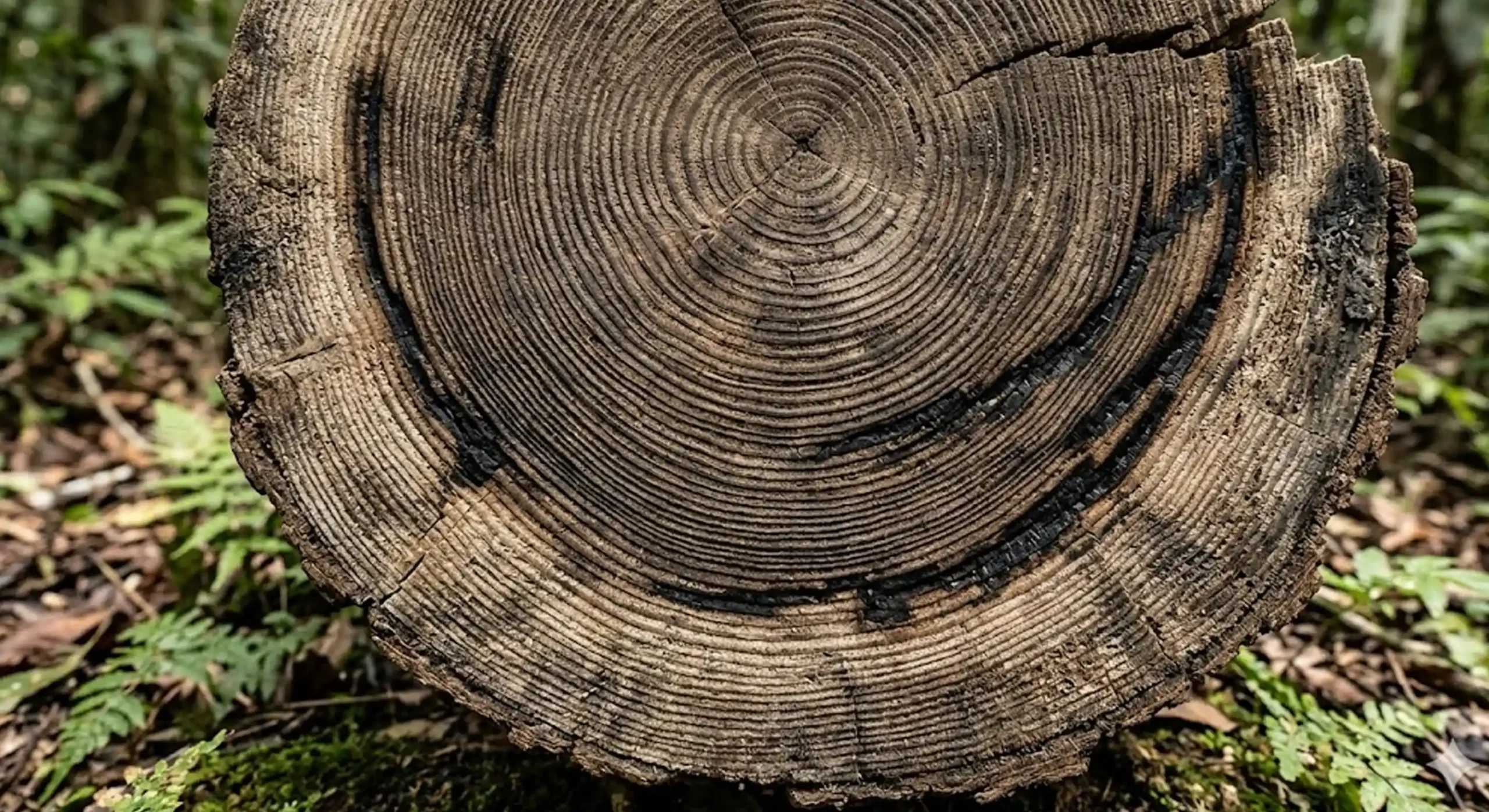
The oldest trees in Amazonia work as living libraries, storing precise meteorological data inside their trunks for half a millennium. By analysing growth rings, scientists have identified records of severe droughts that struck the basin long before the first European explorers reached the heart of the forest. The discipline behind that work, dendrochronology applied to the Amazon rainforest, uses the width and the density of each ring to reconstruct rainfall and temperature histories from remote periods. What the data reveal is a cyclical pattern of extreme climate events that shaped the vegetation structure we see today, and it proves that the forest holds a biological memory far deeper than researchers once assumed.
How a growth ring is read
Research on Amazon tree rings and climate concentrates on long lived species with rhythmic growth, such as the Brazil nut tree, Bertholletia excelsa, and cedar. In years of abundant water, a tree lays down wide, pale rings, a sign of rapid cell division and full health. In years of water stress driven by phenomena such as El Nino, growth slows sharply and leaves narrow, dark marks that behave like scars in time. Recent studies of specimens in remote areas of Amazonas and Para show that the historic droughts of five centuries ago were so intense that they almost halted the flow of sap in enormous trees, leaving an indelible mark on their internal structure.
Reading those marks is not a matter of free interpretation. Each ring corresponds to one complete annual cycle, with its rainy season and its dry season, which is why dendrochronology can date events with annual precision, something Carbon 14 cannot always deliver for recent periods. A well preserved trunk offers, in practice, a continuous time series with no gaps, and every line in it can be compared with lines from other specimens in the same region to confirm whether an event was local or whether it reached across the whole basin.
The megadrought of 1500 written into cedar
In Brazil, work on species such as Cedrela odorata revealed that central Amazonia went through a megadrought around the year 1500, possibly linked to an El Nino episode of global scale. That finding turns tree trunks into one of the very few sources able to describe the climate of the region before any written record existed. Such data are essential for calibrating the climate forecasting models that today guide sustainable agriculture and the protection of headwaters, because they widen the historical base on which those models are built and tested.
The tree as a drought record also offers a valuable perspective on the frequency and the intensity of historic El Nino events in the neotropical region. By cross referencing dendrochronology with modern computational models, researchers found that the climate events of the past bear unsettling similarities to the anomalies observed in recent decades. The fundamental difference is recovery time: in the past, the forest had long intervals between one event and the next. The record held in the trunks shows that Amazonian resilience is now being tested at unprecedented speed, because droughts that once appeared roughly once a century are now repeating within intervals of a few years.
A science that seemed impossible in the tropics
Applying this science in Amazonia faced technical obstacles for decades, because many specialists believed that a constant, warm tropical climate would prevent the formation of visible annual rings. The reasoning seemed sound: without a marked winter there would be no pause in growth and no sharp boundary between one year and the next. The discovery that the flooding regime and the seasonality of rainfall create distinct patterns dismantled that objection, and it allowed Brazil to become an international reference in tree based climatology.
Today, laboratories in Manaus and Belem use X ray technology and stable isotopes to read those wooden pages with microscopic precision. Density measured by X ray detects variations the human eye cannot distinguish, while the chemical signature of isotopes carries information about the origin of the water the plant absorbed. That knowledge is essential to understand which areas of the forest are most vulnerable to global warming, and which species carry the genetic makeup needed to survive extended periods without water.
Trunks that also tell a human story
Beyond registering climate, these rings tell the story of human occupation in the forest. In some specimens it is possible to identify sudden growth surges that coincide with soil management practised by ancestral Indigenous populations, who enriched the ground with nutrients. The tree, therefore, is not merely a climate sensor: it is also a chronicler of the interaction between human societies and nature across the centuries.
Every trunk analysed is a testimony of endurance that survived pests, fires and global atmospheric shifts, and that still stands as a guardian of information human technology is only now beginning to decipher. Each sample connects an ecological question to a historical one, showing that the forest and the people who lived in it have been writing the same chronicle for centuries.
Why the past matters for conservation
Understanding that past written into the wood is the most effective tool available for planning the future of Amazonian conservation. It shows where extreme events have struck before, how long recovery took, and which stands of forest held their growth even under prolonged stress. That is practical information: it helps identify the most fragile areas of the basin, guides decisions about which species deserve priority in restoration projects, and gives conservation policy an evidence base drawn from the forest itself rather than from projections alone. Reading the rings, in the end, is how these giants are given the chance to keep writing their own history.
Reporting: Anne Silva / Amazonia Mag. Source: Revista Amazônia, based on dendrochronology research carried out in the Brazilian Amazon.

Editor, English Edition — Amazonia Mag
Anne Silva is the editor of Amazonia Mag, the English-language edition of Revista Amazônia. She curates, translates and adapts the outlet's science and environment coverage for an international audience, reporting on Amazon wildlife, flora, rivers, climate and research. Every story she edits is grounded in peer-reviewed studies, official data and on-the-ground reporting from the Revista Amazônia newsroom in Belém, Pará, Brazil. More by Anne Silva →