
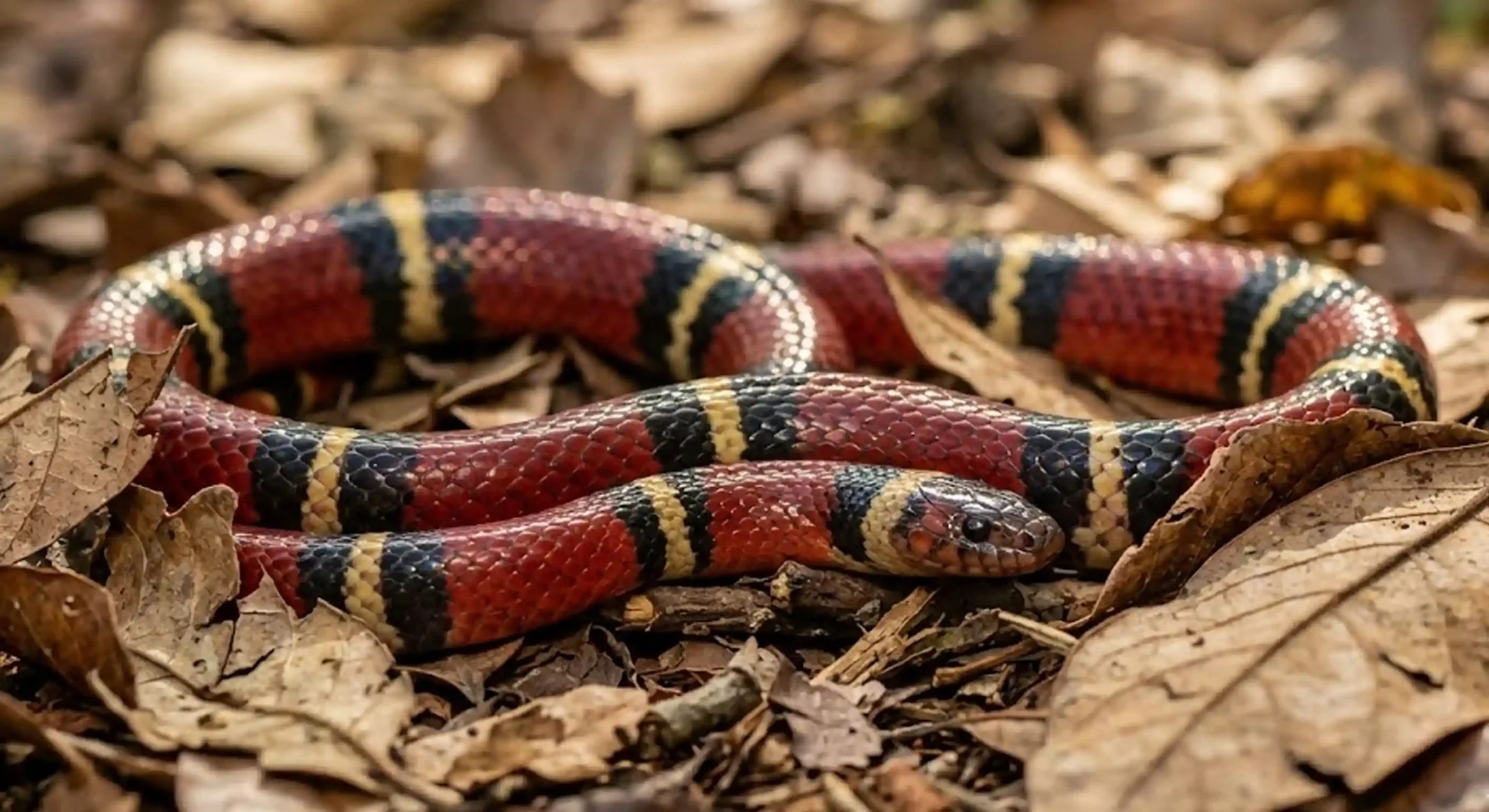
Somewhere on the floor of the Amazon rainforest, a snake with no venom at all is wearing the colors of one of the deadliest reptiles on the continent. It has no fangs capable of injecting toxins, it poses no real danger to anyone, and yet it survives at rates comparable to the lethal species it imitates. Recent molecular studies point to that bluff, known as Batesian mimicry, as one of the most sophisticated survival mechanisms in nature, and Brazilian forests are among the best places on the planet to watch it work.
The phenomenon happens when a palatable or harmless species evolves to copy the warning signals of a dangerous one. The result is a biological bluff that fools birds, mammals and other reptiles alike. At the center of the system sits the false coral snake, a popular name covering several separate lineages that reached the same conclusion over millions of years: the best defense is a convincing costume of danger.
A near perfect copy
Among the stars of this visual and behavioral disguise is Oxyrhopus guibei, one of the most common species in Brazilian territory and one of the most skillful practitioners of the trick. Although it belongs to a family distinct from that of the true coral snakes, its rings follow patterns that trigger an instinctive flight response in any predator that has had a bad experience with the original model, or that carries a genetic aversion to the tricolor pattern.
Batesian mimicry is not merely an aesthetic curiosity. It is a genetic battlefield, and selection is unforgiving. Any individual whose body paint carries a flaw is quickly removed from the game, which keeps the lineage as close as possible to the visual perfection of true coral snakes of the genus Micrurus. One ring out of place, one washed out band, and the bluff stops paying off.
Evolution invented the trick more than once
Science has been working to understand how these snakes hold on to such visual fidelity while living in slightly different ecological niches. Cutting edge genetic research shows that the shift toward the coral pattern happened several times independently across the reptile tree of life, a process known as convergent evolution. In other words, the strategy proved so effective that nature reinvented it again and again in snake families that share no recent common ancestor.
Watching an Oxyrhopus guibei glide across the leaf litter means watching the outcome of millennia of fine tuning. Every red, black or yellow pigment was tested by the pressure of hungry predators that, at some point in that long history, decided not to gamble their lives on a potentially fatal meal.
Telling the real thing from the copy
Separating these species takes a careful eye that goes beyond color and focuses instead on scale arrangement and dentition. True coral snakes carry venom injecting teeth fixed at the front of the mouth. False coral snakes may be aglyphous, with no venom teeth at all, or opisthoglyphous, with teeth set at the back of the mouth that serve only to immobilize small prey such as lizards.
For the ecosystem, the presence of the false coral snake is a sign of balance. These snakes help control populations of small vertebrates and keep the local microfauna healthy without posing any real risk to the people who cross their path. The practical takeaway is simple: distance protects everyone, and no snake needs to be killed for the scare to end.
The clay snake experiment
The reach of this strategy is deep enough to shape the behavior of animals that have never met a true coral snake. Experiments using clay models painted with coral patterns showed that birds of prey avoid attacking those objects even in areas where the true coral snake is rare. That creates a kind of protective aura around the false coral snake, allowing it to occupy space and exploit resources that would be dangerous for snakes wearing more discreet colors. Surviving on somebody else’s mistake is one of the most fascinating lessons Brazilian biodiversity has to offer about resilience and adaptation.
A warning that costs nothing to wear
What makes the case so compelling is the economy of the arrangement. Producing venom is expensive, and using it carries risk. The mimic skips the entire investment and keeps the reward, borrowing a reputation built by a different species and cashing it in every time a predator hesitates. The bluff, however, only works while the original stays in the picture and while the copy stays faithful. That is why the pattern is policed so tightly by selection, and why the same colors keep reappearing across unrelated branches of the reptile family tree.
Bates, butterflies and an Amazonian legacy
Batesian mimicry carries the name of Henry Walter Bates, the naturalist who studied butterflies in the Amazon in the nineteenth century. Bates realized that harmless species gained protection by copying the look of toxic ones. Among snakes, the tactic is efficient enough that even specialists can be fooled in the field, which reinforces a straightforward rule: in the wild, keeping a respectful distance remains the best safety tool for humans and animals alike.
Beyond the familiar Oxyrhopus guibei, Brazil is home to dozens of other species that use variations of Batesian mimicry, each adapted to its own biome, from the Pampa to the Caatinga. Protecting these snakes is essential to preserving evolutionary processes that researchers are only beginning to understand at the molecular level. Habitat destruction fragments those populations and can interrupt the gene flow that sustains the precision of the color patterns, putting at risk one of the greatest showcases of evolutionary intelligence on Earth.
Respecting wildlife, and understanding that the appearance of danger is often nothing more than a shield of fragility, is an invitation to look at the forest with more wonder and less fear. The false coral snake threatens no one. It simply repeats, with a precision built over millions of years, a warning that was never its own.
Reporting: Anne Silva / Amazonia Mag. Source: Revista Amazônia.

Editor, English Edition — Amazonia Mag
Anne Silva is the editor of Amazonia Mag, the English-language edition of Revista Amazônia. She curates, translates and adapts the outlet's science and environment coverage for an international audience, reporting on Amazon wildlife, flora, rivers, climate and research. Every story she edits is grounded in peer-reviewed studies, official data and on-the-ground reporting from the Revista Amazônia newsroom in Belém, Pará, Brazil. More by Anne Silva →