
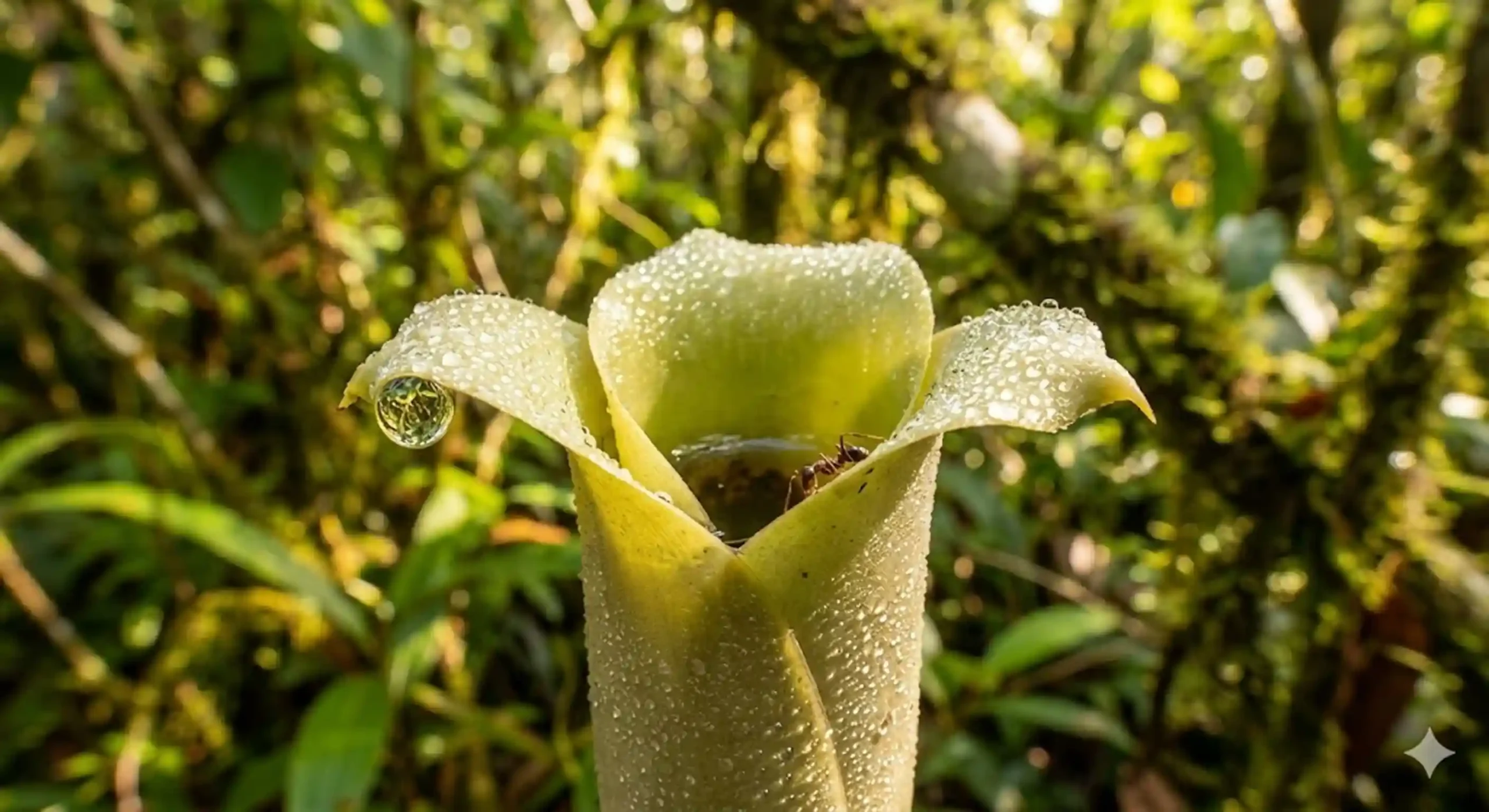
In the rainforest, the deadliest threat to an insect has no teeth and no claws. It is made of leaves, wax and enzymes. Across the Amazon basin, where heavy rain leaches the soil and carries away essential nutrients such as nitrogen and phosphorus, evolution found a brilliant way out. A handful of plants flipped the traditional food pyramid and began consuming animals in order to survive in extreme conditions. What would look like a scene from a science fiction film is, in practice, a feeding strategy refined over thousands of years beneath the canopy of the largest forest on the planet.
Poor soil, hungry plants
To understand the Amazon carnivorous plants, it helps to look down first. Much of the basin sits on old, sandy substrate exposed to a rainfall regime that constantly washes away the available minerals. In that setting, competition for nitrogen and phosphorus becomes fierce, and conventional roots stop being a decisive advantage. The evolutionary answer was radical: if the ground will not supply the nutrients, the plant goes looking for them somewhere else, and that somewhere else turned out to be the bodies of the small animals moving around it.
This shift does not happen everywhere in the forest. It concentrates in very particular environments, such as the white sand areas known in Brazil as campinas and the igapós, flooded forests where water governs the chemistry of the soil. These are places of strong sun, scarce natural fertiliser and demanding conditions, where vegetation has to be resilient in order to thrive. Plant carnivory shows up precisely there, as a local answer to a local problem rather than an oddity scattered at random across the region.
What actually counts as a carnivorous plant
Not every plant that traps an insect is carnivorous in the strict sense. The label requires a combination of features working together: a structure that attracts the prey, a mechanism that retains it, and a biochemical route that turns the captured animal into nutrients the plant can absorb. Remove any one of those elements and what remains is an accident rather than an adaptation. That is why the Amazonian examples matter so much to researchers, because they display the full sequence, from attraction to absorption, in plant groups that are not closely related to one another.
Genlisea, the trap that works underground
Among the most impressive mechanisms are those of the genus Genlisea, popularly known as corkscrew plants. These species developed modified underground leaves able to attract and hold microorganisms and small invertebrates below the surface. There is no visible spectacle, no mouth snapping shut: everything happens in the dark, inside a geometry of channels that lets the prey in and makes leaving extremely difficult. It is a strategy invisible to human eyes and, at the same time, remarkably efficient at pulling nutrients out of an exhausted substrate.
The discretion of Genlisea partly explains why Amazonian plant carnivory took so long to gain visibility outside specialist circles. While species with aerial traps draw attention through their shape, underground traps demand digging, patience and microscopy before they can be studied at all. In the white sand campinas, that silent work sustains entire plant populations that would otherwise have no way of completing their life cycle in such impoverished ground.
Bromeliads with a slippery coat
Science has also turned its attention to Brazilian carnivorous bromeliads, which represent a fascinating stage of specialisation. Unlike ordinary bromeliads, which simply collect rainwater between their leaves, species such as Brocchinia reducta developed a highly slippery wax coating on the leaf surface. When an insect lands, drawn by the shine or by specific odours, it loses grip and slides straight into a central reservoir filled with digestive enzymes. That biological tank turns the prey into a nutritious broth which the plant absorbs directly through its own tissues.
The important detail is the transition. A common bromeliad already has the container, but lacks both the trap and the digestion. Brocchinia reducta shows how a structure that once existed to store water can become, with only a few adjustments, an apparatus for capture and absorption. It is an unusual case of a documented functional shift inside a single plant family, and that is exactly what makes it so valuable to anyone studying how carnivory begins.
Passive traps, active traps and selected prey
The way these botanical weapons work combines chemistry and physics. There are passive traps, such as the pitchers of Heliamphora, which operate as free fall containers and require no movement at all to function. And there are active traps, capable of quick movements at the moment of contact. Researchers at the Instituto Nacional de Pesquisas da Amazônia are studying how these plants manage to select their prey in order to avoid consuming pollinators, a problem that sounds minor and is in fact decisive.
The distinction between prey and pollinator is vital for the reproduction of the species. A plant that devoured indiscriminately the very insects carrying its pollen would be sabotaging its own offspring. What the research suggests is the opposite of the popular image: far from being indiscriminate killers, Amazonian carnivorous plants operate with an almost surgical precision that keeps the local ecosystem in balance and, along the way, keeps them alive as well.
The secret of the pitcher
Some carnivorous plant species in the Amazon have internal hairs that point exclusively downwards. This arrangement prevents any insect, however strong, from climbing the walls of the plant after falling into the digestive fluid. It is a one way system, with no moving parts and no additional energy cost, which guarantees that the effort invested in attracting the prey translates into effective nutrition. In severe and challenging soils, that metabolic economy is the difference between surviving and disappearing.
Living thermometers of environmental health
The importance of these species goes well beyond biological curiosity. They are sensitive indicators of environmental health, because they depend on very specific ecological niches, and those niches tend to be the first to suffer the effects of climate change and deforestation. A degraded campina or an altered igapó stops supporting carnivorous plants long before the damage becomes obvious in the general structure of the forest, which turns them into an early warning that is hard to ignore.
That sensitivity comes at a price. Highly specialised species pay for their efficiency with rigidity: they cannot move, they do not tolerate wide variation, and they rarely find an equivalent environment once their own disappears. The loss of a fragment of campina therefore means far more than the loss of a landscape. It means the interruption of an evolutionary lineage that took an enormous amount of time to form and is unlikely to emerge again somewhere else.
Biomimicry, conservation and the road to COP30
Understanding Amazonian flora and its curiosities also allows science to develop new technologies inspired by biomimicry. Dirt repellent materials based on bromeliad leaves and new enzymatic compounds for industrial use are two concrete examples of how a botanical solution can become a human application. Preserving these habitats guarantees that entire genetic libraries will not vanish before humanity has had the chance to understand them fully.
Investing in the conservation of the campina areas and the igapós where these plants live is, for that reason, a fundamental strategy for Brazilian biodiversity. As COP30 in Belém approaches, highlighting these small marvels of natural engineering reinforces a simple message: the Amazon holds secrets at every scale, from the tallest trees to the tiny plants that found in predation a form of light. In the heart of the jungle, life reinvents itself in every leaf, proving that survival demands far more than strength, it demands constant adaptation.
Reporting: Anne Silva / Amazonia Mag. Source: Revista Amazônia, original edition in Portuguese.

Editor, English Edition — Amazonia Mag
Anne Silva is the editor of Amazonia Mag, the English-language edition of Revista Amazônia. She curates, translates and adapts the outlet's science and environment coverage for an international audience, reporting on Amazon wildlife, flora, rivers, climate and research. Every story she edits is grounded in peer-reviewed studies, official data and on-the-ground reporting from the Revista Amazônia newsroom in Belém, Pará, Brazil. More by Anne Silva →