
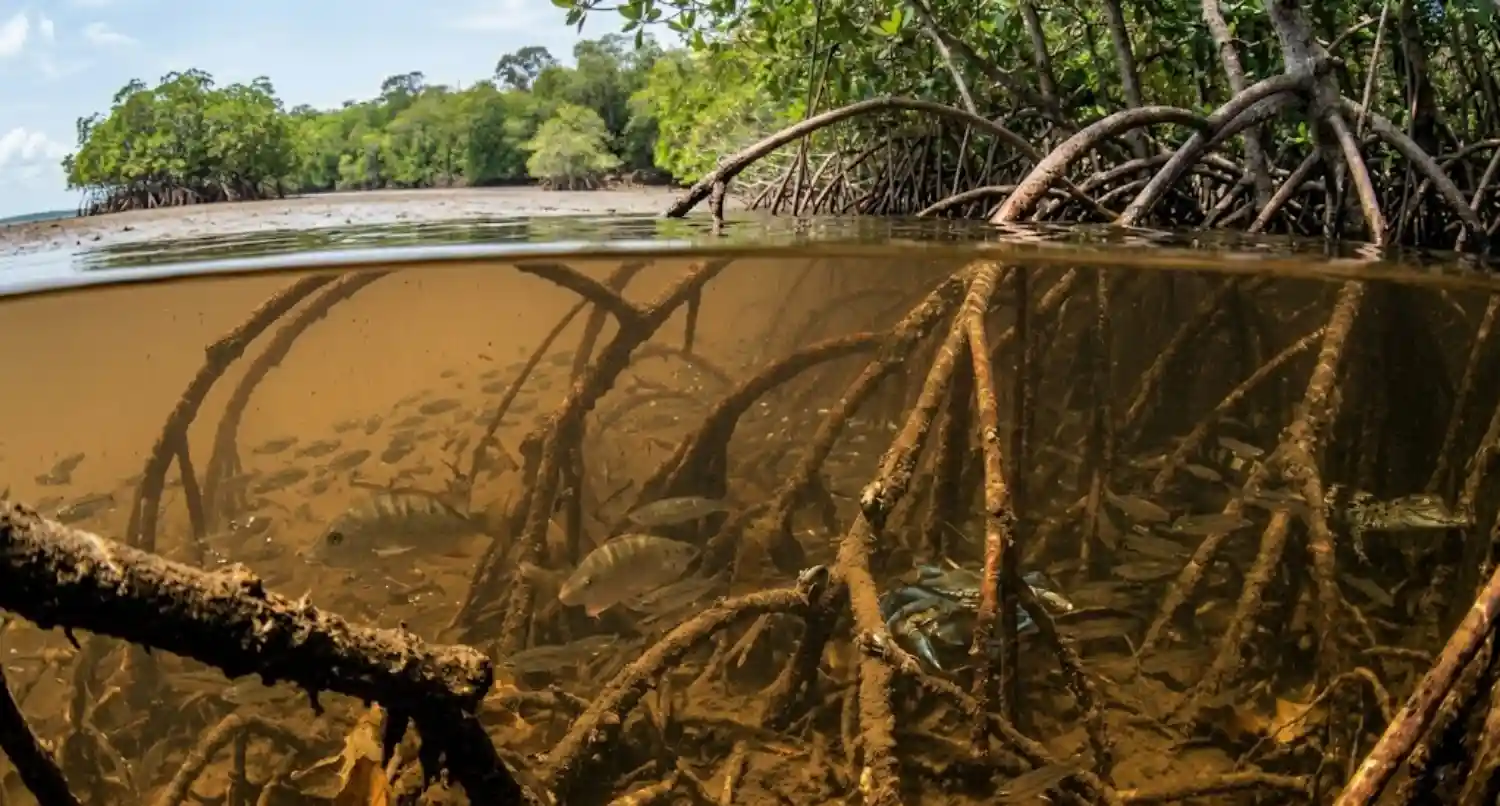
Along the coast of Para, a state in the Brazilian Amazon where the world’s largest river system empties into the Atlantic, there is a forest that lives with its roots underwater. Mangroves are salt tolerant coastal woodlands that take hold in the tidal zone, in soft dark mud that is flooded and drained twice a day. Recent oceanographic studies indicate that more than seventy per cent of the commercially valuable fish caught in the South Atlantic depend, at some stage of their lives, on the protection these mud forests provide. On the Para shoreline the figure takes on an even more striking shape, with confirmation that forty distinct species use the tangle of mangrove roots to secure the survival of their young.
The Para mangrove belt is one of the largest and best preserved stretches of this biome anywhere on the planet, running for hundreds of kilometres along a deeply indented shoreline of bays, channels and tidal creeks. Unlike other parts of the world, where urban expansion flattened coastal wetlands, this corner of the Amazon still holds sanctuaries that are close to untouched, and those sanctuaries set the rhythm of the entire regional fishing economy.
A biological womb built of roots
The architecture of the trees explains much of it. The red mangrove, Rhizophora mangle, and the white mangrove, Laguncularia racemosa, raise arching aerial roots that work as an impenetrable physical barrier against large marine predators. Inside that maze, fry grow up in safety, while the same vegetal structure filters the sediment that Amazonian rivers carry down to the coast. What emerges is an environment of controlled salinity and abundant nutrients, precisely the conditions larvae and juveniles need in order to grow into the fish that will later feed millions of people.
The biological rhythm of these areas is set by the tides, which bring oxygen in and constantly renew the decomposing organic matter. That movement turns the mangrove into a genuine biomass factory, where the life cycle begins in rich, dark sediment. Species such as snook, weakfish and jack would not exist in abundance without this first refuge. Science now understands that the strength of those populations in the open sea is directly proportional to the health of the brackish water washing the riverside and extractivist communities of the region.
A delicate balance under pressure
Not even the sheer scale of the coastal Amazon puts it beyond unprecedented challenges. Rising sea levels and shifting rainfall patterns alter the chemistry of the water, and that shift can disorient the species that come to the mangrove to spawn. The balance is fine, and any break in the connection between the ocean and the flooded forest damages not only biodiversity but the survival of thousands of families who depend on small scale artisanal fishing for food and income.
Disorderly occupation of the shoreline adds a second layer of risk on top of the climate crisis. Where the mangrove retreats, two things disappear at once, the nursery itself and the natural defence of the mainland against the sea, because these forests also absorb wave energy before it reaches solid ground. That is why researchers working on the Para coast argue that protecting these areas is the cheapest and most efficient form of coastal defence available.
Restoration led by the people who know the creeks
To hold back those risks, mangrove restoration initiatives across the Amazon are gaining ground through the direct involvement of local populations, the fishers and gatherers who know every channel and every igarape, the local name for the narrow water lanes that thread through the forest. These programmes pair traditional knowledge with biotechnology to replant degraded areas and monitor water quality in real time. Recovering a single hectare of mangrove means thousands of new individuals from many species can rejoin the annual migratory cycle, strengthening the resilience of the whole marine ecosystem in the face of global threats.
Blue carbon buried in the mud
There is a second treasure below the murky water. Mangrove sediment is one of the richest soils in the world in organic matter, and it stores what scientists call blue carbon, a key asset in slowing global warming. Mangroves lock away up to four times more carbon per unit of area than terrestrial tropical forests, a figure that places Para in a strategic position in international discussions about nature credits. Investing in the protection of these roots is, in the end, investing in climate stability and in keeping life going in the transition zones between land and sea.
The wildlife that depends on this strip goes well beyond fish. Crabs complete their life cycle in the mud and sustain one of the most traditional extractive activities on the Amazonian coast. Migratory birds travel thousands of kilometres to feed and rest in these unique transition zones, which underlines how strategic Para is for biodiversity across the entire western hemisphere. A healthy mangrove, in other words, does not serve local fisheries alone: it holds up continental biological routes.
International recognition of the mangrove as essential heritage for humanity needs to be matched by strict public policy on enforcement and by real incentives for sustainable management. Protect the nursery and the ocean keeps working as an inexhaustible source of life and livelihood. The deep connection between a forest growing in mud and a fish arriving on a plate is the clearest reminder that human survival is bound to the health of every centimetre of ground flooded by the Amazonian tide.
Understanding the invisible value pulsing beneath the cloudy water of Brazil’s northern coast is the first step towards acting as effective guardians of this biological treasure. Every mangrove tree left standing is a guarantee that future generations will still know the abundance of a sea that is born and renewed in the embrace between forest and salt. Protecting the Para mangrove is not only an ecological choice, it is an ethical commitment to the continuity of life in its most resilient and surprising form.
Reporting: Anne Silva / Amazonia Mag. Source: Revista Amazônia, based on oceanographic studies of the Para coastline.

Editor, English Edition — Amazonia Mag
Anne Silva is the editor of Amazonia Mag, the English-language edition of Revista Amazônia. She curates, translates and adapts the outlet's science and environment coverage for an international audience, reporting on Amazon wildlife, flora, rivers, climate and research. Every story she edits is grounded in peer-reviewed studies, official data and on-the-ground reporting from the Revista Amazônia newsroom in Belém, Pará, Brazil. More by Anne Silva →