
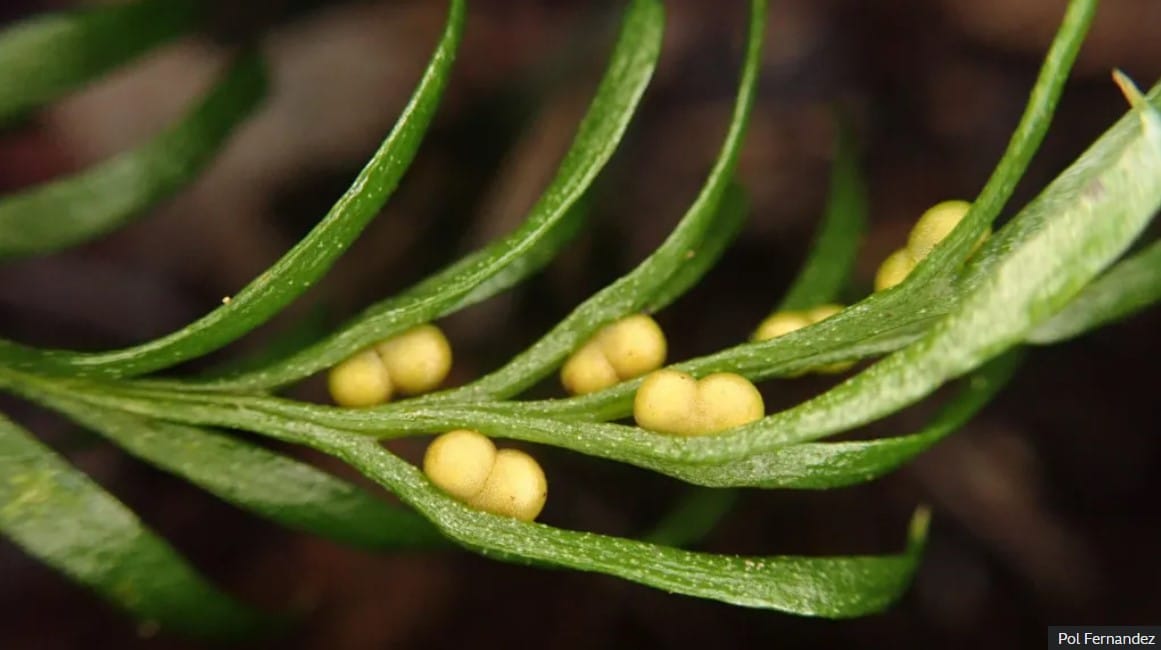
Most people would walk right past it. Tmesipteris oblanceolata is a small fern that grows on tree trunks and branches in the rainforest of New Caledonia, a Pacific island territory. Yet inside its cells sits more DNA than in any other living organism measured so far.
Its genome, the full set of genetic instructions packed into a cell, measures about 160 billion base pairs. Unwound and laid out in a line, that DNA would stretch for roughly 328 feet (100 meters), longer than the height of Big Ben. Scientists describe it as a “crazy” amount of DNA for a plant so modest that few visitors would notice it.
A small fern from the oldest branch of the plant family
Tmesipteris oblanceolata belongs to a primordial group of plants that evolved long before the dinosaurs walked the Earth. It is found only in New Caledonia and a few neighboring islands, where it lives as an epiphyte, rooted on the trunks and branches of rainforest trees rather than in the soil.
That combination makes the species easy to overlook: a delicate, ancient plant living high on the bark of other plants, on a group of islands in the Pacific Ocean. The record came from a species that rarely draws attention, and that is part of what makes it so instructive.
The finding was published in the journal iScience by an international team of researchers. They worked with specimens collected in New Caledonia and extracted genetic material from them for analysis.
What a genome is, and how it was measured
A genome is the complete set of DNA instructions inside a cell. It contains all the information an organism needs to develop and grow. DNA is written in pairs of chemical bases, and the number of those pairs is the standard way to express how large a genome is.
To estimate the size of the fern’s genome, the researchers used a dye. They measured how much dye bound to the DNA extracted from the specimens: the more dye, the larger the genome. This approach does not read the genetic code letter by letter. It weighs, in effect, how much DNA is present. The figure therefore says how large the genome is, and leaves open the question of what all that DNA does inside the plant, which is precisely what researchers want to learn next.
The result was a genome of 160 billion base pairs. For comparison, the human genome holds about three billion base pairs and, if stretched out, would measure about 6.6 feet (2 meters). The fern’s genome is therefore around 50 times larger than ours.
Three Guinness World Records for one fern
The fern now holds three Guinness World Records: the largest genome of any organism, the largest plant genome and the largest fern genome. Few species can claim a set of records that spans all three levels, from the whole living world down to a single family of plants.
Adam Millward, of Guinness World Records, put the discovery in perspective: “To think that this seemingly harmless fern holds 50 times more DNA than humans is a humbling reminder that there is still much about the plant kingdom we do not know, and that record holders are not always the flashiest on the outside.”
His comment points to a simple idea: modest-looking plants are easy to dismiss next to large trees, yet they can hold biological extremes that no showier species can match.
How big can a genome get?
Genome sizes vary enormously across living things. In the animal kingdom, some of the largest genomes belong to certain lungfish and salamanders, which have around 120 billion base pairs. Those animals are far above humans, and still the fern surpasses them.
Not every plant carries a huge genome, either. The oak tree, for example, has a relatively small genome. Genome size does not follow the size of the organism in any obvious way, which is exactly why a tiny fern at the top of the list draws so much scientific interest.
Many plants do have large genomes, and researchers want to understand why. They hope to learn how a large genome affects the way a plant functions, and whether it can influence the risk of extinction. A species that lives only on a handful of islands, as this fern does, is a natural subject for that question.
Why a tiny epiphyte matters to science
The story of Tmesipteris oblanceolata is a reminder that a record in biology does not need a dramatic animal behind it. The most extreme genome known to science belongs to a plant that grows quietly on tree bark, in a forest most travelers will never visit.
It also highlights how much remains to be explored in plant biology. Every measurement of a new species can shift the range of what scientists consider possible, and a single dye-based analysis was enough to rewrite the ranking.
For readers of the Amazon and other tropical forests, the lesson is familiar. Tropical rainforests hold epiphytes, ferns and other small plants that rarely make the news. This fern, from another rainforest on the other side of the world, shows that the least conspicuous residents of the canopy can be the ones that stretch the limits of what we know about life.
Reporting: Revista Amazônia newsroom / Amazonia Mag

Editor · Amazonia Mag
Anne Silva is the editor of Amazonia Mag, the English-language edition of Revista Amazônia. She curates, translates and adapts the outlet's science and environment coverage for an international audience, reporting on Amazon wildlife, flora, rivers, climate and research. Every story she edits is grounded in peer-reviewed studies, official data and on-the-ground reporting from the Revista Amazônia newsroom in Belém, Pará, Brazil. More by Anne Silva →