
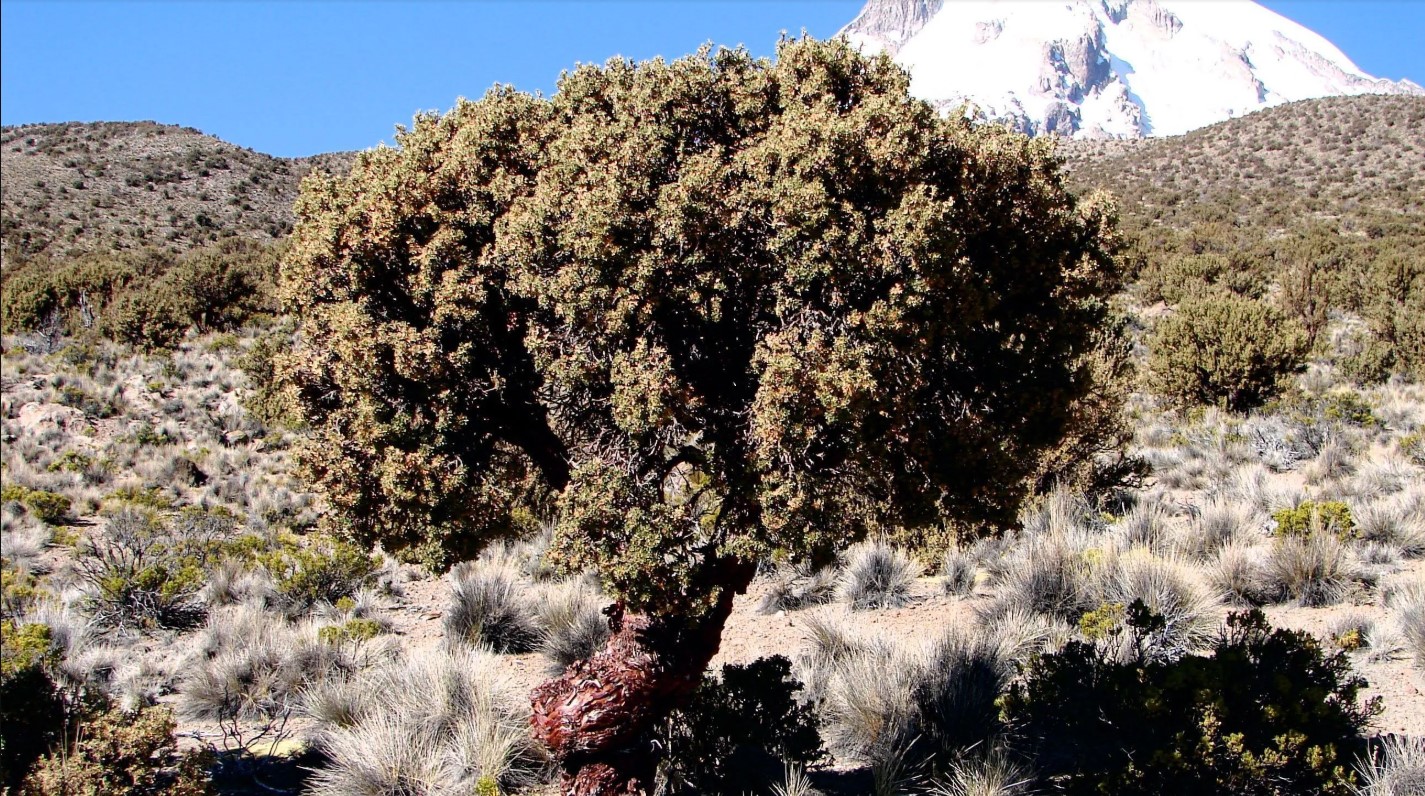
High in the Andes, where the mountains shelter wildlife such as the puma, the Andean condor and the spectacled bear, grows a tree that few people know by name but that matters to millions. It is Polylepis, also called the cloud tree.
These trees grow at altitudes of up to about 5,000 meters (16,400 feet), which makes them the highest-altitude trees on the planet. They play an essential role in keeping Andean ecosystems healthy, and their work reaches far beyond the mountains, all the way to the Amazon River system.
A tree that catches water from the clouds
The cloud tree has a rare ability: it captures water from the clouds. That water is then released gradually through the moss that covers the trees, feeding rivers and springs. Downstream, those waters supply the immense Amazon River system.
In practical terms, a Polylepis forest works like a natural sponge on the mountainside. It takes in moisture, holds on to rainwater and passes it on slowly, so that streams keep running instead of surging and then drying up. These forests also protect the soil against erosion, which is why they are described as fundamental for water security and for the environmental stability of the region.
Millions of people depend on the foothills of the Andes for their water supply. When the forest above them disappears, the protection goes with it.
A forest reduced to a fraction of its size
In the past, vast areas of the Andes were covered by Polylepis forests. Over recent centuries, deforestation and the advance of development have shrunk them to about 500,000 hectares (roughly 1.2 million acres), a tiny fraction of the original cover.
The consequences go beyond the loss of trees. Without the forests, the mountains lose a natural defense against landslides and floods, and the water supply of the communities downhill is put at risk.
Constantino Aucca Chutas and Acción Andina
The Peruvian biologist Constantino Aucca Chutas, a descendant of the Quechua people, felt inspired to protect the ancestral lands of his grandparents and the local communities that depend on them. “I grew up beside the rivers and nature, and I thought to myself, it would be wonderful if we could preserve all of this for future generations,” he said in an interview.
In 2018 he co-founded Acción Andina, a collaboration between the American organization Global Forest Generation and the Peruvian Asociación Ecosistemas Andinos. Its aim is to restore high-altitude forests and protect the communities that depend on them.
The work began in Peru and soon spread to other Andean countries: Ecuador, Argentina, Bolivia, Chile and Colombia. The project aims to restore one million hectares (about 2.5 million acres) of native forest by 2045, and it reports that more than 10 million trees have been planted with the support of thousands of Indigenous families.
“Just like in the Inca Empire, when all the Andean peoples came together, today we unite to protect one tree, the Polylepis,” Aucca Chutas said.
Ancestral values for a modern restoration
The Incas had a deep relationship with nature, with great respect for Pachamama (Mother Earth). Rivers, mountains and animals were revered as part of the balance of the world. “In Inca culture, the environment was treated with respect, and people lived in harmony with nature. We need to recover that teaching,” says Aucca Chutas.
To restore the Andean ecosystem, he also revives the principles of Ayni and Minka, which stood for collaboration among people for the common good. Through Acción Andina he seeks to involve local communities in a collective effort to save the high-altitude forests. “Planting millions of trees is not something I can do alone,” he stresses.
Every year in Cusco, Peru, Acción Andina organizes the Queuña Raymi festival, a tree-planting event that brings together every generation of the local community. It opens with traditional rituals, including dances and music in honor of Pachamama, followed by a journey up the mountain to plant Polylepis seedlings.
Planting is only the first step
After planting, fences and fire-protection programs are put in place, with the help of the communities, to maintain and care for the trees. Exchanging knowledge is central to the project’s success, because local communities have a deep connection with the forest and a unique understanding of how trees grow at different elevations and in different regions.
In return for their efforts, Acción Andina also supports the communities with services such as medical care and solar panels to bring electricity to villages. The organization also helps secure territorial rights and create protected areas shielded from exploitation by logging, mining and oil companies.
The initiative has won global recognition. Acción Andina received Prince William’s Earthshot Prize in the “Protect and Restore Nature” category, and Aucca Chutas was named a UN Champion of the Earth in 2022. Elizabeth Mrema, deputy executive director of the United Nations Environment Programme, highlighted this community-led restoration as an example of how people and communities can unite to protect nature, creating jobs and expanding conservation efforts worldwide.
For Aucca Chutas, the message is simple: “The conservation and protection of Pachamama are the responsibility of all of us.” The cloud tree, growing at the top of the Andes, is one place where that responsibility becomes visible.
Reporting: Revista Amazônia newsroom / Amazonia Mag

Editor · Amazonia Mag
Anne Silva is the editor of Amazonia Mag, the English-language edition of Revista Amazônia. She curates, translates and adapts the outlet's science and environment coverage for an international audience, reporting on Amazon wildlife, flora, rivers, climate and research. Every story she edits is grounded in peer-reviewed studies, official data and on-the-ground reporting from the Revista Amazônia newsroom in Belém, Pará, Brazil. More by Anne Silva →