
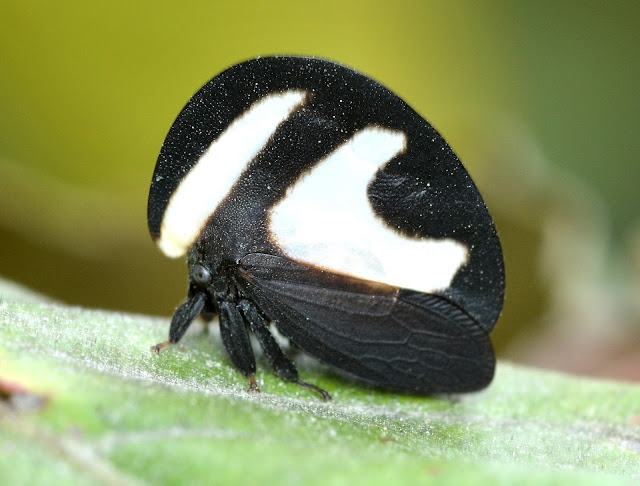
Nature holds alliances that defy the logic of solitary predation and reveal sophisticated systems of cooperation between different species. In the world of insects, few examples are as emblematic as that of the treehoppers, the family Membracidae, known in Brazil as soldadinhos, and their companions the ants.
The silent pact between the troops and the guardians
The partnership between treehoppers and ants is a classic model of mutualism, a symbiosis in which the currency is energy in exchange for safety. Treehoppers pierce plant tissue in search of sap. They process the liquid and expel the excess sugar as a sticky substance called honeydew. For ants, that honeydew is a source of carbohydrates that is easy to reach and highly nutritious.
In return, the ants take on the role of highly efficient bodyguards. Species such as Camponotus rufipes keep constant watch over treehopper populations. At the slightest sign of a predator approaching, the guardians react aggressively, using their mandibles to bite and drive off invaders. The protection extends from the more vulnerable nymphs to the adults and helps the treehopper colony thrive.
Curiously, this relationship can also benefit the host plant. When ants remove the honeydew continuously, a sugary residue that favors the growth of sooty mold, a dark fungus that coats leaves and hampers photosynthesis, is kept from building up.
The deal works because each side offers something the other cannot easily get on its own. The treehopper has no jaws to defend itself against an organized attack, and the ant cannot pierce the plant to reach the sap. Together they form a small economy of services in which sugar pays for vigilance.
The architecture of survival: the helmet
The look of treehoppers is one of the great spectacles of entomology. Their extravagant shapes are not mere decoration but the result of an anatomical structure called the pronotum. Sitting over the thorax, that segment expands to form what researchers call a helmet or casque.
The structure can take very different forms depending on the species. Some treehoppers use it to resemble a rose thorn or a fragment of twig, so that a predator looking for an insect sees only a piece of plant. Others imitate dried seeds. There are varieties that take the disguise to the extreme and copy the silhouette of ants, a way of fooling potential attackers. In Bocydium globulare, one of the most iconic species of Brazilian fauna, the helmet is adorned with spheres and hairs, a form so unusual that it looks more like a piece of jewelry than an insect.
These shapes work as mimicry and camouflage, two different strategies. Camouflage means going unnoticed by blending into the surroundings. Mimicry means resembling another object or living thing and borrowing the image of that model. The treehopper helmet serves both purposes.
For a predator that hunts by sight, an insect that looks like a thorn is almost beside the point: it does not move like prey and does not have the outline of prey. That is the underlying logic of so much variety. Each shape is a different answer to the same problem, which is to stop looking like food.
Where the helmet came from, and the controversy over its shapes
What intrigues the academic community is the evolutionary origin of this structure. A study published in the journal Nature proposed that the helmet might represent a modified third pair of wings, one that would have reappeared after millions of years of genetic inhibition, with features recalling some insects of the Paleozoic era.
The basis of that idea is striking. Modern insects have wings only on the second and third segments of the thorax, so the development of a large structure on the first (T1) is an anomaly. For geneticists, treehoppers managed to switch off molecular brakes that normally prevent appendages from growing in that region of the body.
The hypothesis, however, is not unanimous. Other morphological analyses hold that the helmet is not an independent articulated appendage but an expansion of the first thoracic segment itself. The debate remains open, and it is a good example of how a small structure can test traditional concepts in evolutionary biology.
That plasticity let the family explore varied ecological niches, with a helmet adapted to the needs of each ecosystem, whether in the dense Amazon rainforest or in cerrado grasslands. The exact usefulness of certain complex geometries is still under investigation, which is why treehoppers remain one of the most mysterious and visually striking groups in the animal kingdom.
Life in troops and the future of research
The social life of treehoppers is an important part of the success of their partnership with ants. Many species are gregarious and live in dense “troops,” which makes the ants’ job of tending them easier. By gathering in groups, treehoppers increase the supply of honeydew in a single spot, which makes the ants’ investment of time and energy far more worthwhile. This collective strategy maximizes the safety of the whole group.
The integration of morphology, genetics and social behavior makes treehoppers an ideal model for studying biological adaptation. While the ants look after their sugar “dairy cows,” science is trying to understand how nature shapes armor so effective and so varied.
Each small treehopper, with its peculiar helmet, is a reminder that evolution is not afraid to experiment with shapes that, to our eyes, look like something out of a dream.
Reporting: Revista Amazônia newsroom / Amazonia Mag

Editor · Amazonia Mag
Anne Silva is the editor of Amazonia Mag, the English-language edition of Revista Amazônia. She curates, translates and adapts the outlet's science and environment coverage for an international audience, reporting on Amazon wildlife, flora, rivers, climate and research. Every story she edits is grounded in peer-reviewed studies, official data and on-the-ground reporting from the Revista Amazônia newsroom in Belém, Pará, Brazil. More by Anne Silva →