
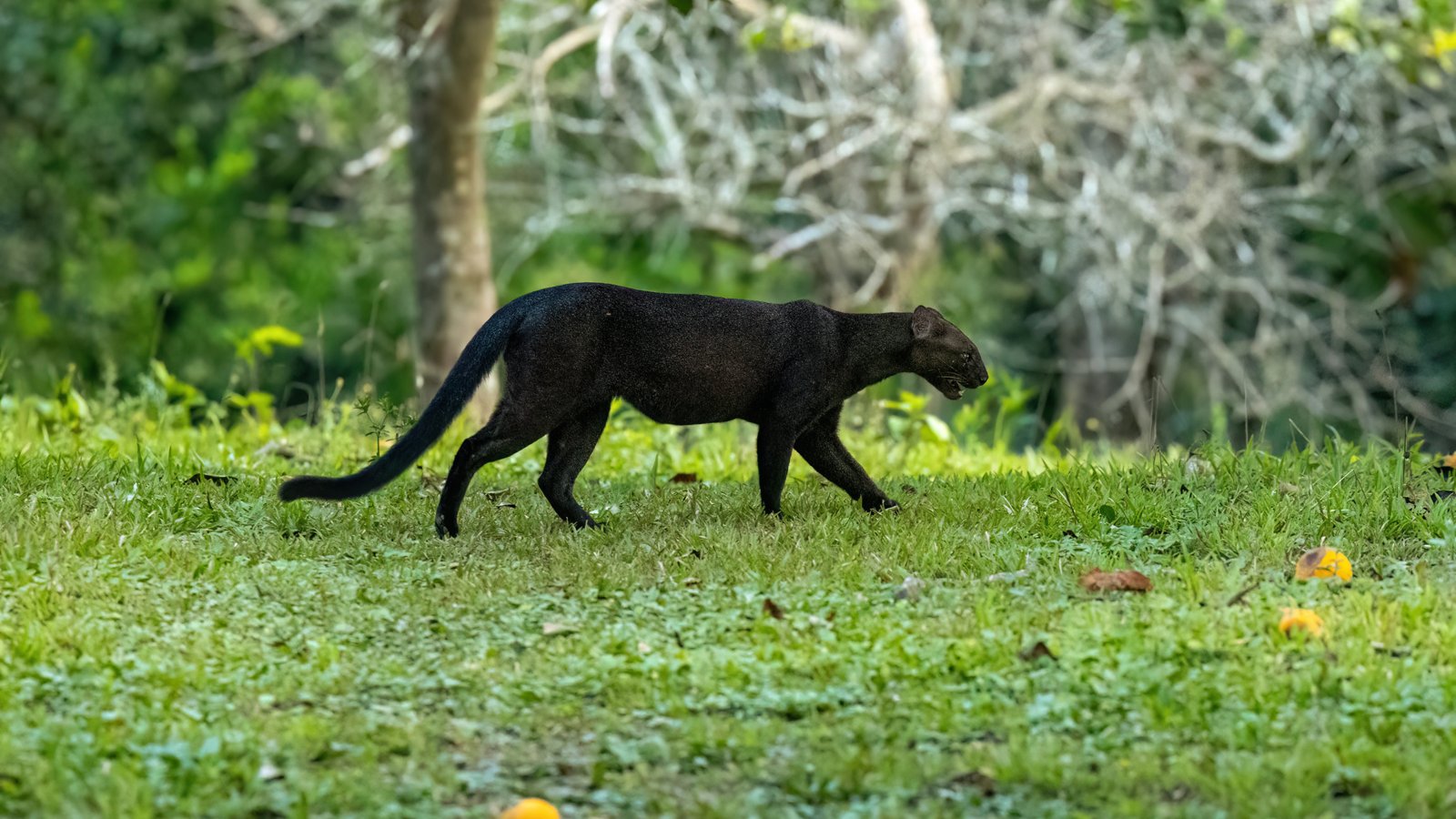
The jaguarundi (Herpailurus yagouaroundi) has always looked like an easy cat to find. It hunts by day, crosses open ground and turns up even in degraded landscapes. For that very reason it was treated for decades as a common species. The assessment in the Red List of the International Union for Conservation of Nature (IUCN) shows the opposite: it moved from Least Concern to Near Threatened.
According to the assessment, the world population of adults is estimated at about 13,000 individuals, spread from Mexico to Argentina. That is a small number for such a vast territory, and it sums up a classic lesson in conservation: an animal that is seen often is not necessarily an abundant one.
The visibility trap
The assessment was led by Brazilian researcher Tadeu de Oliveira, co-chair of the IUCN Cat Specialist Group. He says the main obstacle was the perception that the animal was abundant simply because it is spotted more easily than other cats, which move at night and inside dense forest.
It is an understandable bias. A daytime animal that crosses a clearing sticks in the memory of whoever sees it, while a nocturnal cat of the deep forest almost never meets a person. If impressions were treated as data, the second would look rare and the first common, when the reality could be the reverse.
When the team gathered information from researchers across the whole range and put numbers on the records, the picture changed. The jaguarundi is not only rare but is among the least abundant cats across most of its distribution. The exceptions are a few localities in Mexico and Brazil.
The species can also live in cleared land. When a forest is degraded and starts to resemble a savanna, the setting begins to look like the habitat the cat prefers. It is not ideal, but it allows the animal to stay, and that helped mask the decline.
The Amazon is no longer a refuge
One decisive point was the Amazon. Once seen as a possible refuge for the species, the region is no longer considered safe. One reason is the size of each animal’s territory: in some places, males use areas of up to 100 square kilometers (about 39 square miles). With the forest fragmented, keeping viable populations becomes harder.
The logic is simple. An animal that needs a lot of space suffers more when the landscape is cut into pieces, because each fragment holds very few individuals and the links between them are lost. With the Amazon no longer working as a reserve, the species came to meet the criteria for Near Threatened.
In Brazil, the most recent national assessment, coordinated by researcher Flávia Tirelli, already classified the jaguarundi as Vulnerable. The global and national categories do not have to match, but both point in the same direction.
What the jaguarundi is
It is a small cat, up to about 15 pounds (7 kilograms), with a long body, short legs, rounded ears and a long tail. Its un-catlike look, which recalls an otter or a tayra, earned it nicknames such as otter cat and, in Portuguese, black cat. The coat ranges from dark gray, almost black, to reddish brown.
It lives in savannas, dry forests, forest edges and transition zones, from the Cerrado and the Caatinga to the Amazon. It eats small rodents, birds, reptiles and insects. That varied diet and its tolerance of different settings explain in part why it seemed so secure.
The threats
The assessment lists conflicts with chicken keepers, who kill the animal in retaliation when it attacks domestic fowl, road deaths, and diseases such as rabies and mange, passed on by domestic and feral dogs. Attacks by dogs also appear among the causes of death.
On top of that comes an enormous gap in knowledge. According to co-author Mariam Weston-Flores, chair of the Ocelot Working Group, most of the existing data are incidental: they come from camera traps set up to study other animals, because almost nobody researches the jaguarundi specifically.
Such by-catch data have an obvious limit. A camera placed to photograph another species is tuned to that species’ habits, not to those of a daytime cat that prefers open ground. That is why targeted studies are needed, with methods designed for a rare species that is active by day and fond of open areas.
What can help
Because the cat is opportunistic and uses varied settings, protecting forests alone is not enough. Weston-Flores describes the species as very opportunistic and warns that strategies focused only on habitat can miss the real threats. The assessment recommends conserving key habitats, such as Brazil’s Cerrado and Caatinga, and securing connectivity between them.
Practical measures include chicken coops protected against predators, wildlife crossings under busy roads and dog vaccination campaigns, which reduce the spread of disease. These are concrete solutions that address the most frequent conflicts rather than just protecting land area.
The authors call for permanent monitoring, because some populations are already declining and the species could move closer to Vulnerable. They also hope the new status will draw funding and scientific interest to a cat about which very little is known. The lesson, according to Oliveira, is to assess species with data, not with the impression of those who see them often.
Frequently asked questions
Is the jaguarundi dangerous to people? No. It is a small, wary cat that avoids human contact. The most common conflict is with people who keep chickens.
How many jaguarundis are there? The IUCN assessment estimates about 13,000 adults across the whole range, from Mexico to Argentina.
Reporting: Revista Amazônia newsroom / Amazonia Mag

Editor · Amazonia Mag
Anne Silva is the editor of Amazonia Mag, the English-language edition of Revista Amazônia. She curates, translates and adapts the outlet's science and environment coverage for an international audience, reporting on Amazon wildlife, flora, rivers, climate and research. Every story she edits is grounded in peer-reviewed studies, official data and on-the-ground reporting from the Revista Amazônia newsroom in Belém, Pará, Brazil. More by Anne Silva →