
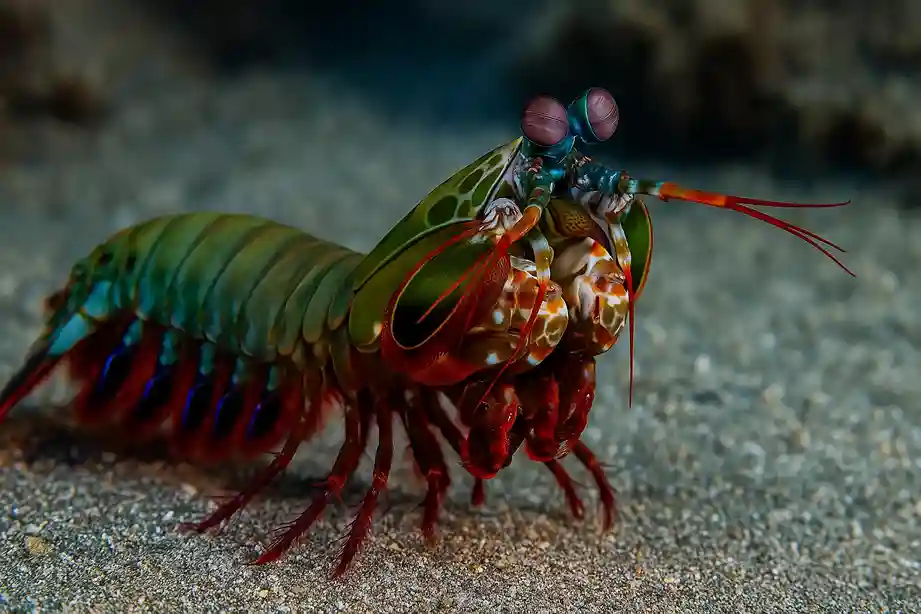
The mantis shrimp, a small crustacean of tropical and subtropical seas, delivers one of the fastest strikes in the animal kingdom. Measurements made by the biologist Sheila Patek and colleagues, published in the journal Nature in 2004, showed that the appendage it uses as a hammer can exceed 80 kilometers per hour (50 miles per hour) underwater, with an acceleration of more than 10,000 times the force of gravity. The blow is so fast that it forms vapor bubbles in the water, and the collapse of those bubbles also hits the prey.
This is what science has measured so far about the strike, about the structure that withstands the impact, and about the eyes of the animal.
What the mantis shrimp is
The mantis shrimp is a stomatopod, a group of crustaceans with more than 400 described species. Despite the name, it is neither a shrimp nor a praying mantis. The nickname comes from its elongated body and its folded front appendages, which resemble those of the insect.
It lives in burrows on the seafloor and hunts snails, crabs, other mollusks and fish. Stomatopods are usually divided into two groups according to the shape of the tip of their appendages. Smashers have a club-shaped tip and break the shells of snails, crabs and mollusks. Spearers have a tip with spines and impale soft-bodied prey such as fish.
How the strike works
The raptorial appendages, the front limbs used to capture prey, are held like a spring and released all at once. In the species that crush hard-shelled prey, such as the peacock mantis shrimp (Odontodactylus scyllarus), the tip works as a hammer.
In a study published in 2005 in the Journal of Experimental Biology, Sheila Patek and Roy Caldwell measured the force of these blows. According to the authors, each strike produces two force peaks, separated by an interval of 390 to 480 microseconds.
The first comes from the impact of the appendage, with a force of 400 to 1,501 newtons, thousands of times the weight of the animal itself. The second comes from the collapse of cavitation bubbles, which reaches 504 newtons.
On average, the cavitation force equals 50 percent of the impact force, but it can exceed it by up to 280 percent. For that reason, according to the researchers, even if the appendage does not break the shell in one go, the bubbles help finish the job.
To put the numbers in perspective, the newton is the unit of force, and 1,500 newtons correspond to the weight of about 150 kilograms (330 pounds). Aquarists have reported cracked aquarium glass caused by large species, and the force of up to 1,501 newtons measured in the laboratory for a single strike makes that possible.
What cavitation is
Cavitation is not boiling water. When something moves very fast inside a liquid, the pressure drops so much at one point that the water forms vapor bubbles even at normal temperature. When those bubbles collapse, they release a shock wave. It is the same phenomenon that wears down ship propellers.
In the mantis shrimp, this means that the strike has a second effect after the first. The prey is hit by the appendage and then by the shock wave of the collapsing bubbles, a fraction of a millisecond later.
Why the hammer does not break
Hitting hard shells thousands of times should destroy the appendage itself. A study led by James Weaver, published in the journal Science in 2012, analyzed the club of the peacock mantis shrimp and concluded that it is a composite material optimized to resist damage.
The impact layer is rich in hydroxyapatite, the same mineral found in bones. Beneath it, chitin fibers are arranged in layers that rotate in a spiral, which prevents a crack from crossing the whole structure. This architecture has inspired research on materials that resist impact.
In practical terms, the animal carries a tool that is hit again and again without failing. The design combines a hard mineral surface that takes the blow with a fibrous structure underneath that stops damage from spreading, and that combination is also what engineers look for when they study impact-resistant materials.
The most complex eyes in the sea
The mantis shrimp has compound eyes that move independently and are divided into three regions, which allows it to judge depth with a single eye. The central band of the eyes has up to 12 types of photoreceptors for color, compared with three in humans, and the animal also perceives ultraviolet and polarized light.
More receptors, however, do not mean seeing more colors. A study by Hanne Thoen and colleagues, published in Science in 2014, showed that the mantis shrimp tells similar colors apart worse than humans do. According to the authors, it seems to recognize colors more directly, by comparing which receptor was activated, which may make identification faster.
Taken together, these studies describe an animal whose two best-known features, the hammer and the eyes, work in ways that are not what the popular image suggests. The strike is as much about bubbles as about the blow, and the eyes are built for speed of recognition rather than for fine color distinction.
Reporting: Revista Amazônia newsroom / Amazonia Mag

Editor · Amazonia Mag
Anne Silva is the editor of Amazonia Mag, the English-language edition of Revista Amazônia. She curates, translates and adapts the outlet's science and environment coverage for an international audience, reporting on Amazon wildlife, flora, rivers, climate and research. Every story she edits is grounded in peer-reviewed studies, official data and on-the-ground reporting from the Revista Amazônia newsroom in Belém, Pará, Brazil. More by Anne Silva →