
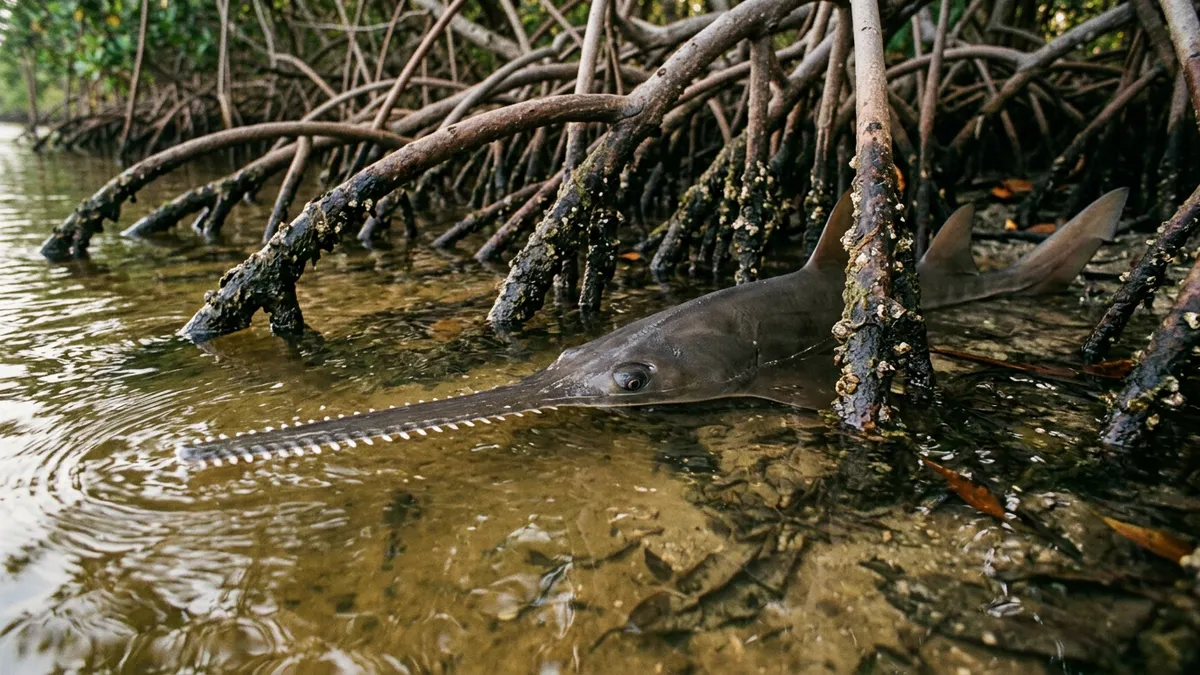
Juveniles reappear among mangrove roots
Among the shallow waters and mangrove roots of the Indian River Lagoon, in Florida, juvenile smalltooth sawfish have returned to a space the species had abandoned for decades. The return was not noticed only through the occasional presence of an animal. Scientists followed the fish with acoustic transmitters and saw that they used the same areas again and again.
The study, published in March 2026 in the journal Fishery Bulletin, tracked seven juveniles tagged between 2020 and 2023. They spent up to 87% of the days on which they were detected in an area of 0.15 square miles (0.4 square kilometers) in the south fork of the St. Lucie River, which flows into the lagoon. The pattern indicates that the lagoon still offers important conditions for an early stage of the species’ life, although on its own it does not allow the conclusion that the population has recovered.
The work was carried out by the Harbor Branch Oceanographic Institute of Florida Atlantic University, known as FAU, in partnership with the Florida Fish and Wildlife Conservation Commission, known by the initials FWC. The observation focuses on young individuals, precisely the stage at which protected, shallow places can offer shelter and chances to feed.
The smalltooth sawfish is recognized by its elongated snout, with lateral teeth that look like a saw. In the Indian River Lagoon, the central question is not only finding a single animal, but understanding whether juveniles choose the same set of environments over time. The tracking pointed to repeated use of shallow stretches associated with mangroves.
That behavior makes the lagoon a place of interest for conservation, because a nursery is defined not by its appearance but by the function it serves for the young. When animals return to the same areas, researchers can identify which parts of the habitat deserve attention.
Tracking reconstructs a lost presence
According to the study, the smalltooth sawfish was extirpated, meaning locally wiped out, from the Indian River Lagoon estuary by the 1970s, through mortality in accidental fishing catches. Reports of sightings to the sawfish recovery hotline in the United States remained rare until 2015, when they began to grow, peaking between 2020 and 2023.
Instead of depending only on sightings, the team began to track juveniles and found a sequence of repeated uses of similar areas. The information matters because the presence of a single animal could represent only a passage. Recurrent use, on the other hand, suggests that mangroves remain part of the species’ life cycle.
The research does not present the return as a complete recovery, nor does it identify a single factor responsible for it. What the study documents is a behavioral return to a shallow-water environment.
The recent context of the species includes the events known as spinning fish, in which animals swim in circles, lose their balance and often die. In the winters of 2024 and 2025, these episodes affected more than 80 species of marine fish in the Florida Keys. According to the FAU statement, they probably killed hundreds of large sawfish, juveniles and adults. The causes are still under investigation, with hypotheses that include environmental stress and algal neurotoxins.
The tracking in the Indian River Lagoon was done between 2020 and 2023, before those episodes, and therefore does not measure the effect of those deaths. Two signals appear in the same story, without one explaining the other: there was probable large-scale mortality in the Keys, and there was repeated use of a nursery in the lagoon, on Florida’s east coast.
Why shallow areas matter
Mangroves work as transition environments between land and water, with channels, protected margins and roots that alter the movement of water. For juvenile smalltooth sawfish, the repeated use of these zones indicates that the structure of the habitat may be related to staying in place during the early life stage. The study does not allow the researchers to detail which resource was decisive.
The central finding is spatial behavior: the juveniles were tracked in shallow mangrove areas and repeatedly used similar places. Juveniles were most associated with water between 75 and 84 degrees Fahrenheit (24 to 29 degrees Celsius) and salinity of 15 to 30, which indicate a moderate inflow of fresh water.
Matt Ajemian, a researcher at FAU, said that several groups of juveniles use the St. Lucie River repeatedly across seasons and years, which meets the criteria established for a nursery. That kind of evidence helps shift conservation from a broad idea, such as protecting the whole lagoon, to more precise attention to the stretches the animals actually frequent.
The result also shows why tracking technology can complement visual observation. A young sawfish can go unnoticed in an extensive lagoon, especially in shallow water surrounded by vegetation. Following the signals makes it possible to verify permanence and repetition, instead of recording only the moment when an animal is seen.
Information is still lacking, however, to measure the size of the return. These limitations do not cancel the discovery, but they define its reach: the study identifies a nursery in use again, and does not declare that the threat to the species has ended.
A positive sign that requires continued protection
The most concrete consequence of the study is the confirmation that the Indian River Lagoon can still serve as a nursery for the smalltooth sawfish. The return of juveniles to shallow mangrove areas provides a reference for monitoring and reinforces the need to consider these stretches in conservation decisions.
If an environment is used repeatedly, changes to it can affect a specific stage of the life cycle, even when the change is not immediately noticed across the whole lagoon. The result is positive because it reveals a persistent relationship between the animals and their habitat. There is no basis, however, to say that the species is no longer threatened or that the return happened because of a single cause. The study offers a direction for protection, not a guarantee of future stability.
The smalltooth sawfish also has a history in Brazil, but there the picture is different. There are historical records of the species from Amapá to Rio Grande do Sul. According to the literature on the species in the country, the last confirmed records occurred in the 1970s and 1980s, in Pará and Ceará, and the ICMBio, Brazil’s federal biodiversity agency, classifies it as critically endangered, the category of highest risk before extinction.
The results from Florida do not transfer automatically to the Brazilian coast: the situation of each population needs to be assessed with its own data, including presence, age of the animals, habitat use and local threats.
What remains is a precise image: after decades of decline, young sawfish have again repeatedly occupied a mangrove nursery. In conservation, sometimes the most important signal is not a large count, but the discovery that a place is still recognized by the animals.
Reporting: Natália Santos / Amazonia Mag

Editor · Amazonia Mag
Anne Silva is the editor of Amazonia Mag, the English-language edition of Revista Amazônia. She curates, translates and adapts the outlet's science and environment coverage for an international audience, reporting on Amazon wildlife, flora, rivers, climate and research. Every story she edits is grounded in peer-reviewed studies, official data and on-the-ground reporting from the Revista Amazônia newsroom in Belém, Pará, Brazil. More by Anne Silva →