
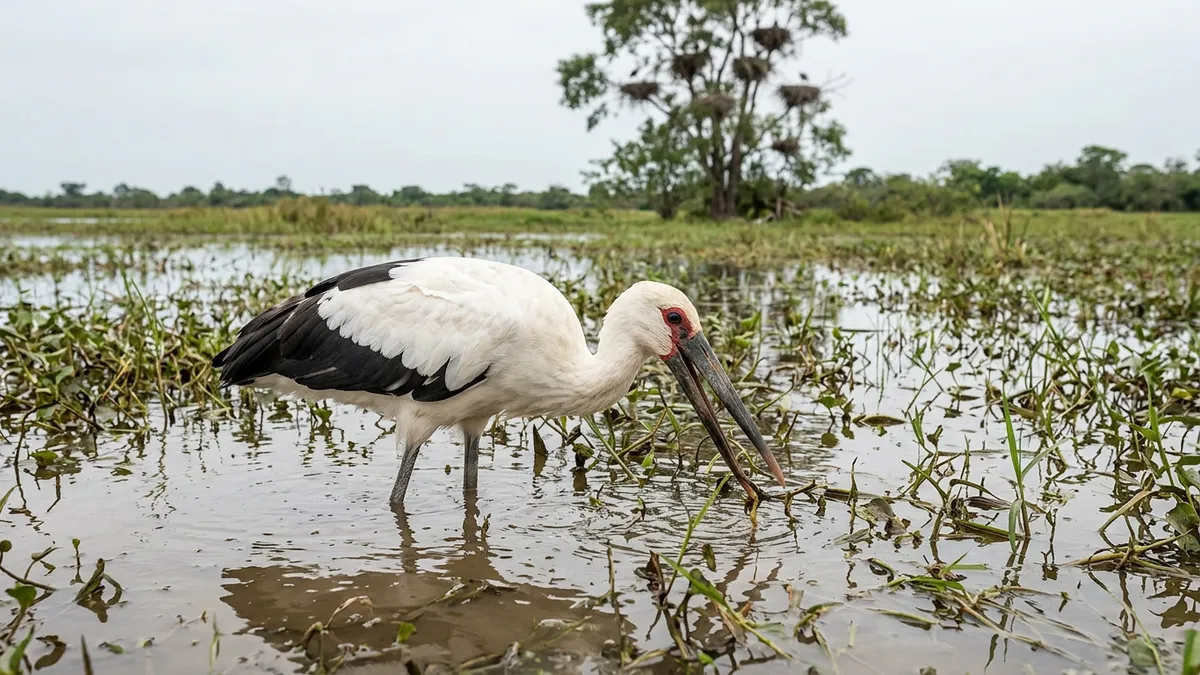
Across the wet fields and swamps of South America walks, slowly and with its eyes fixed on the water, one of the three storks found in Brazil: the maguari stork (Ciconia maguari). According to WikiAves, Brazil’s bird-photo and sighting database, it shares the country with the jabiru (Jabiru mycteria) and the wood stork (Mycteria americana).
It is a bird of almost 3.6 feet (1.1 meters) that hunts mainly by sight in flooded areas and builds its nest on the ground or on aquatic plants, in small colonies.
A South American stork of flooded areas
The Cerrado Museum says the maguari measures between 38 and 43 inches (97 and 110 centimeters) in length. It has white plumage with black wings and tail, a long neck, long legs and a long bill, and touches of red on the legs, around the eyes and at the base of the bill.
The species uses wet fields, flooded grasslands, marshes, swamps and shallow lagoons. WikiAves notes that while other storks stay in marshes with sparse vegetation, the maguari usually remains in wet environments with dense vegetation, which makes it one of the harder storks to spot.
In high flight, it can be confused with the wood stork. The difference, according to the same source, lies in the neck covered with white feathers, while the adult wood stork has a bare neck, and in the black tail, almost hidden by the long white feathers of the belly.
Hunting guided mainly by sight
According to Birds of the World, the ornithological database of the Cornell Lab of Ornithology, the maguari is an opportunistic, visual forager. That means it does not wait for one particular prey: it walks through shallow water and catches what it finds. Its prey includes frogs and tadpoles, fish, especially eels, water snakes and aquatic insects.
The Cerrado Museum adds crustaceans, small rodents and other reptiles to the list, and WikiAves sums up the diet as essentially aquatic invertebrates, crustaceans, amphibians, water snakes and fish.
Outside the breeding season, Birds of the World records that the diet comes to include rodents, while the birds roam large areas in search of abundant food in each place. The species also forages in groups, and aggregations of hundreds of birds have been seen, mainly in the south of its range.
That way of hunting depends on eyesight and shallow water: the bird advances on foot, watches what moves among the plants and acts when a prey comes within reach. That is why its list of foods is so varied, and why shallow, vegetated waters matter so much to the species.
A nest on the ground or on aquatic vegetation
According to WikiAves, the maguari nests on aquatic plants, on floating islands and in the densest part of large marshes, in colonies of 5 to 20 nests close to one another, a few dozen yards apart. The clutch is four eggs, and pairs perform mating dances near the nest, with rhythmic bill clapping.
The pattern differs from the jabiru, whose nests are in the tallest trees of sparse or riverside forests, at an average height of 36 feet (11 meters), according to AMDA.
The Cerrado Museum reports that breeding takes place between August and October, in colonial groups, with nests of reeds and branches on floating vegetation.
The comparison helps show that storks do not follow a single nest model: each species chooses a different support, and the maguari works at water level, among reeds and floating vegetation, unlike the one that builds high in the trees.
What a study of amateur photos shows
A study published in 2023 in the journal Papéis Avulsos de Zoologia, by Dárius Pukenis Tubelis and Ivinna Kariny da Costa Vieira, analyzed 65 photographic records from the WikiAves database, collected over 13 years and in 32 municipalities. About 86% of the breeding records came from the Pampa, in southern Brazil. The nests were large platforms with one to three chicks. Ground nests appeared in grasslands or reed patches, and nests in shrubs were at the boundary between lagoons and grasslands, often in colonies with egrets and herons.
Also according to that study, incubation was recorded from July to November, chicks from August to December, and fully feathered young from late October to February. Most of the breeding activity took place below 984 feet (300 meters) in elevation.
The authors suggest that the species, being easy to observe, serves ecotourism initiatives, as long as the microenvironments it depends on are kept: grasslands, wetlands, lagoons, woody plants and reed areas.
One useful detail of the work is that it draws on photos taken by bird watchers and posted to WikiAves. It shows how amateur records, gathered in a shared database, make it possible to describe dates, places and nest types for a species that is hard to follow in the field.
Presence in Brazil and in the Amazon
The maguari is found across much of South America. WikiAves describes it as common in Rio Grande do Sul and limited in the Amazon and in northeastern Brazil. The Cerrado Museum places its occurrences mainly in the South, Center-West and Southeast regions, with scattered populations in the north of the country.
The Cerrado Museum reports that the species is not considered threatened by ICMBio, Brazil’s federal conservation agency, or by the International Union for Conservation of Nature, the IUCN, and that its populations are stable. Birds of the World classifies it as Least Concern.
For anyone watching the bird in marshes and flooded grasslands, what identifies the maguari is the combination of visual hunting in shallow water and a nest built right at water level, among reeds and aquatic plants.
Reporting: Natália Santos / Amazonia Mag

Editor · Amazonia Mag
Anne Silva is the editor of Amazonia Mag, the English-language edition of Revista Amazônia. She curates, translates and adapts the outlet's science and environment coverage for an international audience, reporting on Amazon wildlife, flora, rivers, climate and research. Every story she edits is grounded in peer-reviewed studies, official data and on-the-ground reporting from the Revista Amazônia newsroom in Belém, Pará, Brazil. More by Anne Silva →