
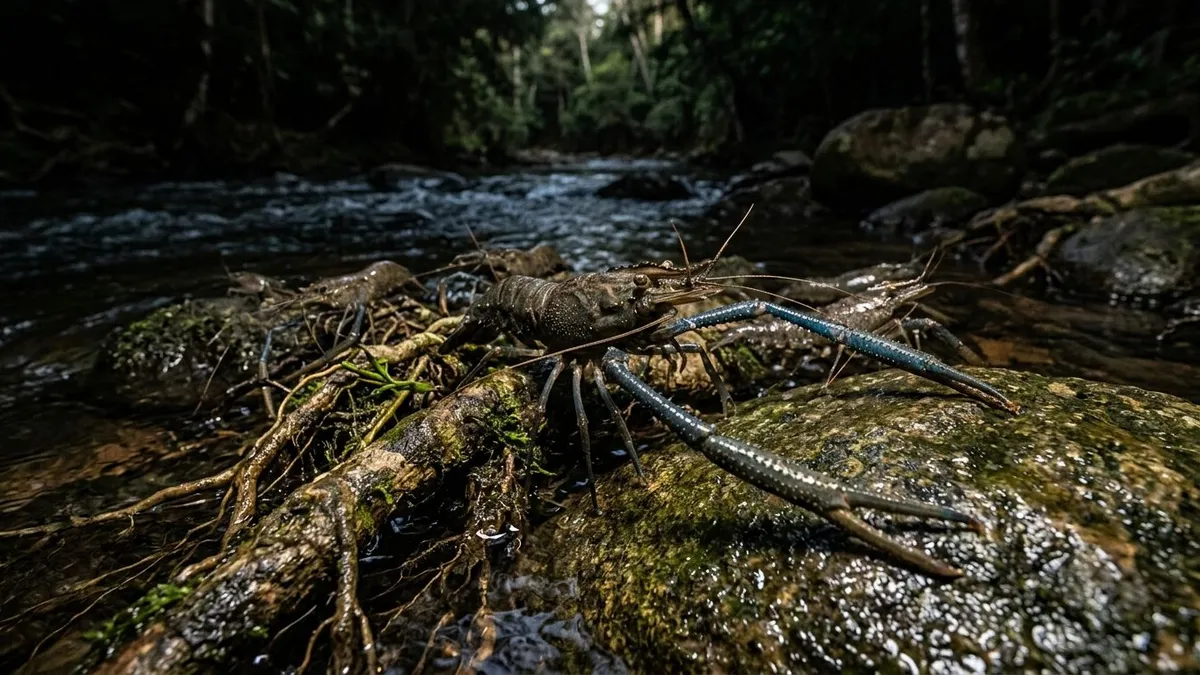
The pitu, or river prawn, needs two different environments to complete its life cycle. Its larvae require brackish water, where they find the conditions they need to develop, while the adult lives in fresh water. This alternation is called an amphidromous cycle, and it turns the movement between the river and areas touched by the sea into a biological stage rather than an occasional choice.
After the early phase, individuals head upriver and can settle in stretches far from any salt influence. The migration takes place mainly at night and can bring many pitus together on the move. In dominant males, one of the elongated claws also stands out as a body trait tied to competition among individuals. When a dam blocks the passage, the obstacle cuts a route the species cannot do without.
The amphidromous cycle begins where fresh water meets salt
The pitu does not spend its whole life in one kind of water. Its amphidromous cycle combines a larval phase tied to brackish water with an adult phase in fresh water. Brackish water results from the mixing of river water and seawater, producing an environment with an intermediate concentration of salt. For the larva, this condition is part of its development. Without a passage through the right environment, the sequence of the cycle is compromised.
This strategy differs from the migration of fish that leave the sea to reproduce in rivers, or make the opposite trip. In the pitu’s case, the movement organizes distinct phases of life. The larva depends on the brackish zone, while the adult uses the river. For that reason the connection between the two environments has to stay open. The cycle is not just a trip in search of food: it involves a change of habitat linked to the animal’s age and needs.
A change of habitat follows the transformation of the body
During the larval phase, the pitu does not yet have the working form of the adult. Development takes place in brackish water until the animal moves on to the juvenile stage and can occupy fresh water. The change of environment accompanies this bodily transformation. The organism stops depending on the conditions of the larval phase and comes to live in a stretch of the river with different characteristics.
In fresh water, the adult pitu uses its segmented body, its jointed legs and its claws to move around, explore the bottom and deal with other animals. A claw, or chela, is the modified end of a leg, similar to a pincer. In the dominant male, one of them is elongated. This difference does not change the central fact of the cycle, but it shows that after the larval phase the animal also faces social relations inside the river environment.
Night migration brings many pitus onto the move
The trip upriver happens mainly during the night. At that hour, lower light reduces visual exposure and creates conditions for the animals to leave their shelters and advance along the watercourse. The migration can happen en masse, with many individuals heading in the same direction. This collective movement makes visible a stage that, during the day, may stay hidden among stones, roots, leaves and other features of the riverbed.
Night migration also helps explain why watching a single pitu does not reveal the whole behavior of the species. The animal may spend much of its time close to the bottom of the river, but at certain moments it starts a larger-scale movement. The upriver direction is essential for reaching the fresh-water environments used in adult life. When the way is clear, different stretches of the river system can work as connected parts of a single route.
The elongated claw sets the dominant male apart
Among males, the claw plays an important role in appearance. In the dominant male, one of the claws is elongated, creating a visible asymmetry when the individual is compared with other pitus. This structure should not be confused with an antenna, a walking leg or a separate organ. It is a chela, formed by the modified end of an appendage, and it belongs to the set of traits that distinguish the adult animal.
The presence of a dominant male indicates that the pitu does not live only in a direct relationship with the physical environment. Individuals also interact with one another, and the difference in the claw can take part in those relations. Without stretching its function, the trait lets us recognize that there is social organization and competition among males. The elongated structure is therefore an adult characteristic set within a broader context, in which shelter, space and contact with other animals influence how long an individual stays in the river.
Dams cut the route, and a river is a sequence of environments
A dam creates a physical break in the course of a river. For an animal that has to climb against the current at one stage of its cycle, this structure can block or reduce access to fresh-water stretches. The problem is not only the momentary difficulty of getting across. If individuals cannot reach adult habitat, the separation between the larval and adult phases compromises the working of the entire amphidromous cycle.
The pitu’s sensitivity to dams is tied to its dependence on a continuous route. Even if the water looks suitable in an isolated stretch, the species needs a connection between the environments it uses at different moments of life. Observing the night migration and recognizing the places where animals pass helps identify this need. For the ecosystem, keeping the path open means preserving the chance for the crustacean to complete a trajectory that begins in brackish water and continues upriver.
The migrations also move matter and energy within the aquatic system. Larvae, juveniles and adults take part in different feeding relationships as they develop, and the presence of the pitu provides a resource for other animals. The crustacean, in turn, is part of the dynamics of the riverbed and the banks. The migration therefore matters not only to the pitu itself. It helps keep organisms circulating between environments connected by water.
The pitu shows that a river is not just a place where water flows, but a sequence of environments that sustain one another. The larva needs salt, the adult needs fresh water, and the animal depends on the path between the two. The route connects phases that take place in different waters, serving as a path, a place to live and a link between parts of the cycle. Interrupting it means separating stages that evolved to work in sequence.
When that continuity is preserved, a small night migration keeps alive an ecological link that usually goes unnoticed. The claw of the dominant male draws attention, but it is the whole journey that explains why the species remains in the river system.
Reporting: Natália Santos / Amazonia Mag

Editor · Amazonia Mag
Anne Silva is the editor of Amazonia Mag, the English-language edition of Revista Amazônia. She curates, translates and adapts the outlet's science and environment coverage for an international audience, reporting on Amazon wildlife, flora, rivers, climate and research. Every story she edits is grounded in peer-reviewed studies, official data and on-the-ground reporting from the Revista Amazônia newsroom in Belém, Pará, Brazil. More by Anne Silva →