
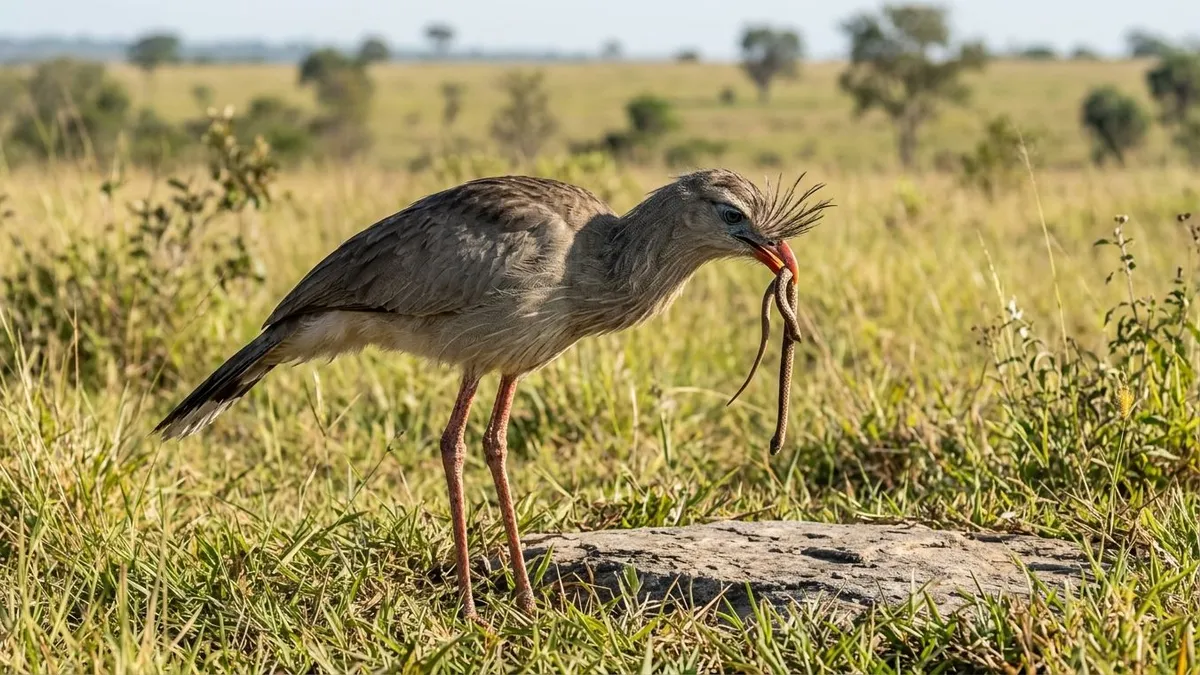
The red-legged seriema (Cariama cristata) does most of its hunting on foot. Where many birds of prey depend on flight to find food, this long-legged bird of Brazil’s open country tracks its quarry along the ground and runs it down. Its anatomy lets it reach high speeds while its eyes stay fixed on the low vegetation, searching for reptiles and other small vertebrates.
When it finds a snake, including a venomous one, the seriema does not try to bite it repeatedly or pin it down with its talons for a long struggle. It seizes the reptile firmly in its beak and delivers hard blows, slamming the prey against rocks and packed ground. The impact disables the snake before it can strike back in its own defense, which is the one thing a venomous snake does best.
Built to run across open grassland
The seriema’s way of getting around depends on proportionally long legs and muscles suited to sustained effort on flat terrain. Unlike birds that move in short hops, it takes long, rhythmic strides that carry it over large distances without spending energy on brief flights. This preference for travelling on foot suits a hunter whose food hides beneath low plant cover.
The chase is the decisive moment. On bare ground or in short vegetation, the speed of the pursuit keeps snakes and lizards from reaching burrows or dense growth where they could shelter. Being able to run flat out without losing balance makes ground pursuit the species’ main method of finding food, and it explains why the bird is so closely tied to open country.
Throwing the snake: how the strike works
Facing a venomous snake demands a fast kill without exposure to the venom. The seriema keeps a safe distance from the snake’s striking range by making use of the reach of its own beak and the length of its legs. Its first move is a quick lunge to fix the snake’s neck. Holding the reptile behind the head or on the upper third of the body limits how far the snake can move and keeps it from curling around to bite the bird’s legs or body.
The beak is slightly curved and rigid, suited to gripping slippery prey, and the muscles of the neck and head work together to accelerate the throw. With the snake held, the bird whips its head in a rapid circular motion from top to bottom. The target of the impact is a hard surface such as a rock, a dry log or beaten earth.
The force of the accelerating neck sends the reptile’s body against the stone with enough energy to fracture its spine. The bird repeats the movement until the snake is completely immobilized. With the backbone broken in several places, the snake loses the ability to coil and to strike. This method removes the risk of envenomation through mechanics and distance, not through contact with the fangs, and it turns a rock into a working tool: the hard ground does the damage that the bird’s beak alone could not.
A voice that carries across the fields
Besides its hunting skills, the seriema uses a powerful, piercing call to mark its territory in open areas. The sound can carry for miles (kilometers) and works as a clear warning to other members of the species. The long, rhythmic cry is usually given in the early morning or at dusk, often by pairs calling in duet to reinforce their claim over the area where they forage.
Strong territoriality lets a pair keep exclusive access to the food resources of its stretch of field. When it detects intruders or potential threats on the ground, the bird lifts its head, stretches its body upright and gives the alarm call. The sound warning helps prevent direct physical clashes, saving energy that would otherwise be spent on violent territorial disputes with other seriemas.
A rustic nest and shared parenting
Although it spends most of the day on the ground, the seriema builds rustic nests in low shrubs or small trees. It selects firm forks of branches off the ground, which helps protect the clutch from predators that move along the ground. The nest is assembled from woven twigs, dry leaves and mud, forming a shallow platform that is still strong enough to bear the weight of the adults and their young.
Male and female share every stage of the breeding cycle, from incubating the eggs to feeding the chicks. Both parents take turns at the nest and leave to look for food in the field, bringing small reptiles and insects that they have torn into pieces beforehand. This cooperative arrangement favors the survival of the chicks, which stay under their parents’ care until they develop their plumage and the ability to run.
What the seriema does for its habitat
In the savannas and grasslands of Brazil, the seriema acts as a small to medium-sized ground predator. The hunting pressure it exerts helps keep in check the numbers of snakes, rodents and large insects. By limiting the growth of these populations, the bird contributes to the ecological balance of native vegetation and of the transition areas around it.
The species needs wide space in which to run and exposed hard surfaces on which to kill its prey, so a drastic alteration of the landscape undermines its hunting efficiency. Preserving native vegetation and the rocky features of the ground is important for this bird’s life cycle to keep running without interruption.
Species with such specialized behavior reflect the complexity of evolutionary adaptation in Brazilian ecosystems. The combination of fast locomotion on foot and the direct use of the physical environment as a hunting tool shows how refined animal behavior can be in the face of dangerous prey. Protecting open-field habitats secures predatory dynamics that depend on the constant interaction between native wildlife and the physical elements of the landscape.
Reporting: Natália Santos / Amazonia Mag

Editor · Amazonia Mag
Anne Silva is the editor of Amazonia Mag, the English-language edition of Revista Amazônia. She curates, translates and adapts the outlet's science and environment coverage for an international audience, reporting on Amazon wildlife, flora, rivers, climate and research. Every story she edits is grounded in peer-reviewed studies, official data and on-the-ground reporting from the Revista Amazônia newsroom in Belém, Pará, Brazil. More by Anne Silva →