
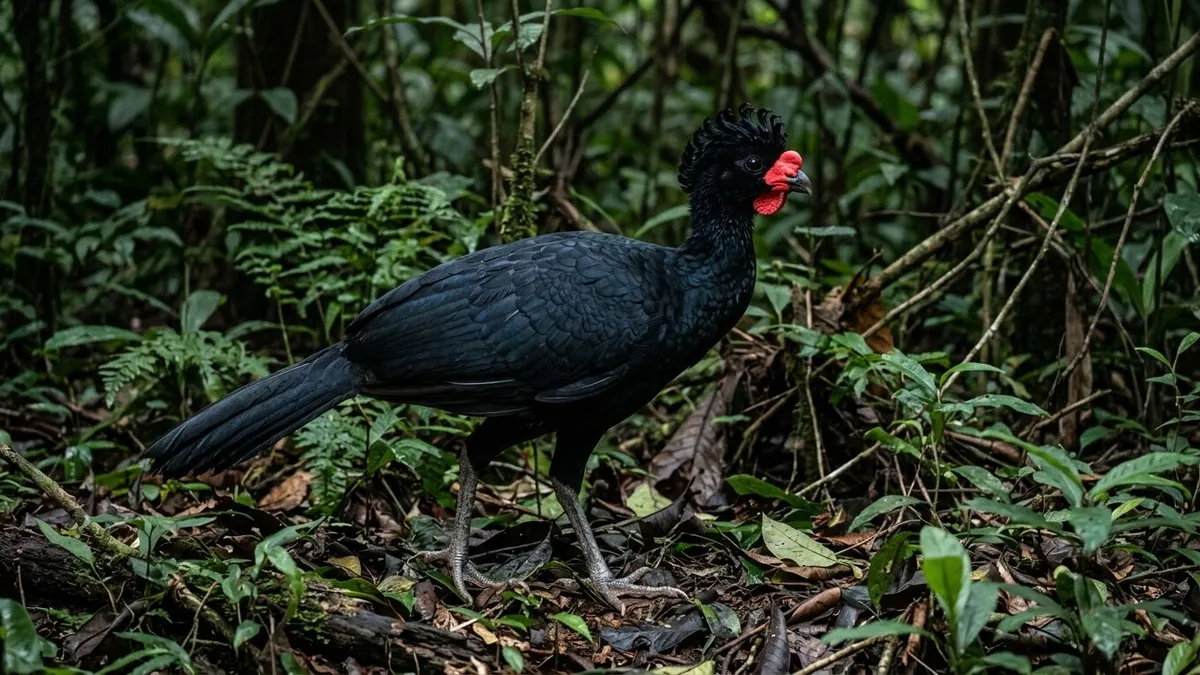
The mutum, a curassow, makes a deep sound because its elongated trachea makes the air vibrate at a low frequency. Instead of relying on a high-pitched song, which can lose strength when it meets leaves, branches and trunks, the bird uses a call that can push through dense vegetation and reach more distant parts of the forest.
This way of communicating is tied to the curassow’s life on the forest floor, where visibility is limited and visual contact is not always possible. The same bird also plays another ecological role: by eating fruit and carrying large seeds, it contributes to the regeneration of forest stretches. Hunting pressure, however, cuts its numbers in exactly the places where that work is needed.
How an elongated trachea produces a low frequency
The curassow’s sound begins with air passing through the respiratory system and with the vibration of the structures that produce the voice. The elongated trachea takes part by lengthening the path the air travels before the sound leaves the body. That shape favors lower frequencies, heard as a deep, low call. The call does not depend on volume alone. Frequency, which is the rate of the sound vibration, also determines how a sound travels through the environment.
In a closed forest, sound meets a series of obstacles. Leaves, vines and branches can reflect part of the energy, scatter another part and blur certain frequencies. High-pitched sounds tend to interact more with small elements of the vegetation, while low sounds move on with less relative scattering. That does not mean the call crosses the forest without loss, only that it keeps a useful reach for communication between birds separated by plant cover.
The curassow’s respiratory anatomy does not work alone. The bird’s body brings together lungs, air sacs and airways that move air continuously, a condition for sustaining vocalizations. The elongated trachea is the element highlighted in this mechanism because it changes the path of the air and favors a deep emission. The result is a call that combines low frequency with enough presence to cross the irregular structure of the forest.
The curassow has a robust body and spends much of its time near the ground, where vegetation, fallen trunks and terrain can limit the line of sight. In that setting, vocal communication partly makes up for the lack of visual contact. A bird does not need to be seen to be located by another. The sound works as spatial information, signaling that an individual is nearby or helping to keep contact when leaves and understory hide the body. The call is therefore a resource tied to the architecture of the forest and to the way the animal occupies that space.
Why a deep call helps in dense forest
The curassow lives in an environment where sound travels differently than in open areas. In open country, a bird can combine sight and voice across a space with few obstacles. In the forest, a curtain of leaves stays between individuals even at relatively short distances. A low-frequency call offers a practical solution because it is scattered less as it crosses dense vegetation. The bird can send a signal that remains identifiable after passing through several layers of plants.
This can be useful in different kinds of contact. One individual can answer the presence of another without leaving right away the spot where it is foraging. It can also keep up communication while moving through the understory, where sight is often interrupted. The sound does not remove obstacles or guarantee an exact direction for the listener, but it widens the chance of an encounter and lowers the dependence on direct observation. The forest, which makes seeing hard, also becomes a medium that carries the curassow’s deep call.
Sound shapes social life and the use of territory
Low-frequency vocalizations can organize contact between individuals that share the same forest landscape. In the curassow, the call lets a bird be detected even while it stays hidden among plants. This kind of communication matters especially for an animal that does not spend all its time moving through open areas. The sound can signal presence, encourage approach or keep individuals apart, depending on the context in which it is sent and received.
The greater reach should not be mistaken for a message that crosses the whole forest unchanged. Relief, vegetation density, humidity and wind direction all affect the path of the sound. Even so, a deep emission has a physical advantage over higher frequencies when there are many obstacles in the way. The elongated trachea is therefore more than an anatomical curiosity. It is tied to a communication strategy that fits the environment where the curassow feeds, moves and keeps in touch with others of its kind.
The curassow carries large seeds to new corners of the forest
The importance of the curassow does not end with the sound it makes. The bird also acts as a seed disperser because it eats fruit and moves through the forest. Once swallowed, seeds can be carried far from the plant that produced the fruit and released at another point. This movement increases the distance between the mother plant and part of its offspring, reducing the concentration of seeds under the same crown. For species with large fruits and seeds, birds able to swallow or carry them are especially relevant.
Dispersal creates opportunities for new plants to establish themselves in clearings, edges and forest stretches that have suitable light, water and soil. The curassow does not control the fate of each seed, but its movement connects different parts of the environment. While looking for food, the bird takes part in a process that shapes the distribution of vegetation over time. Sound communication and seed transport are different functions, yet both depend on the animal remaining in a continuous forest landscape.
Hunting changes a role that depends on the bird being there
The curassow is sensitive to hunting, a pressure that can remove adults from areas where the species still finds food and shelter. The loss is not only a drop in the number of birds seen. Fewer curassows mean fewer deep calls crossing the forest and fewer chances of dispersal for the seeds these animals carry. When hunting continues, the loss of individuals can compromise the species’ presence in some stretches, especially where natural replacement does not keep up with the animals taken.
Protecting the curassow means conserving the animal and also the processes it helps carry out. Preserved forests offer fruit, paths for movement and cover for the bird, while less hunting lets individuals stay long enough to fulfill their role as dispersers. The deep sound reveals an adaptation to dense forest, but keeping that function going depends on something more direct: enough living curassows to occupy the forest. A silent landscape may simply be a landscape without birds, not an environment without communication.
The curassow’s call shows that a forest is also built from signals the eyes rarely reach. An elongated trachea turns air into a message able to beat part of the vegetation, while the bird’s movement spreads seeds through the same space. When hunting removes this animal, a voice of the understory and an agent of regeneration vanish at the same time. Hearing a curassow is a reminder that conservation protects more than isolated species. It keeps in place physical and ecological relationships that go on working as long as the forest stays whole.
Reporting: Natália Santos / Amazonia Mag

Editor · Amazonia Mag
Anne Silva is the editor of Amazonia Mag, the English-language edition of Revista Amazônia. She curates, translates and adapts the outlet's science and environment coverage for an international audience, reporting on Amazon wildlife, flora, rivers, climate and research. Every story she edits is grounded in peer-reviewed studies, official data and on-the-ground reporting from the Revista Amazônia newsroom in Belém, Pará, Brazil. More by Anne Silva →