
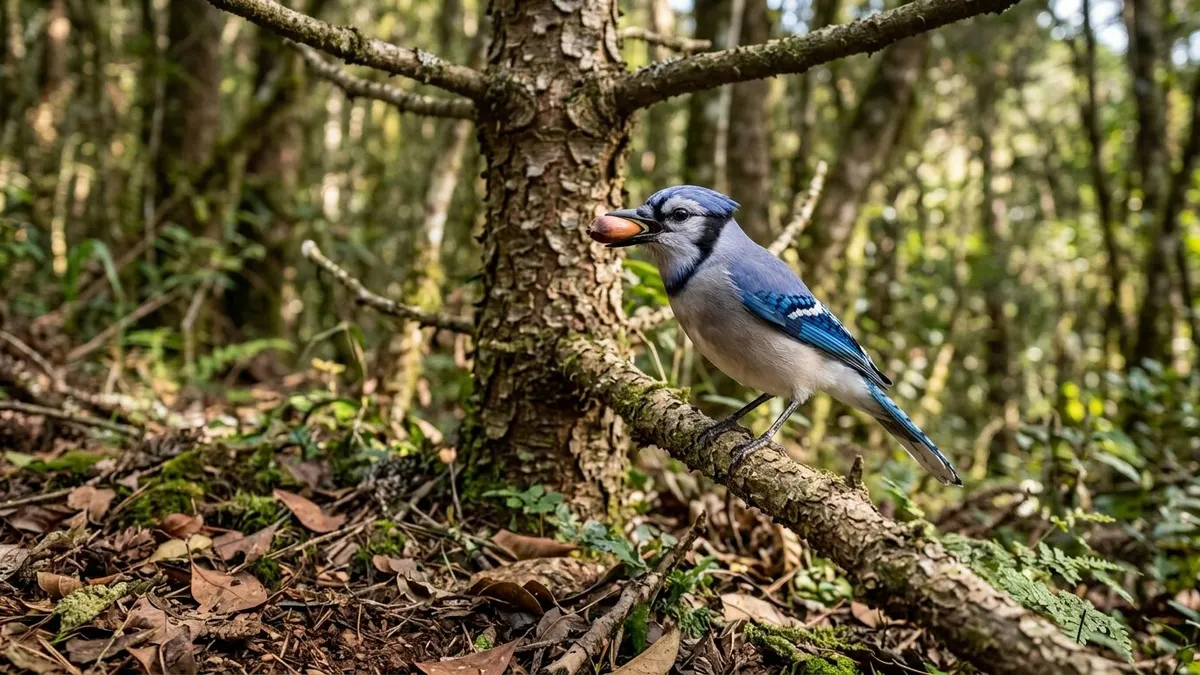
A pine nut can vanish from the branch of an araucaria and turn up far from the tree, hidden under leaves, twigs and loose soil. The animal behind that journey is the azure jay, a bird that picks up the seed, carries it in its bill and buries it at different spots around its range.
The scene is about more than a meal. By building food reserves for later, the jay also scatters seeds that can grow into new araucarias. It is one of the best-known relationships between a bird and a plant in southern Brazil.
The pine nut disappears under the leaf litter
The pine nut, called pinhão in Brazil, is the seed of the araucaria, a native tree whose reproductive structures are eaten by many animals and also used by human communities. The bird at the center of this story is the azure jay, Cyanocorax caeruleus, a species tied to araucaria forests and to other environments in southern and southeastern Brazil.
The jay does not bury every pine nut in the same place, and it does not depend on a single tree for food. It selects seeds, moves across the landscape and creates storage points spread over a wide area. That spreading reduces the concentration of seeds around the mother tree and raises the chance that some of them are carried to clearings, forest edges or other places where a new plant can take hold.
The process begins when the jay finds the pine nuts, and it ends differently for each seed. Some are eaten. Others are recovered later. A portion is never located again by the bird itself.
A food reserve built on spatial memory
After carrying a pine nut away, the jay places it on the ground and covers it with material available in the surroundings. The stash works as a food reserve for periods when finding fruits or seeds is harder. To use it, the bird has to recognize the landscape and keep references to the places where it left its food, which is why the behavior is linked to a sharp spatial memory.
Finding a cache cannot rely on a visible mark alone. Leaves fall, vegetation changes and other species can turn over the soil. The jay combines its recollection of a spot with elements of the surrounding terrain to find its way back. When it returns and finds the pine nut, it recovers the reserve. When it does not return, the seed stays in the ground, available to the cycle of the forest.
The sequence repeats according to the supply of pine nuts and the bird’s food needs. First the araucaria produces its seeds. Then the jay collects some of them, carries each one and buries it in a different place. Later it looks for its stores when it needs food. This is seed storage with partial recovery, and that phrase describes the phenomenon better than the idea that the bird simply loses everything it buries.
Memory is efficient, but it does not cancel out the changes in the environment or the actions of other animals. Some hiding places become inaccessible, while others are discovered by predators or by competing consumers. The result is a mix of planned behavior, recovery of part of the reserves and seeds that stay in the soil.
When the unrecovered part becomes a seedling
A pine nut that remains buried can absorb water, begin to germinate and form a new araucaria, as long as the spot offers suitable conditions. The seed has to last long enough not to rot, be eaten or be damaged before it sprouts. It also depends on moisture, temperature, light and room to grow. For that reason, not every abandoned cache turns into a tree.
Dispersal still changes where the seeds sit in the territory. Instead of staying concentrated under the crown of the araucaria that produced them, they can reach more distant places where a new plant has a chance to grow. In this way the jay acts as an agent of transport and storage, connecting the seed production of the tree to the regeneration of stretches of forest.
Why the relationship counts as mutualism
This contribution also explains why the link between the bird and the araucaria is described as mutualism. The jay gets food and builds reserves to use later. The araucaria benefits from the movement of its seeds and from the chance that new plants will establish themselves in different places.
That benefit does not mean every single interaction is good for every seed. When the jay eats a pine nut, that seed loses any chance of germinating, and when the bird recovers a reserve, the seed also leaves the soil. Mutualism shows up in the overall outcome of the relationship: the bird uses the resource while part of the seeds are dispersed and never return to the stock. The mechanism depends on the behavior repeating over time, not on one visit or one buried pine nut.
A limited partnership, yet decisive for the landscape
The azure jay is not the only species that eats or carries araucaria seeds, and the regeneration of the tree does not depend on the bird alone. Other animals can take part in dispersal, while wind and natural fall also move reproductive structures on a smaller scale or over different distances. Germination can fail for lack of water, compacted soil, unsuitable shade, decomposition or consumption by other organisms. The araucaria itself faces environmental and historical limits that the presence of the bird does not solve.
Even so, the jay’s behavior adds an important route by which seeds reach new places. Its contribution is best understood as one part of an ecological network, not as a single explanation for where the tree grows.
In Brazil, this connection matters most in the landscapes where the araucaria occurs, mainly in the South and in parts of the Southeast. The tree, Araucaria angustifolia, is a visual and ecological landmark of those forests, and its pine nut is part of food webs and of harvesting practices. When a jay buries a seed and does not recover it, an everyday gesture can contribute to a change that only shows up many years later, when a seedling establishes itself and grows.
The process has no single date. It unfolds in cycles tied to the production of pine nuts and to the activity of the birds. A forest often starts with a reserve that nobody came back to collect.
Reporting: Natália Santos / Amazonia Mag

Editor · Amazonia Mag
Anne Silva is the editor of Amazonia Mag, the English-language edition of Revista Amazônia. She curates, translates and adapts the outlet's science and environment coverage for an international audience, reporting on Amazon wildlife, flora, rivers, climate and research. Every story she edits is grounded in peer-reviewed studies, official data and on-the-ground reporting from the Revista Amazônia newsroom in Belém, Pará, Brazil. More by Anne Silva →