
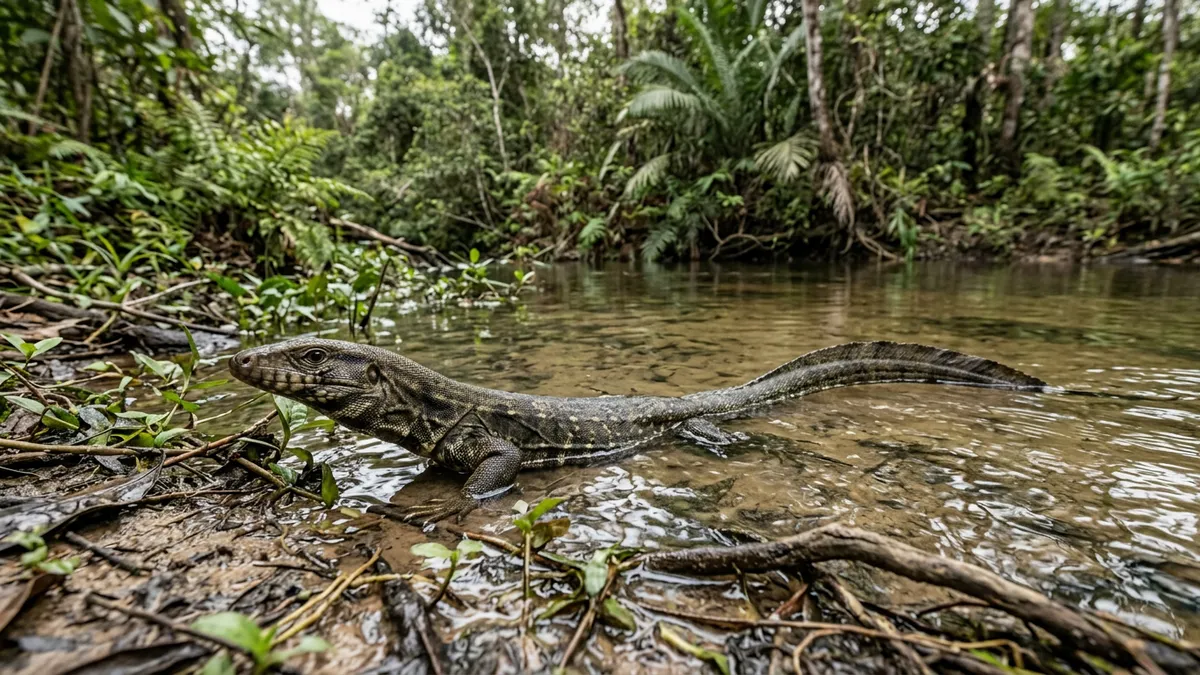
At first glance, the caiman lizard looks like a small caiman that has crawled out of an Amazonian riverbank. When it senses a threat, however, the animal can slip into the water, push itself along with its sideways-flattened tail and vanish below the surface. It stays submerged for minutes, a prolonged breath-hold that serves as an escape strategy.
The behavior completely changes how a watcher reads the animal from its profile alone. Instead of walking away over land, it uses the stream as an escape route and turns the water into a temporary shelter.
The dive that fools the observer on the bank
The caiman lizard, known in Brazil as jacarerana, is a semiaquatic teiid lizard, tied to the edges of streams (igarapés) and other bodies of running or still water near the forest. The word teiid places it among lizards, not among crocodilians. Caimans belong to a different lineage of reptiles, with their own anatomy, evolutionary history and way of life.
So saying the caiman lizard is not a caiman does not merely point out that it is smaller or shaped differently. It means recognizing that the animal developed its own solutions within a different group. The similar profile comes from a body adapted to the bank and a head that, seen quickly, recalls that of a crocodilian. The popular name records the look but can hide the biological identity. The water shows the difference more clearly, because the caiman lizard swims like a lizard equipped to escape.
How the tail turns the body into an escape tool
As it moves through the water, the laterally compressed tail acts as a surface that pushes the water back and produces forward motion. The principle is simple, but it takes coordination among trunk, limbs and tail. The caiman lizard does not rely on a rounded, heavy tail of the kind found in a generic description of a lizard. Its narrow, sideways shape favors a wave-like movement and lets the animal change position quickly when it enters the stream. The result is functional swimming, suited to a reptile that lives at the border between land and water.
This anatomy should not be read as proof that the animal stays in the water all the time. The bank offers room for moving about, while the water can serve as a passage and hiding place when danger arises.
The long breath-hold completes the response. When it dives, the caiman lizard pauses its breathing for a time and stays below the surface for minutes, lowering the chance of being located during its escape. The exact time can vary with the situation, the temperature, the effort made and the conditions of the water, so it is not right to turn the ability into a fixed number. Nor should the animal be said to stay under indefinitely. The strategy has a limited duration and depends on the physiology of the reptile.
A lizard of the stream edge
Away from moments of flight, the caiman lizard occupies a position tied to the borders of watercourses. The stream environment brings together damp ground, nearby vegetation and immediate access to water, conditions that suit a semiaquatic lizard. The margin works as a space for moving around, while the stream provides the escape route. The animal’s routine is shaped by this constant closeness between the two environments.
This also guards against a common reading of semiaquatic animals. That the caiman lizard dives does not mean it lives like a caiman or like an animal that is exclusively aquatic. The lizard alternates between behaviors on the surface, on the bank and in the water as needed. The look of the animal adds to the confusion, because a low body and a head in profile recall a crocodilian to someone who sees it for only a few seconds.
But the escape mechanism reveals another evolutionary design. Instead of depending only on strength or on a bite tied to the image of caimans, the caiman lizard combines discretion, swimming and time spent underwater.
What the resemblance to a caiman does and does not explain
The comparison with a caiman arises from the general shape and the setting, but it should not be used as a scientific classification. The caiman lizard belongs to the teiids, a group of lizards, while caimans are part of the crocodilians. Both are reptiles and share a very distant evolutionary history within that large set, but they are not close relatives.
It would also be wrong to conclude, from the resemblance alone, that one animal copied the other or that they share the same abilities. A flattened tail and the tolerance for long periods without breathing are traits related to using the water, not evidence of identity between the lineages. Evolution can produce similar forms in different groups when they face similar conditions. Here the bank-side profile and the semiaquatic habit help explain the converging look, but the full anatomy and the classification put the caiman lizard on another branch.
What remains solid is the sequence: the animal senses the risk, dives, uses its flattened tail to swim and can stay submerged for minutes before coming back up. The scene sums up a useful lesson about Brazilian biodiversity. The animal that looks most like another does not always occupy the same place on the tree of life. Sometimes it is precisely the escape mechanism, seen in the dark water of a stream, that reveals its true identity.
Reporting: Natália Santos / Amazonia Mag

Editor · Amazonia Mag
Anne Silva is the editor of Amazonia Mag, the English-language edition of Revista Amazônia. She curates, translates and adapts the outlet's science and environment coverage for an international audience, reporting on Amazon wildlife, flora, rivers, climate and research. Every story she edits is grounded in peer-reviewed studies, official data and on-the-ground reporting from the Revista Amazônia newsroom in Belém, Pará, Brazil. More by Anne Silva →